
Investing in mutual funds often means choosing from different strategies, each designed with a specific approach to selecting investments. One such option is a value fund, which focuses on companies that may appear attractively valued compared with their underlying fundamentals. But what is a value fund, and how does this approach work? Understanding the basics can help investors decide whether this type of equity fund fits their investment goals.
This guide explains value funds, how they work, their features, benefits, risks and other important considerations.
A value fund is an equity mutual fund. It follows a value investing approach.
These funds generally look for companies that may be trading at a lower valuation than their underlying fundamentals suggest. The approach is based on the idea that a stock’s market price and its intrinsic value may differ.
For example, a company may have steady cash flows, established operations and reasonable growth prospects. Yet, its stock may trade at a valuation that the fund manager considers attractive.
However, a low share price does not always mean a stock is undervalued. Weak earnings, high debt or falling demand may also result in a lower valuation.
Fund managers therefore use fundamental analysis when selecting stocks. Since value funds invest in equities, their returns can fluctuate with market conditions and are not guaranteed.
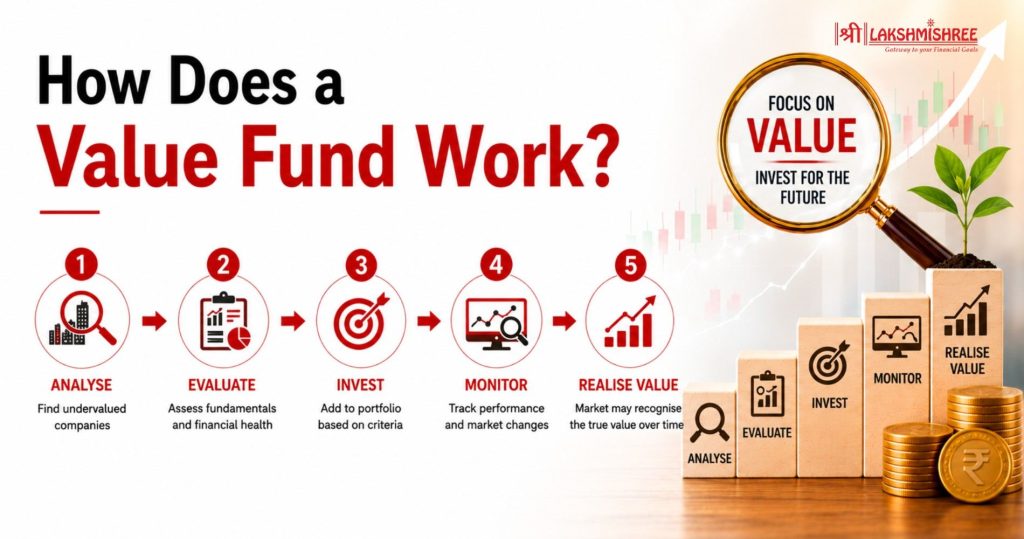
A value fund works by searching for companies that the fund manager believes may be undervalued based on their fundamentals and market valuation.
The process generally begins with analysing businesses and their financial position. The fund manager may assess factors such as earnings, cash flows, debt levels, profitability and future business prospects.
Companies that meet the fund's investment criteria may then be included in the portfolio. The fund manager continues to monitor these holdings as their financial performance, valuations and market conditions change.
The underlying approach is based on the possibility that the market may eventually recognise the perceived value of these businesses. However, there is no fixed timeline for this to happen.
Overall, value funds can offer opportunities, but attractive valuations do not remove investment risk.
Value funds may be suitable for investors who have long-term financial goals and can stay invested through market fluctuations.
For example, they may be considered by investors who are:
Value funds may be less suitable for short-term financial goals, such as expenses planned within the next few months or years. They may also not suit investors who prefer stable and predictable returns.
Before investing, consider your risk appetite, financial goals and investment horizon.
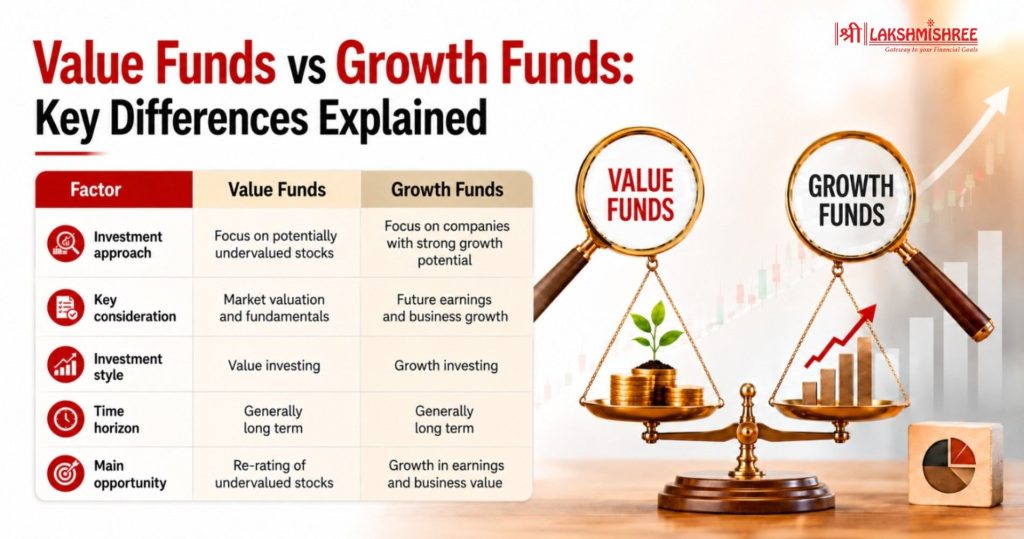
Both value and growth funds invest in equities. However, their stock-selection approach is different.
| Factor | Value Funds | Growth Funds |
| Investment approach | Focus on potentially undervalued stocks | Focus on companies with strong growth potential |
| Key consideration | Market valuation and fundamentals | Future earnings and business growth |
| Investment style | Value investing | Growth investing |
| Time horizon | Generally long term | Generally long term |
| Main opportunity | Re-rating of undervalued stocks | Growth in earnings and business value |
The choice between the two depends on your investment goals, risk tolerance and overall portfolio strategy.
Choosing a value mutual fund requires more than comparing past returns. Investors should understand the fund's strategy, portfolio and costs before investing.
Related Reading: Portfolio Diversification: Meaning, Benefits & Best Ways to Do It | DCF Valuation: Meaning, Formula, Calculation, Example & Uses
Once you have selected a suitable fund, you can invest through a Systematic Investment Plan (SIP) or a lump-sum investment.
A SIP allows you to invest a fixed amount at regular intervals. It can be useful for investors who prefer disciplined investing. A lump-sum investment involves investing a larger amount at one time.
After considering your financial goals, risk appetite and investment horizon, you can invest in value funds through Lakshmishree Investment and Securities.

Value funds are generally equity-oriented mutual funds. Tax on gains depends on factors such as the holding period and the prevailing tax rules.
Short-term capital gains and long-term capital gains may be taxed differently. Tax rules can also change over time.
Therefore, check the latest applicable tax regulations on mutual funds before making an investment decision. You may also consult a qualified tax professional for specific guidance.
Understanding what is a value fund can help investors decide whether this investment approach fits their financial goals. These funds focus on companies that may be attractively valued based on their fundamentals.
However, value investing requires patience. Market conditions, business performance and valuation changes can affect returns.
Before investing, consider your risk appetite, investment horizon and existing portfolio. A value fund should be selected based on your overall financial plan, not only on past performance.
A value fund is an equity mutual fund that follows a value investing strategy. It generally looks for companies that may be undervalued based on their fundamentals and market valuation.
Yes. Value funds are exposed to equity market risks. A stock may remain undervalued for a long time or may decline further. Business and economic conditions can also affect returns.
Value funds can be considered for long-term investing. The strategy often requires patience because the market may take time to recognise the perceived value of a company.
Value funds generally focus on potentially undervalued companies. Growth funds focus more on companies expected to deliver strong future growth. Both strategies carry market risk.
Yes. Investors can generally invest in eligible value funds through a Systematic Investment Plan (SIP). A SIP allows investors to invest a fixed amount at regular intervals.
Consider the fund's investment philosophy, portfolio, fund manager, performance, expense ratio, exit load and risk level. Also check whether it fits your financial goals and investment horizon.
Disclaimer: This article is for educational and informational purposes only and does not constitute investment advice or a recommendation to buy or sell any specific security. Investing in stocks involves market risk. Past performance is not indicative of future results. Please conduct your own due diligence before making any investment decisions.