
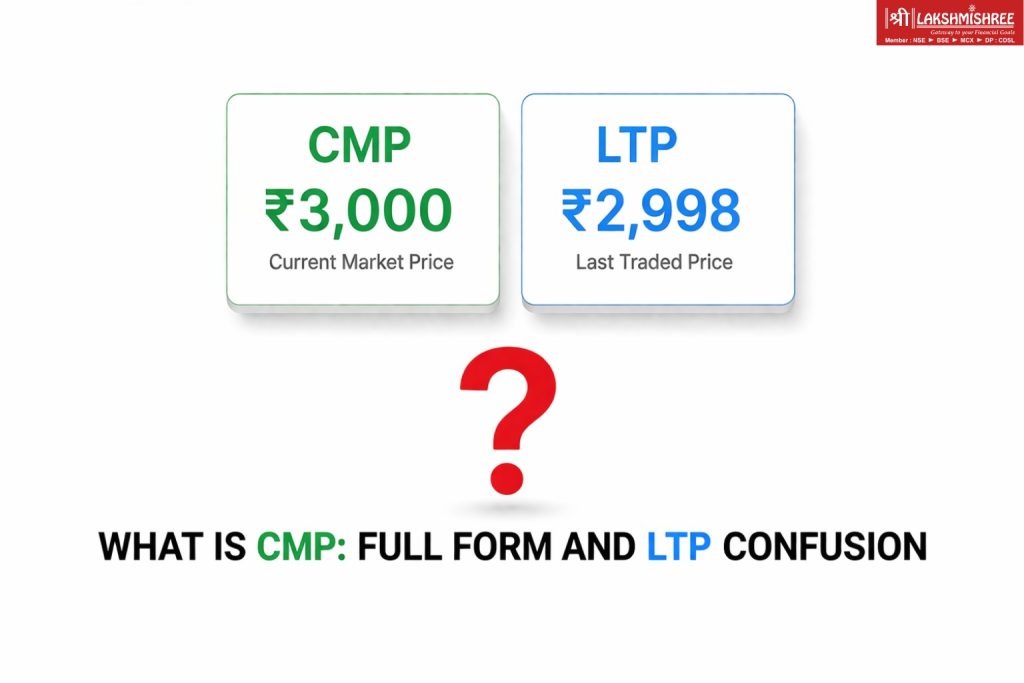
After you have successfully opened your Demat account. You open your Trading app to buy Reliance, Tata Motors, or any other favorite stock. But just as you’re about to click 'Buy,' you see that your trading app has many short forms like CMP and LTP, among others, which makes the stock market feel a little difficult in starting, as well as very fun when you have mastered these abbreviations. A key example is CMP, often confused with LTP, as they fluctuate side-by-side:
CMP: ₹3,000 | LTP: ₹2,998.
You searched for the CMP full form in the stock market, which is among the highest-volume full-form queries in finance, as they look almost identical. Also, because choosing the wrong one can lead to a 'slippage'- a common mistake in beginners, where you end up paying more for a stock than you planned.
In Short, CMP is stock market jargon, and CMP full form is Current Market Price. While LTP (Last Traded Price) tracks the last price at which buyers and sellers had a deal. However, CMP is the price where buyers and sellers are ready to deal right now. Mastering the CMP is for many the first step in their trading journey.
This 2026 guide clarifies what CMP stands for and how to use it to place perfect orders every time.
CMP stands for Current Market Price. It is the price at which a particular stock is available to be bought or sold right now, in real time, on the stock exchange like NSE or BSE.
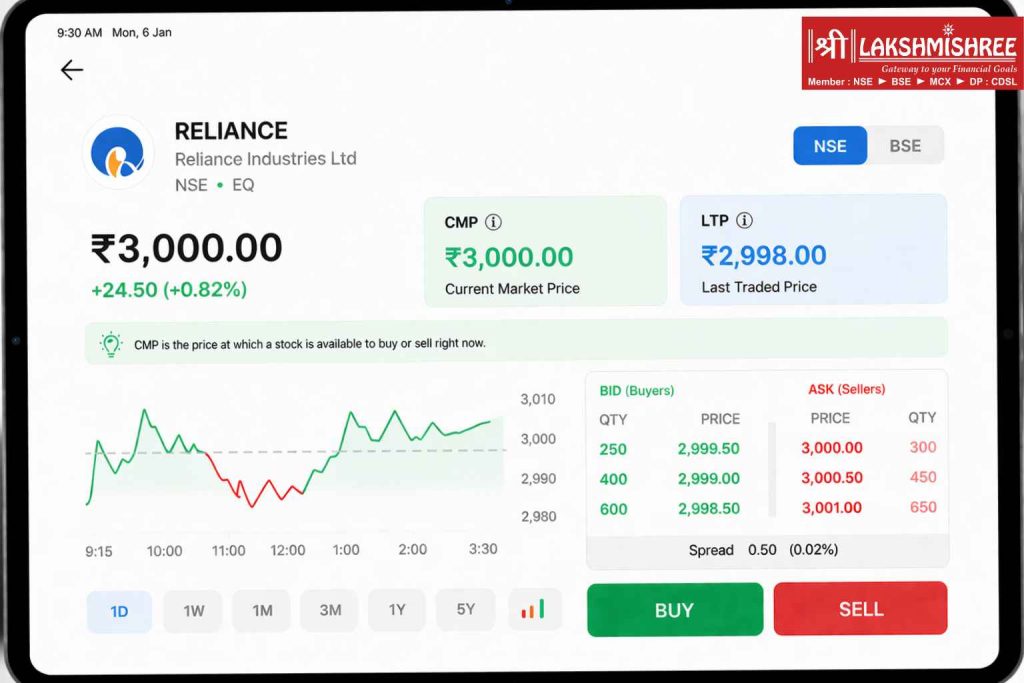
Think of it like a price tag that updates every fraction of a second during trading hours. If the CMP of Reliance Industries is ₹3,000, it means you can buy one share of Reliance right now for approximately ₹3,000.
Because this number changes with every tick of the market, understanding what is CMP in stock market logic is the only way to avoid paying more than you intended. Whether you call it the CMP or by its full form or simply the live Price of a stock, the most accurate way to imagine CMP in stocks is the meeting point of a buyer and a seller at that specific price at that very moment.
CMP in stock market daily operations is the price at which the market is willing to execute your order instantly, with no waiting. It is the live valuation that solves the most important question in trading: "How much do I need to pay to own this share right now?"
Example: Suppose you want to buy Tata Motors shares.
Essentially, CMP in trading is the "fair price" agreed upon by the crowd at any given moment. Understanding the CMP meaning in share market apps is vital because it acts as your baseline for every profit or loss you calculate. The journey of trading literally starts from this flickering price and this is also the reason to take this finance jargon to your heart.
The difference between CMP and LTP is the most common point of confusion for new traders. While CMP and LTP often flicker side-by-side on your Lakshmishree or any other broker dashboard, they represent two different moments in time.
If you are asking, is CMP and LTP same?, the answer is no. LTP tells you what happened a microsecond ago; CMP tells you what is possible right now.
CMP vs LTP Comparison Table
| Feature | CMP (Current Market Price) | LTP (Last Traded Price) |
| Full Form | Current Market Price | Last Traded Price |
| Market Status | The price available RIGHT NOW | The price of the LAST completed trade |
| Update Speed | Every tick (approx. 100ms) | Only when a buy/sell trade executes |
| Best For | Placing a new order | Checking what the last person paid |
| After Market | Disappears (No active price) | Stays visible (Shows the "Closing Price") |
In a highly liquid stock like Reliance, the difference between CMP and LTP is usually negligible, often just ₹0.05. Because thousands of people are trading every second, the Last Traded Price and the Current Price are virtually identical.
However, in Penny Stocks or small-cap shares, you might see a wide gap. For example, a small stock might have an LTP of ₹50, but the CMP (the price sellers want right now) could be ₹52. If you place a Market Order based on the LTP, you will be shocked to find you bought it at ₹52. This is called "Slippage."
For illiquid stocks — small-cap or penny stocks, there can be a meaningful gap between CMP and LTP because fewer trades happen per minute.
Post-Market Behavior
The easiest way to understand the CMP vs LTP meaning is to look at your app at 4:00 PM (after the market closes). You will see the LTP (Closing Price), but the CMP will be blank or showing N/A. This is because while the history of the last trade remains, there is no current market to buy or sell.
The CMP in stock market logic relies on a high-speed, live auction called the Order Book. It is not a fixed calculation; it is a moving target determined by the real-time supply and demand on the National Stock Exchange (NSE) or BSE.
At any given microsecond, the CMP in share market trading is formed by the battle between two groups:
The best ask price (the lowest price a seller will accept) is effectively what makes the CMP for a buyer.
Example:
This is why when you place a market order to buy, you will typically pay the ask price, and when you place a market order to sell, you will receive the bid price.
The NSE updates this price data every 100 milliseconds i.e. 10 times per second. This is why CMP can appear to be continuously moving during active trading hours.
One of the biggest hurdles for beginners is seeing three different prices for the same stock. While you might be searching for the CMP full form in share market apps, you will likely stumble upon Face Value and Book Value too.
Three terms that beginners often confuse:
CMP (Current Market Price): The price you pay today, in the open market. Reflects investor sentiment, earnings expectations, and supply-demand dynamics. Changes every second.
Face Value (Par Value): The original price printed on the share certificate when the company first issued shares which is typically ₹1, ₹2, ₹5, or ₹10. Does not change with market movements. Relevant for dividend calculation and accounting, not for your trading decisions.
Book Value: The net asset value of the company divided by shares outstanding. The ratio of CMP to Book Value (called Price-to-Book or P/B ratio) tells you whether a stock is trading above or below its intrinsic asset value. This is exactly what the popular search for high book value stocks trading at a discount refers to stocks where CMP is below book value.
The fact that the Current Market Price (₹1,307.30) is over 130 times higher than the Face Value (₹10) is entirely normal. It reflects the massive expansion, global brand value, and future earnings potential that Mukesh Ambani has built over decades.
If you have ever felt your heart race as the CMP in share market apps flickers rapidly, you are witnessing a "live auction" in its purest form. The CMP meaning in stock market terms is never static because it is the exact point where supply meets demand at that specific millisecond.
Think of the market as a global tug-of-war:
When Supply Rises: More sellers exit → Buyers negotiate for lower prices → CMP ticks down.
When Demand Rises: More buyers enter → Sellers can charge a premium → CMP ticks up.
Google’s search data shows that traders often look for the "Why" behind sudden price moves. Rapid changes in the CMP of Reliance, Tata Motors or Ultratech are usually triggered by::
During highly volatile sessions such as budget days, RBI policy announcements, US Fed meetings etc the CMP can change by 3–5% in under a minute. This is normal market behaviour.
Pro-Tip: During these high-speed sessions, the LTP (what happened a second ago) can be vastly different from the CMP (what is happening now). To avoid "buying the peak" by mistake, always use a Limit Order rather than a Market Order to ensure you don't pay a premium during the chaos.
This is the practical part. Understanding the CMP meaning and learning the CMP Full Form in stock market apps is only half the battle; knowing how to use it to execute a trade is what prevents costly mistakes. When you are on your Lakshmishree Varahi or any other trading terminal, your choice depends on one question: Do you need speed or a specific price?
You want to buy 10 shares of HDFC Bank as quickly as possible.
Use a market order when: Speed matters more than price precision. Works best for highly liquid large-cap stocks.
You want to buy HDFC Bank but only if the price dips to ₹1,650.
Use a limit order when: You have a specific entry price in mind and can afford to wait.
When you place a buy order at CMP on your Lakshmishree trading terminal, the system fetches the live-wire price directly from the NSE/BSE feed.
Pro-Tip for 2026: If you are trading a "Penny Stock" where the LTP is ₹10.00 but the CMP (Ask price) is ₹10.50, a market order will force you to pay that 5% premium. In such cases, always use a Limit Order to maintain control over your capital.
One of the most frequent questions from new traders is: "Why is the CMP on Zerodha different from the price I see on Google or the news?"
The truth is, the CMP meaning in share market apps is consistent across the board. Whether you use Lakshmishree Varahi, Zerodha, or Upstox, every platform fetches its data from the same official source: the NSE or BSE feed.
While the price at the exchange is identical, the speed at which it reaches your mobile screen can vary. This is called Latency.
To ensure you aren't looking at a delayed feed, open the "Market Depth" or "Order Book" section of your app.
The Warning: If the CMP stock meaning on your screen stays frozen for more than 5 seconds while the market is open, do not place a Market Order. You risk buying at a price that no longer exists.
Experienced traders and technical analysts use CMP as the reference point for several key calculations:
When CMP crosses above the 50-day EMA (Exponential Moving Average), it is considered a bullish signal. When CMP falls below the 200-day EMA, many traders treat it as a bearish trend confirmation. To understand how to use exponential moving average alongside CMP, see our EMA indicator guide.
When CMP approaches a previously established support level (a price where the stock has repeatedly bounced), traders watch for buy signals. When CMP hits resistance (a price ceiling), they watch for reversal signals like the hammer candlestick pattern.
Both P/E ratio (Price-to-Earnings) and P/B ratio (Price-to-Book) are calculated using CMP in the numerator. As CMP changes daily, so do these valuation ratios — which is why fundamental investors monitor CMP alongside earnings and book value to find high book value stocks trading below intrinsic value.
At its core, the CMP in stock market terminology is the most fundamental number on your screen. It is the real-time answer to: "What does this share cost me right now?"
Mastering the CMP meaning, understanding the CMP full form in share market terms is the bridge between being a confused beginner and a strategic investor. By understanding how this live price interacts with the LTP (Last Traded Price) and feeds into critical valuation metrics like the P/B Ratio, you gain the clarity needed to execute trades without the anxiety of slippage.
If you are currently tracking high book value stocks trading at a discount, where the CMP is significantly lower than the company’s actual asset worth, the Lakshmishree research desk provides the specialized data and weekly insights you need to find these hidden gems.
Backed by a 31-year legacy and the trust of 60,000+ investors, Lakshmishree Investment and Securities is a SEBI-registered authority dedicated to making price discovery simple. Open a free Demat account today to access our professional-grade trading terminals and expert-led stock screeners.
CMP stands for Current Market Price. It is the live, real-time value of a share on the NSE or BSE at this exact second. If you are searching for the CMP full form in share market apps, remember it represents the 'live-wire' price at which you can buy or sell a stock right now without waiting.
No, CMP and LTP are related but not identical. While LTP (Last Traded Price) tells you what the previous buyer paid, CMP tells you what you have to pay right now. During active market hours, the difference between CMP and LTP is usually just a few paise, but after 3:30 PM, the CMP disappears while the LTP remains as the "Closing Price."
CMP is determined by the live "Order Book" (Demand vs. Supply), not a fixed formula. The lowest price a seller is willing to accept (Best Ask) becomes the CMP for a buyer. Conversely, the highest price a buyer offers (Best Bid) is the CMP for a seller. This "handshake" is processed by the exchange's matching engine every 100 milliseconds.
In both NSE and BSE, CMP refers to the live quote during market hours (9:15 AM to 3:30 PM). Because most Indian stocks trade on both exchanges, the CMP price is usually identical. However, if there is a slight gap, it provides an opportunity for "Arbitrage." If your app screen isn't flickering, you might be looking at a delayed feed rather than the true CMP stock meaning.
After 3:30 PM, the CMP becomes "N/A" or disappears because active trading has stopped. There is no "current" price because no one can buy or sell instantly. At this point, the LTP takes over and is displayed as the final "Closing Price" until the market re-opens the next day at 9:15 AM.
Buy at CMP (Market Order) for speed; use a Limit Order for price control. For high-volume stocks like Reliance, buying at CMP is safe. However, for "Penny Stocks" or illiquid shares, buying at CMP can lead to slippage, where you accidentally pay a 2–5% premium. Professionals always check the CMP vs LTP gap before deciding which button to click.