
Every few months, a first-time investor discovers ETFs, compares them with mutual funds, and immediately starts ETFs vs. Mutual Funds debate inside and out, wondering the same thing;
Have I been investing the wrong way this whole time? Should I have chosen ETFs instead of mutual funds? Are mutual fund expense ratios quietly reducing my long-term returns without me even noticing?
The ETFs versus Mutual Funds investment in India is a journey from confusion to awareness. Investors are finally paying attention to costs, compounding, liquidity, and performance differences that were mostly ignored during the earlier SIP boom years.
The rise of passive investing, index ETFs, and low-cost investing strategies has made many investors rethink whether actively managed mutual funds still justify their higher expense ratios.
The real answer depends on four things:
Because ETFs and mutual funds solve different problems. Some investors value simplicity and automated SIP discipline. Others care more about liquidity, lower expense ratios, and direct market pricing.
| The Goal | Active Mutual Fund | ETF |
|---|---|---|
| Demat? | No (Direct) | Mandatory (Broker) |
| Cost | Higher (Expert-led) | Lowest (Passive) |
| Best For | Set-and-Forget | Active Traders |
Related reading: ETFs Vs Index Mutual Funds
In the ETF vs Mutual Fund debate, the "better" option isn't determined by returns, but by your investing behavior. While both vehicles can track the same index, they optimize for different priorities.
An Exchange Traded Fund (ETF) is built for market efficiency, offering the lowest expense ratios and intraday liquidity for those with a Demat account. Conversely, a mutual fund prioritizes the disciplined SIP investor, offering automated simplicity and NAV certainty without the need for a trading terminal.
| Feature | Index ETF | Mutual Fund (Direct) |
| Purchased Via | Stock Exchange | AMC App / Bank |
| Demat Account | Mandatory | Not Required |
| Pricing | Real-time (CMP) | End-of-day NAV |
| SIP Method | Manual / Broker-led | Fully Automated |
| Friction | Bid-Ask Spread | None |
| Cost Ratio | Ultra-Low (0.05%+) | Low-Mid (0.15%+) |
So If you value technical efficiency and want to execute trades at specific market prices, the ETF is your tool for passive investing.
But, if you prioritize a "set-and-forget" routine where every rupee is deployed through fractional units, the mutual fund remains the most practical path to long-term wealth.
The better depends on whether you want a "hands-on" market instrument or a "hands-off" wealth engine. Which side matters more depends on how you actually invest.
To truly understand the ETF vs Mutual Fund landscape, you have to look past the returns. The real difference is a fundamental shift in market access:
This ETF vs Mutual Fund distinction determines your execution risk. With an ETF, you are riding the second-by-second volatility of the stock market. With a mutual fund, you are opting for the stability of the end-of-day Net Asset Value (NAV).
That distinction changes how both vehicles behave.
An Exchange-Traded Fund (ETF) functions as a market-traded basket of securities, allowing you to buy an entire index exactly like an individual stock. Instead of selecting separate companies, one transaction on the NSE or BSE provides instant diversification. In the ETF vs Mutual Fund selection process, the ETF stands out for its passive mandate, replicating a benchmark like the Nifty 50 automatically to capture total market returns.
This structural efficiency enables the lowest expense ratios in the passive investing world. By 2026, these instruments offer specialized tactical access:
Ultimately, the Index ETF is built for transparency and speed. Whether you are using a Nifty ETF for core stability or a sectoral fund for growth, you are choosing a vehicle designed for high liquidity and minimal cost drag.
A mutual fund pools capital under a professional fund manager at an AMC (Asset Management Company). Unlike exchange-traded rivals, units are transacted at the end-of-day Net Asset Value (NAV). This structure removes the need for a Demat account, fueling the massive growth of SIP investing among retail participants who value automated simplicity.
These vehicles broadly follow two paths: active management (aiming to generate alpha) and passive index funds (replicating a benchmark). This is a pivotal point in the ETF vs Mutual Fund comparison. While active strategies carry higher fees, the cost is justified if the manager consistently outperforms the market.
In the Indian ecosystem, category selection is vital. In small-cap mutual funds, roughly 60–65% of managers have historically beaten their benchmarks post-fees.
In Contrast, large-cap outperformance is less frequent. Consequently, the active vs passive investing choice depends on whether a specific sector offers a high probability of generating market-beating returns after costs.
| ETFs | Mutual funds |
|---|---|
| Efficiency Control Liquidity | Simplicity Automation Discipline |
One product is built around trading infrastructure. The other is built around investment management convenience.
For investors building a portfolio through Lakshmishree, both options are accessible. The choice is practical, not philosophical. See our best ETFs in India and best SWP mutual funds for specific product picks.
In the ETF vs Mutual Fund cost audit, the headline expense ratio is usually the primary differentiator. ETFs maintain a structural edge in cost-efficiency because they are system-driven, replicating a benchmark automatically without the high overhead of professional stock-picking teams.
Conversely, an actively managed mutual fund carries the price of human expertise. While this human-led approach targets market-beating returns, it results in higher management costs compared to automated rivals.
Mutual funds, include:
inside the expense ratio itself.
But the important nuance most investors miss is that the comparision is not ETF vs all mutual funds, the real comparison is lies in a specific niche of Mutual funds (Index Mutual Funds) that we have covered extensively in a separate blog.
| Investment Type | Typical Expense Ratio | Structure |
|---|---|---|
| ETFs | 0.05% – 0.30% | Passive index tracking through exchange |
| Direct Plan Index Mutual Funds | 0.10% – 0.50% | Passive investing through AMC |
| Active Mutual Funds | 0.50% – 2.50% | Active stock selection and fund management |
That is why the ETF vs mutual fund fee debate is often oversimplified. Lower visible expense ratio does not automatically mean lower total investing cost.

Because it compounds over time, lower ratios mean more profit for you: Know Expense Ratio clearly
While headline expense ratios favor exchange-traded products, the ETF vs Mutual Fund reality depends on three hidden frictions.
First, the bid-ask spread: While negligible in liquid giants like Nifty BeES, the liquidity gap in thinner sector funds can act as a 0.5%–1% silent tax on every trade.
Second, brokerage fees: It can create a significant transaction drag on small purchases unless you use a zero-brokerage platform.
Finally, tracking error: The replication slippage between the index and the fund, often reveals that passive mutual funds are more efficient. By bypassing exchange-driven price friction entirely, certain managed vehicles actually deliver higher net returns than their supposedly "low-cost" rivals.
Most investors look at expense ratios and think: “0.5% difference doesn’t sound much.” But in long-term SIP investing, small percentage differences compound into surprisingly large rupee gaps over decades.
The table below assumes:
Actual returns will vary, but the comparison clearly shows how ETF vs mutual fund cost structures affect long-term wealth creation.
| Investment Vehicle | Expense Ratio | Corpus After 20 Years | Estimated Cost Drag |
|---|---|---|---|
| Nifty 50 ETF | 0.10% | ~₹91.2 lakh | Minimal |
| Nifty 50 Index Fund (Direct) | 0.20% | ~₹89.8 lakh | ~₹1.4 lakh |
| Active Large Cap Fund (Direct) | 1.00% | ~₹83.1 lakh | ~₹8.1 lakh |
| Active Large Cap Fund (Regular) | 1.75% | ~₹77.2 lakh | ~₹14.0 lakh |
Read the last column carefully.
The “Cost Drag” number is not abstract finance terminology. It is money created through your SIP discipline and long-term compounding that gradually shifted toward fees instead of remaining invested in your portfolio.
The compounding effect of expense ratios becomes far more visible over long investment horizons. A 0.10% or 0.20% difference may look insignificant yearly. Over 20 years of SIP investing, however, the gap becomes meaningful.
But the most important insight in the ETF vs mutual fund discussion Direct Plan vs Regular Plan and Passive vs Active Investing. That is where the largest wealth gap appears.
The difference between a low-cost ETF and a Regular Active Mutual Fund in this example is roughly ₹14 lakh on the same SIP amount.
That is the number investors should focus on first.
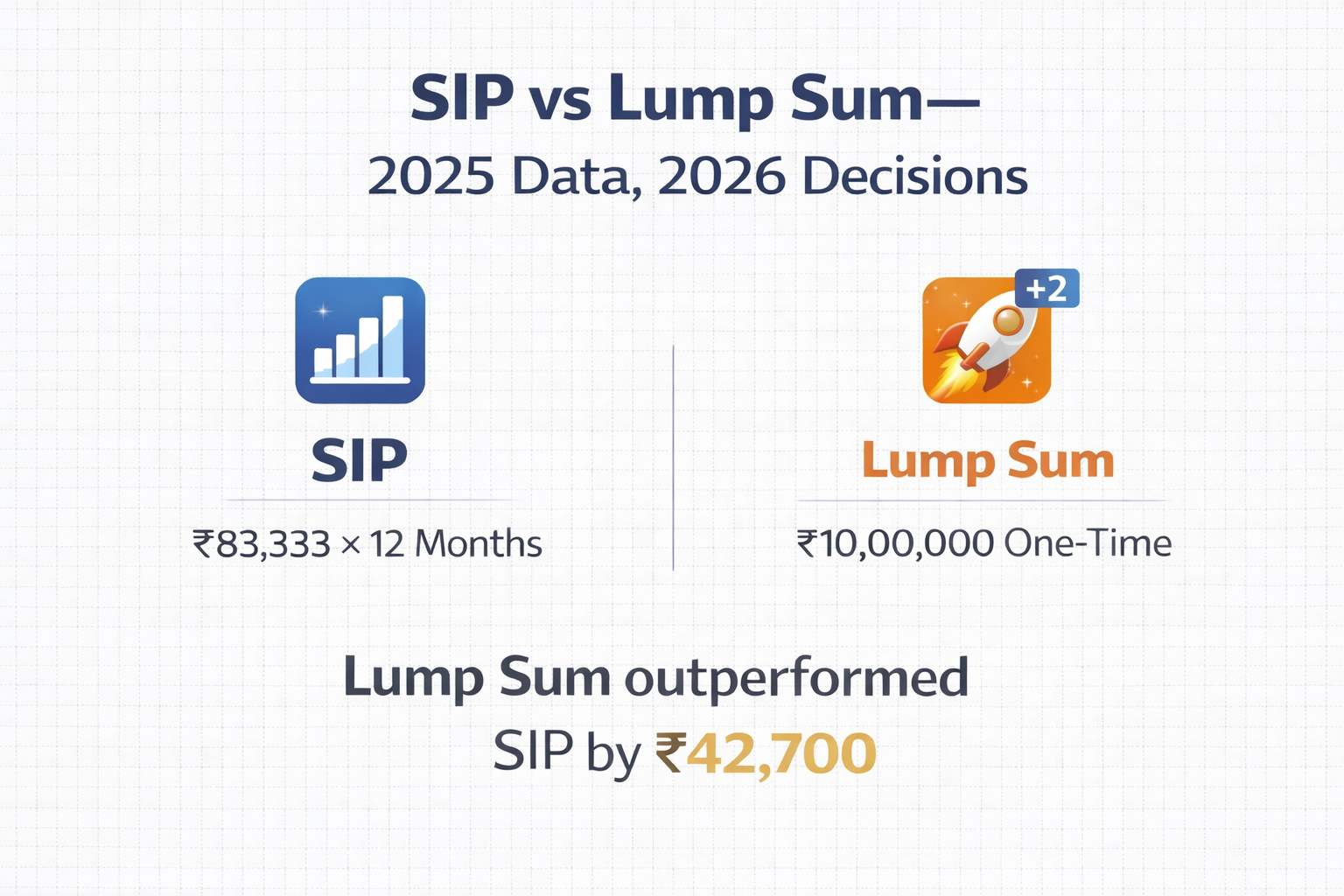
To see how a one-time entry can further widen this corpus gap, read our [2026 SIP vs Lump Sum Data Audit]. overlayed with the blueprint image.
Related reading: Expense Ratio in Mutual Funds | Exit Load in Mutual Funds
When we talk about ETF vs Mutual fund returns, we are really asking: Do you want a "Guaranteed Average" or do you want to try for "Extra Profit"?
Both have different ways of growing your long-term wealth.
An ETF (Exchange Traded Fund) does not try to be "smart." It simply follows a list like the Nifty 50.
An Active Mutual Fund hires a professional manager to try and beat the market benchmark. This extra profit is called Alpha.
Your Net Returns (the money that stays in your pocket) are calculated as:
Market Growth + Manager’s Skill - Expense Ratio.
Lakshmishree Research Tip: Most investors lose money not because of the fund, but because they sell during a market crash. This is the "Panic Tax." Because Index Mutual Funds and ETFs are simpler to understand, investors tend to stay disciplined for the long term.
The Bottom Line: Your SIP discipline is more important than the product. A simple Nifty 50 tracker held for 20 years will almost always outperform a "Top-Rated" active fund that you sold after only 2 years.
Mutual funds dominate the Indian SIP investing landscape because they offer total automation. From bank debit to NAV allocation, the process requires zero manual intervention, eliminating the mental friction of monthly execution. This is a primary reason why managed vehicles maintain a convenience edge in the ETF vs Mutual Fund comparison.
More importantly, you can only purchase whole units, not fractions. This creates "idle-cash drag" where leftover funds earn stagnant savings rates instead of market returns. Over a long-term horizon, this lack of total capital deployment can quietly erode your compounding potential compared to the seamless efficiency of a mutual fund where every rupee is put to work immediately.
Major brokers like Lakshmishree, allow recurring ETF purchases, effectively a broker-side SIP. Broker side ETF SIP comes with two limitations an AMC SIP does not have.
Think of it like buying gold coins monthly with ₹5,000. If a coin costs ₹2,100, you buy 2 (₹4,200) and ₹800 sits in your bank earning 3% instead of the 12% the market offers. Over years, this idle-cash drag compounds quietly against you.
For retail participants deciding between an ETF vs Mutual Fund, the monthly contribution size often dictates the winner. If your SIP amount is below ₹5,000, a passive mutual fund provides significantly better capital efficiency. It eliminates the fractional unit problem, ensuring every rupee captures market returns immediately through total automation.
As your portfolio scales beyond ₹5,000 per month, the "idle-cash drag" becomes mathematically insignificant, making both exchange-traded and managed vehicles equally viable for consistent wealth creation.
In the Indian regulatory framework, the ETF vs Mutual Fund choice is taxation-neutral. Whether you select an exchange-traded product or a managed vehicle, your capital gains tax depends entirely on the underlying asset class i.e. Equity, Debt, or Gold and your specific holding period.
This applies to most Nifty 50 ETFs and large-cap mutual funds. To maximize your post-tax returns, the goal is to cross the 12-month threshold:
Recent structural changes have simplified non-equity taxation, though the "Long-Term" benefits have shifted:
While personal tax rates are identical, the ETF vs Mutual Fund comparison reveals a subtle structural advantage for exchange-traded products known as lower portfolio turnover.
In a mutual fund, the manager must often sell underlying stocks to meet investor redemptions, potentially triggering internal tax costs.
In an ETF, investors trade units with each other on the exchange, meaning the fund rarely needs to liquidate its holdings. This "unit-to-unit" trading makes ETFs slightly more tax-efficient internally, a benefit often reflected in their lower headline expense ratios.
Don’t let the 20% 'Speed Tax' erode your wealth. Plan your 2026 exits and master the 12.5% math with our LTCG vs STCG Tax Rate 2026 Guide →
The Bottom Line: Taxation is a neutral factor. Your choice should depend on whether you want the intraday trading power of an ETF or the "set-and-forget" simplicity of a Mutual Fund SIP.
| If you are… | Better option |
|---|---|
| A beginner investor | Mutual Fund |
| A passive long-term investor with Demat | ETF |
| A SIP-focused investor | Mutual Fund (or Index Fund) |
| A cost-focused investor with Demat | ETF |
| Someone who wants simplicity | Mutual Fund |
| Comfortable with Demat account | ETF |
| Investing in mid-cap or small-cap | Active Mutual Fund |
| Investing in gold, silver, or international assets | ETF |
Illiquid sector ETFs.
A Nifty PSU Bank ETF or small-cap sector ETF can have very thin volumes. A ₹2 lakh sell order in a thinly-traded ETF moves the price against you before it fills. A mutual fund redemption at NAV has no such impact.
Small SIP amounts.
Below ₹3,000 per month, the fractional unit problem means a meaningful slice of your money sits idle. An index mutual fund deploys every rupee automatically.
During a market crash.
When a circuit breaker hits, ETF trading stops completely. You cannot buy the dip or exit until trading resumes.
| Feature | ETF | Index Mutual Fund |
|---|---|---|
| During a crash | Trading halts : locked in | Orders accepted open |
| Execution price | Live (can be irrationally low) | End-of-day NAV (fair value) |
| Best for | Traders who monitor in real time | Long-term SIP investors |
During sharp sell-offs, ETFs can trade at a discount to their actual NAV. You might sell for less than the real value of the underlying stocks because panic has moved the exchange price below fair value. A mutual fund always redeems at exact NAV. You are not cheated by market fear.
Warren Buffett recommends low-cost index funds for almost everyone. His 2014 will instructs that 90% of the money left for his wife go into a low-cost S&P 500 index fund. The Indian equivalent is a Nifty 50 Index Fund or ETF. His point has never been ETF versus Index Fund specifically; it is passive and low-cost versus active and expensive. Either passive vehicle satisfies that principle.
Index Mutual Funds are the entry point to passive investing in India without a Demat account.
The ETF vs Mutual Fund decision is secondary to the act of starting itself. If you are facing analysis paralysis, You should choose the path of least resistance: start an automated SIP in a Direct Index Fund today.
Now that every question has an answer, here is how to take the first step in under 10 minutes.
To invest in an ETF:
To invest in a Mutual Fund:
[Open your Demat account with Lakshmishree →]
If you have read this far, you already know more than most investors about this decision.
For most salaried Indians doing a monthly SIP for 10 to 20 years, a Direct Plan Index Mutual Fund is the best starting point as it has low cost, no Demat required, every rupee invested, full automation. An ETF becomes the better choice when you have a Demat account, invest larger amounts, and want the absolute minimum in fees or need access to specific assets like gold or international indices. An active mutual fund remains worth considering for mid-cap and small-cap allocation, where Indian fund managers have historically demonstrated the ability to add returns above the index.
That is the complete answer. Everything else in this debate is detail.
| Topic | Where to go |
|---|---|
| Best ETFs in India 2026 | Best ETFs in India |
| Best Gold ETFs | Best Gold ETFs India |
| Best Silver ETFs | Best Silver ETFs India |
| SWP Mutual Funds for monthly income | Best SWP Mutual Funds |
| Mutual Fund Exit Load | Exit Load in Mutual Funds |
| Expense Ratio explained | Expense Ratio in Mutual Funds |
For passive, low-cost investing with a Demat account: ETF is marginally better on cost. For SIP investors without Demat: Index Mutual Fund is better on convenience. For investors seeking alpha in mid and small-cap: Active Mutual Fund has historically outperformed in India despite higher costs. There is no universal winner it depends on your specific situation.
Buffett recommends low-cost index funds for most investors. The Indian equivalent is either a Nifty 50 ETF or a Nifty 50 Index Mutual Fund. His 2014 will stipulates that 90% of his estate should go into a low-cost S&P 500 index fund. He has not specifically distinguished between ETF and index mutual fund — his focus is on low cost and passive strategy, both of which either vehicle satisfies.
For broad market exposure: Nippon India ETF Nifty BeES (NIFTYBEES) - largest AUM, highest liquidity, expense ratio 0.04%. For gold: ICICI Prudential Gold ETF; lowest expense ratio (0.50%), strong 5-year CAGR. See our best ETFs in India and best gold ETFs for complete lists.
Neither is inherently safer: both are SEBI-regulated and hold the same underlying assets. An ETF tracking Nifty 50 and a Nifty 50 Index Fund hold identical stocks. The safety of an investment depends entirely on the underlying portfolio, not the vehicle.
Most brokers now offer recurring purchase features that function as ETF SIPs. The practical limitation is fractional units, a ₹1,000 monthly investment in an ETF priced at ₹127 gives you 7 units with ₹111 left over uninvested each month. Index mutual funds invest every rupee regardless of unit price.
An ETF trades on the stock exchange at live prices all day and requires a Demat account. A mutual fund is bought and sold at end-of-day NAV directly through the AMC without a Demat account. Both can track the same index with similar returns.
For a 20-year SIP investor, an Index Mutual Fund (Direct Plan) is the most practical choice- passive returns, no Demat required, full SIP functionality, no bid-ask spread. A Nifty 50 ETF saves approximately 0.10 to 0.15% per year more meaningful over 20 years but not a decisive factor relative to investment discipline.
Disclaimer: This article is for educational purposes only. It does not constitute investment advice. All data is approximate as of May 2026. Investments are subject to market risks. Read all scheme-related documents before investing. Consult a SEBI-registered financial advisor before making investment decisions. Lakshmishree Investment & Securities Ltd.
SEBI Regn. No.: INZ000170330 | Research Analyst: INH000014395.
© 2026 Lakshmishree Investment & Securities Ltd. All rights reserved.