

Gold ETFs in India offer investors a convenient way to invest in gold without the need to buy, store, or manage physical gold. These exchange-traded funds aim to track domestic gold prices and can be bought and sold on stock exchanges through a demat and trading account.
For investors looking to add gold to their portfolio, Gold ETFs can provide exposure to the precious metal along with the convenience of market-based investing. However, choosing the right Gold ETF requires looking beyond returns and considering factors such as expense ratio, tracking error, liquidity, AUM and trading volume.
In this guide, we cover the leading Gold ETFs in India, their key performance metrics, how Gold ETFs work, how to invest in them, and how they compare with other gold investment options.
Gold ETFs, or Gold Exchange Traded Funds, are exchange-traded investment products that aim to track the domestic price of gold. Instead of purchasing physical gold, investors buy units of a Gold ETF through a stock exchange.
Gold ETFs combine the price exposure of gold with the trading convenience of an exchange-listed security. Since the units are held electronically, investors do not need to arrange physical storage or worry about making charges associated with jewellery.
Gold ETFs in India generally invest in physical gold of high purity or use structures designed to closely track gold prices. Their objective is to provide returns broadly aligned with the domestic price of gold, subject to expenses and tracking differences.
Gold ETFs are designed to follow the movement of gold prices.
The process broadly works as follows:
For retail investors, the most important point is that Gold ETFs provide gold-price exposure without requiring them to physically purchase and store gold.
There is no single Gold ETF that is best for every investor. A more useful approach is to compare established funds using factors such as AUM, liquidity, expense ratio, tracking error, historical performance and fund track record.
Based on these factors, the following five are among the leading Gold ETFs in India:
Nippon India ETF Gold BeES is one of India's largest and most established Gold ETFs. Its large asset base and significant trading activity make it a prominent option for investors seeking exchange-traded exposure to gold.
CAGR Returns:
| 1Y Return (%) | 3Y Return (%) | 5Y Return (%) |
| 37.96 | 35.50 | 25.40 |
The fund's large AUM and established history are among its key strengths. Investors should nevertheless compare its expense ratio and tracking performance with other Gold ETFs before investing.
ICICI Prudential Gold ETF is another large Gold ETF in India, offering investors an exchange-traded route to gain exposure to gold prices.
CAGR Returns:
| 1Y Return (%) | 3Y Return (%) | 5Y Return (%) |
| 37.93 | 35.83 | 25.65 |
Its relatively competitive expense ratio and large asset base make it one of the established options in the Gold ETF category.
SBI Gold ETF is managed by SBI Funds Management and provides investors with exposure to gold through an exchange-traded structure.
CAGR Returns:
| 1Y Return (%) | 3Y Return (%) | 5Y Return (%) |
| 37.97 | 35.56 | 25.42 |
Its long operating history and large asset base make SBI Gold ETF one of the established Gold ETFs in India.
HDFC Gold ETF is another large and established fund that aims to track the domestic price of gold.
CAGR Returns:
| 1Y Return (%) | 3Y Return (%) | 5Y Return (%) |
| 40.03 | 35.55 | 25.42 |
HDFC Gold ETF has a long track record and a substantial asset base, making it a relevant option when comparing established Gold ETFs.
Kotak Gold ETF is an established Gold ETF with a history dating back to 2007. It provides exchange-traded exposure to the domestic price of gold.
CAGR Returns:
| 1Y Return (%) | 3Y Return (%) | 5Y Return (%) |
| 39.71 | 35.69 | 25.37 |
Kotak Gold ETF combines a long operating history with a relatively competitive expense ratio and low tracking error compared with several peers.
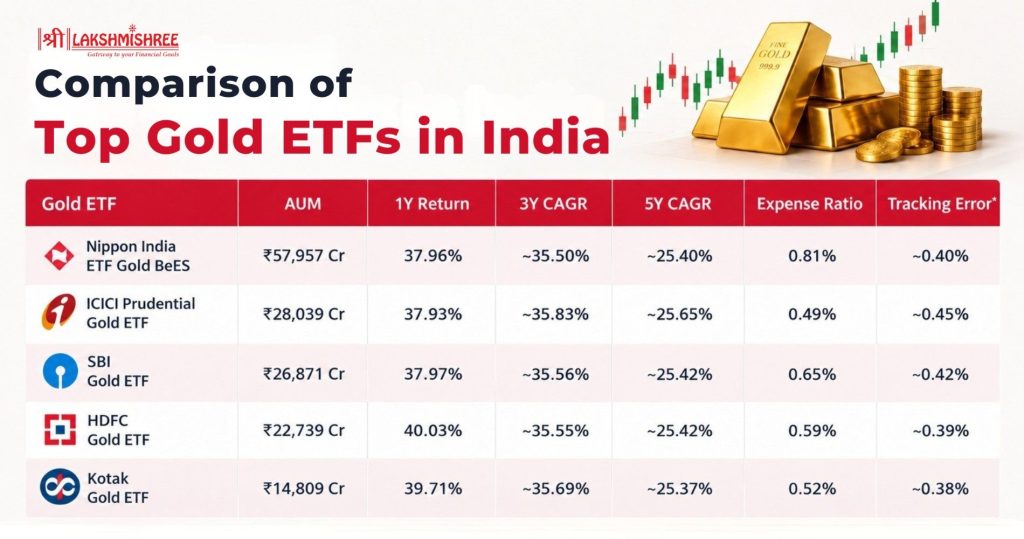
*Data as of 9 September 2026, unless otherwise stated. AUM, returns, expense ratios and other market-linked figures are subject to change. Tracking-error figures are based on the latest comparable disclosure available and may have a different reporting date.
A fund with the highest recent return is not necessarily the best choice. Investors should consider multiple factors together.
For example:
Therefore, the right Gold ETF depends on an investor's priorities rather than on one performance figure.
Gold BeES is itself a Gold ETF, specifically, Nippon India ETF Gold BeES.
Therefore, comparing "Gold ETF vs Gold BeES" is technically similar to comparing a broad category with one particular fund.
Instead, investors should compare individual Gold ETFs based on:
Gold BeES is one of the largest and most established Gold ETFs in India, but investors should still compare it with other available ETFs rather than assuming that its size automatically makes it the best choice.
Investors can choose from several ways to invest in gold, and each option has different costs, liquidity, convenience and holding requirements.
| Feature | Gold ETF | Physical Gold | Digital Gold | Gold ETF FoF |
| What is it? | Exchange-traded fund tracking gold | Coins, bars or jewellery | Gold purchased through a platform | Mutual fund investing primarily in Gold ETFs |
| Demat account | Generally required | No | No | Generally not required |
| Exchange traded? | Yes | No | No | No |
| Liquidity | Exchange-based | Depends on buyer/seller | Platform-dependent | Mutual fund redemption rules |
| Costs | Expense ratio, brokerage, spread | Making, storage and purity costs | Platform-related charges/ spread | Fund + underlying ETF expenses |
| SIP | Not typically | No | Platform-dependent | Often available, subject to scheme |
| Best suited for | Exchange-traded gold exposure | Physical ownership | Small digital gold purchases | Mutual fund-style gold investing |
Gold ETFs are suitable for investors who want exposure to gold without physically storing it. Physical gold, on the other hand, involves considerations such as storage, security, purity and making charges.
Digital gold can be purchased through online platforms without a Demat account. However, investors should check the provider's pricing, storage arrangements, charges and applicable regulatory framework before investing.
A Gold ETF FoF invests primarily in Gold ETFs and is purchased as a mutual fund rather than traded directly on a stock exchange. It generally does not require a Demat account and may offer SIPs, but investors should consider the additional layer of fund expenses.
Sovereign Gold Bonds are not included in the comparison above because as of September 2026, fresh SGB issues are currently not available for new subscription. Existing SGB holders can continue to hold their bonds subject to the applicable maturity, redemption and transfer provisions.
Related Reading: What is Gold ETFs: List, Advantages and Risks | Digital Gold vs Physical Gold vs Gold ETF India 2026: Which is Best for You?
The appropriate option depends on the investor's objective:
Investing in Gold ETFs generally involves the following steps:
You need a Demat and trading account with a broker or financial intermediary that allows exchange trading.
Compare ETFs on factors such as:
Select an ETF based on your investment objective and the factors most relevant to you.
Search for the ETF using its exchange ticker and place a buy order through your trading platform.
Track the investment periodically and review whether it continues to fit your overall asset allocation and financial objectives.
Get your FREE Demat account from Lakshmishree Investments and Securities today.

The tax treatment of Gold ETFs in India depends on how long you hold the units before selling them. Gold ETFs are treated as non-equity investments for capital gains taxation.
If you sell Gold ETF units within 12 months of purchase, any capital gain is treated as short-term capital gain (STCG). The gain is generally taxed at your applicable income-tax slab rate.
If you hold Gold ETF units for more than 12 months, the gains are treated as long-term capital gains (LTCG). For eligible transfers under the current tax rules, LTCG is taxed at 12.5% without the benefit of indexation.
Unlike specified equity investments, Gold ETFs do not qualify for the ₹1.25 lakh annual LTCG exemption applicable to equity-oriented investments.
Gold ETF and Gold ETF Fund of Fund (FoF) taxation should not be treated as identical. The long-term holding period for Gold ETFs is more than 12 months, while Gold ETF FoFs generally have a 24-month holding period for long-term capital gains. The applicable tax rate for eligible long-term gains is 12.5% without indexation.
Tax rules, rates and exemptions may change. Investors should check the latest income-tax provisions or consult a qualified tax professional before making investment decisions.
Gold ETFs in India provide investors with a convenient way to gain exposure to gold without the storage and security requirements associated with physical gold.
Nippon India ETF Gold BeES, ICICI Prudential Gold ETF, SBI Gold ETF, HDFC Gold ETF and Kotak Gold ETF are among the leading established options in the category. However, investors should not select a fund solely on the basis of its recent returns.
Factors such as AUM, liquidity, expense ratio, tracking error, historical performance and fund structure should be considered together.
Gold ETFs can form part of a diversified portfolio, but the appropriate allocation depends on an individual's financial goals, risk tolerance, investment horizon and overall asset allocation.
There is no single Gold ETF that is best for every investor. Nippon India ETF Gold BeES, ICICI Prudential Gold ETF, SBI Gold ETF, HDFC Gold ETF and Kotak Gold ETF are among the established Gold ETFs in India and can be compared based on AUM, expense ratio, liquidity, tracking error and historical performance.
Gold ETFs in India can be useful for investors seeking exposure to gold without purchasing and storing physical gold. However, their suitability depends on an investor's financial goals, risk tolerance and overall portfolio allocation.
Expense ratios can change, so investors should check the latest fund factsheets before investing. Among the five ETFs covered in this article, ICICI Prudential Gold ETF currently has a relatively low expense ratio of approximately 0.49%, while Kotak Gold ETF is around 0.52%.
A conventional Gold ETF is traded on a stock exchange and is not normally purchased through a mutual-fund SIP in the same way as an open-ended mutual fund. Investors seeking systematic investment options can consider Gold ETF FoFs, subject to the individual scheme's SIP facility.
Gold ETFs may be more convenient for investors seeking investment exposure because they avoid physical storage and jewellery-making charges. Physical gold may be preferable for investors who specifically want to own and use the physical asset. The better option depends on the investor's objective.
A Gold ETF is bought and sold on a stock exchange and generally requires a Demat account. A Gold ETF FoF is a mutual fund that invests primarily in Gold ETFs and can generally be purchased without a Demat account. A FoF may also offer SIPs, depending on the scheme.
Disclaimer: This article is intended for educational purposes only. Please note that the data related to the mentioned companies may change over time. The securities referenced are provided as examples and should not be considered as recommendations.