

The best hospital stocks in India are attracting investor’s attention as healthcare spending, insurance coverage and demand for specialised treatment continue to rise. India’s hospital industry is also expanding its bed capacity and adopting advanced medical technologies. Medical tourism and lifestyle-related diseases are adding to long-term healthcare demand.
At the same time, listed hospital companies face high capital requirements, competition and valuation risks. Therefore, you need to study both business fundamentals and market performance.
This article looks at major listed hospital companies, their financial metrics and historical share-price performance.
Hospital stocks are shares of listed companies whose primary business involves providing healthcare services through hospitals and related medical facilities. These companies may operate multi-speciality hospitals, super-speciality centres or specialised healthcare networks.
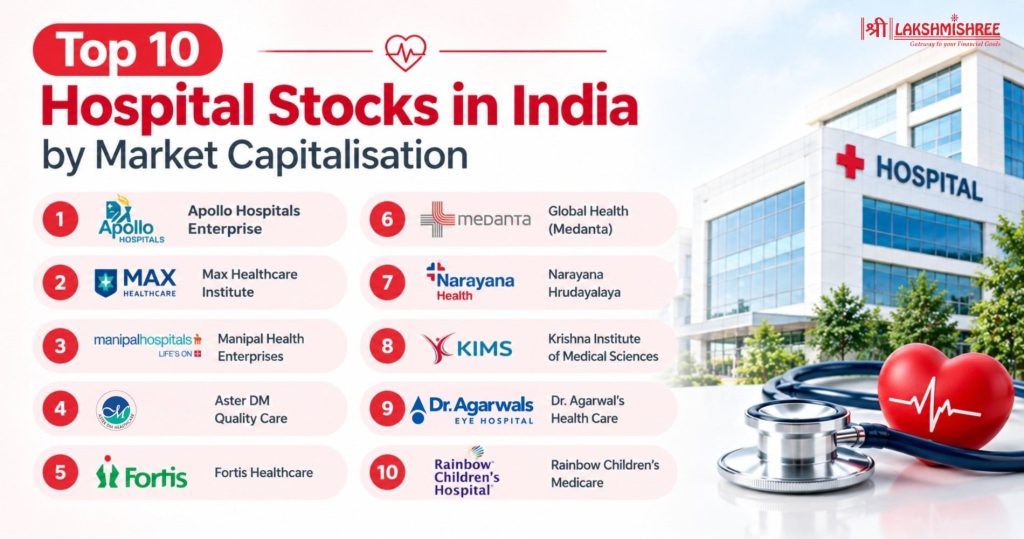
The table below ranks major hospital companies by market capitalisation. Market cap indicates company size and should not be treated as a standalone measure of investment quality.
| Company | Market Capitalisation | 3Yr Share Price CAGR |
| Apollo Hospitals Enterprise | ₹1,27,645 Cr | 21% |
| Max Healthcare Institute | ₹98,552 Cr | 25% |
| Manipal Health Enterprises | ₹95,687 Cr | N/A |
| Aster DM Quality Care | ₹66,247 Cr | 33% |
| Fortis Healthcare | ₹63,153 Cr | 36% |
| Global Health (Medanta) | ₹40,498 Cr | 30% |
| Narayana Hrudayalaya | ₹38,038 Cr | 20% |
| Krishna Institute of Medical Sciences | ₹32,765 Cr | 26% |
| Dr. Agarwal’s Health Care | ₹15,861 Cr | N/A |
| Rainbow Children’s Medicare | ₹13,965 Cr | 10% |
Apollo Hospitals Enterprise is one of India’s largest listed healthcare companies. Its business includes hospitals and several allied healthcare services. The company operates a large multi-speciality hospital network and has a significant presence across India's healthcare market.
Key details:
Share Price CAGR
| 1 Yr Share Price CAGR | 3 Yr Share Price CAGR | 5 Yr Share Price CAGR |
| 17% | 21% | 13% |
Max Healthcare Institute operates a network of multi-speciality and super-speciality hospitals. Its expansion across major healthcare markets has made it one of India's largest listed hospital companies by market capitalisation.
Key details:
Share Price CAGR
| 1 Yr Share Price CAGR | 3 Yr Share Price CAGR | 5 Yr Share Price CAGR |
| -9% | 25% | 23% |
Manipal Health Enterprises is a large private multi-speciality hospital chain offering services ranging from consultations and diagnostics to tertiary and quaternary care. It became publicly listed in 2026, so it does not yet have a comparable 1-year, 3-year or 5-year CAGR history.
Key details:
Aster DM Quality Care operates hospitals and healthcare facilities across India and has a presence in multiple medical specialties. The company is the listed entity following the combination of Aster DM Healthcare and Quality Care India.
Key details:
Share Price CAGR
| 1 Yr Share Price CAGR | 3 Yr Share Price CAGR | 5 Yr Share Price CAGR |
| 18% | 33% | 29% |
Fortis Healthcare operates multi-speciality and super-speciality hospitals across India. Its hospital network provides inpatient and outpatient services across several medical disciplines. The company has more than 5,800 operational beds across its network, including joint ventures and O&M centres.
Key details:
Share Price CAGR
| 1 Yr Share Price CAGR | 3 Yr Share Price CAGR | 5 Yr Share Price CAGR |
| -11% | 36% | 25% |
Global Health operates the Medanta hospital network across Gurugram, Indore, Lucknow, Patna, Ranchi and Noida. The company provides tertiary and quaternary healthcare across specialties such as cardiac sciences, oncology, neurosciences, orthopaedics and organ transplants. It had 3,435 installed beds as of September 2025.
Key details:
Share Price CAGR
| 1 Yr Share Price CAGR | 3 Yr Share Price CAGR | 5 Yr Share Price CAGR |
| 13% | 30% | N/A |
Narayana Hrudayalaya operates a network of multi-speciality and super-speciality hospitals in India and the Cayman Islands. Its network includes 42 healthcare facilities with 5,554 operational beds, including its Cayman Islands operations.
Key details:
Share Price CAGR
| 1 Yr Share Price CAGR | 3 Yr Share Price CAGR | 5 Yr Share Price CAGR |
| 8% | 20% | 29% |
Krishna Institute of Medical Sciences, or KIMS, is a major healthcare group serving Andhra Pradesh and Telangana. It provides primary, secondary, tertiary and quaternary healthcare across more than 40 specialties and super-specialties.
Key details:
Share Price CAGR
| 1 Yr Share Price CAGR | 3 Yr Share Price CAGR | 5 Yr Share Price CAGR |
| 7% | 26% | 26% |
Dr. Agarwal’s Health Care is a specialised healthcare company focused primarily on eye-care services. Its offerings include cataract surgery, refractive procedures, consultations and diagnostic services.
Key details:
Share Price CAGR
| 1 Yr Share Price CAGR | 3 Yr Share Price CAGR | 5 Yr Share Price CAGR |
| 3.24% | N/A | N/A |
Rainbow Children’s Medicare operates a specialised hospital network focused on paediatric and women's healthcare. The company operates 24 hospitals and five clinics across nine cities, with a total bed capacity of 2,565.
Key details:
Share Price CAGR
| 1 Yr Share Price CAGR | 3 Yr Share Price CAGR | 5 Yr Share Price CAGR |
| -1% | 10% | N/A |
Market-cap categories provide a simple way to understand the relative size of listed companies. Under the AMFI [Association of Mutual Funds of India] classification framework, the top 100 companies by full market capitalisation are large-cap, ranks 101–250 are mid-cap and companies ranked 251 onward are small-cap. These classifications can change over time.
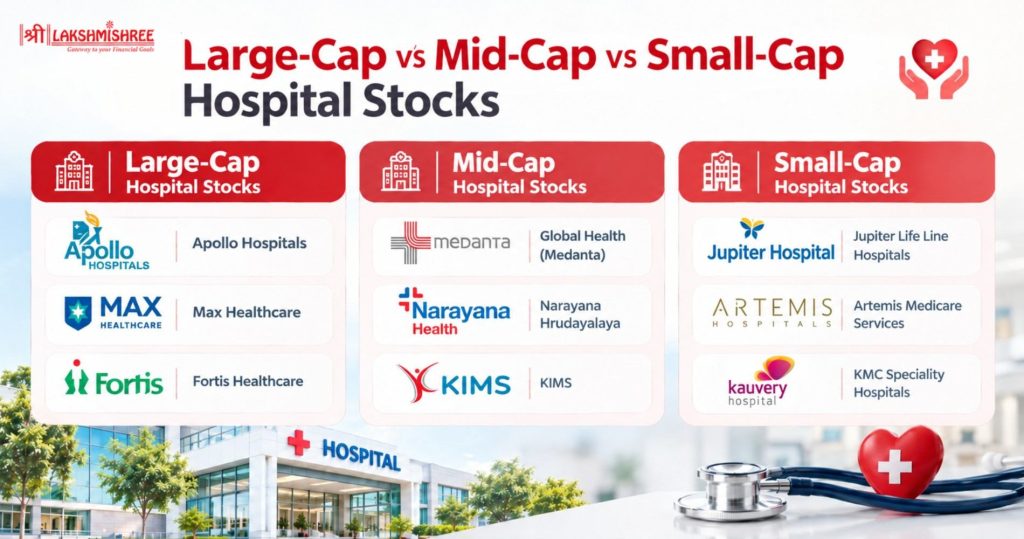
Large-cap hospital companies generally have established brands, larger networks and greater operating scale.
| Company | Market Cap | CMP | Dividend Yield | 3 Yr Share Price CAGR |
| Apollo Hospitals | ₹1,27,645 Cr | ₹8,889 | 0.22% | 21% |
| Max Healthcare | ₹98,552 Cr | ₹1,014 | 0.20% | 25% |
| Fortis Healthcare | ₹63,153 Cr | ₹838 | 0.12% | 36% |
Mid-cap hospital companies generally have an established operating base while retaining scope for network and capacity expansion.
| Company | Market Cap | CMP | Dividend Yield | 3Yr Share Price CAGR |
| Global Health | ₹40,198 Cr | ₹1,495 | 0.03% | 30% |
| Narayana Hrudayalaya | ₹38,038 Cr | ₹1,861 | 0.24% | 20% |
| KIMS | ₹33,802 Cr | ₹805 | 0% | 26% |
Global Health, Narayana Hrudayalaya and KIMS are currently represented in mid/small-cap index classifications, illustrating why investors should use the latest official classification rather than relying on a fixed market-cap number.
Small-cap hospital companies generally have smaller operating bases and may be more sensitive to individual expansion projects.
| Company | Market Cap | CMP | Dividend Yield | 3Yr Share Price CAGR |
| Jupiter Life Line Hospitals | ₹8,706 Cr | ₹266 | 0.08% | 7% |
| Artemis Medicare Services | ₹5,267 Cr | ₹333 | 0.14% | N/A |
| KMC Speciality Hospitals | ₹2,550 Cr | ₹156 | 0% | 21% |
Data is based on the latest available market data around 25 September 2026. Market capitalisation, CMP, P/E, ROCE and dividend yield can change with market prices and company results. CAGR represents historical share-price performance and is not a forecast of future returns.
The classification of individual companies can change with periodic market-cap rankings. Investors should verify the latest AMFI classification before using large-cap, mid-cap or small-cap labels.
For long-term investing, hospital stocks should be assessed based on their ability to grow earnings, expand capacity, generate healthy returns, and manage financial risks.
Investors should also consider regulatory changes, competition, execution of expansion projects, and changing healthcare demand when evaluating hospital stocks for the long term.

Hospital stocks are part of the wider healthcare sector but have different business drivers from pharmaceutical, diagnostic and medical-device companies.
| Hospital Stocks | Other Healthcare Stocks |
| Focus mainly on healthcare delivery | May include pharma, diagnostics and medical devices |
| Occupancy is an important metric | Different operating metrics apply |
| Bed capacity affects growth | Manufacturing or distribution capacity may matter |
| Often require significant capex | Capital intensity varies |
| Revenue is linked to patient services | Revenue drivers vary |
Therefore, if you are researching healthcare stocks in India, you should use metrics appropriate to the specific business model.
Related Reading: Top 10 Pharma Companies in India 2026 | Top 10 Life Insurance Companies in India 2026
Hospital stocks can offer long-term growth potential, but investors should also consider the risks involved. Regulatory changes related to healthcare, pricing, and compliance can affect profitability. High capital expenditure is common because hospitals require significant investment in new facilities, beds, and equipment. Competition for patients, doctors, and specialised services can impact growth. Execution risk can arise if expansion projects face delays or cost overruns. Finally, high valuations can limit future returns if earnings growth does not meet market expectations.
India's healthcare sector has several structural growth drivers, including increasing healthcare expenditure, insurance coverage and demand for specialised treatment. Major listed hospital companies offer exposure to this expanding industry, but their financial profiles and valuations differ. If you are researching the best hospital stocks in India, you should compare market capitalisation, profitability, debt, operating metrics and historical share-price performance. A high historical CAGR does not guarantee future returns. Independent research and consideration of individual investment objectives and risk tolerance remain important before investing.
Major listed hospital companies include Apollo Hospitals Enterprise, Max Healthcare Institute, Fortis Healthcare, Aster DM Quality Care, Global Health, Narayana Hrudayalaya, KIMS and Rainbow Children’s Medicare. The ranking can change as market prices and market capitalisation change.
Hospital stocks can be evaluated using revenue growth, profit growth, occupancy, ARPOB, ROCE, ROE, debt, cash flow and valuation. You can also examine bed capacity and planned expansion.
Occupancy rate, ARPOB, bed capacity, EBITDA margin, ROCE, ROE, debt and operating cash flow are useful metrics. P/E can also help you assess valuation relative to earnings.
Hospital companies may benefit from long-term healthcare demand and expansion opportunities. However, suitability depends on the individual company's fundamentals, valuation, financial position and your risk profile.
Disclaimer: This article is intended for educational purposes only. Please note that the data related to the mentioned companies may change over time. The securities referenced are provided as examples and should not be considered as recommendations.