
Silver is both a precious metal and an important industrial commodity. It is used in jewellery, solar panels, electronics and electrical applications. For investors searching for silver mining stocks in India, the listed universe is relatively limited.
India does not have a large standalone silver-mining industry. Much of its silver production comes from lead-zinc mining and processing.
This article focuses on listed companies with meaningful silver mining exposure.
India has a relatively small silver mining industry compared with the world's leading producers. Unlike countries such as Mexico, Peru or China, India does not have a large number of primary silver mines.
Most silver produced in India comes as a by-product of lead and zinc mining, rather than from mines developed primarily for silver. Globally, lead and zinc mines also remain the largest source of mined silver.
This structure is important for investors. The Indian listed market has limited direct silver exposure, with Hindustan Zinc being the key listed company associated with silver production. Vedanta provides indirect exposure through its stake in Hindustan Zinc.
India produced about 20.2 Moz of silver in 2025, according to the World Silver Survey 2026.
India's silver market is much larger than its domestic mine production. The country relies heavily on imports to meet domestic demand.
| Silver Market Indicator | Approximate Annual Quantity | Reference |
| India's silver production | ~746 tonnes, FY2023-24 | Indian Minerals Yearbook |
| India's silver imports | 7,337 tonnes, FY2023-24 | Indian Minerals Yearbook |
| India's silver demand | 7,951 tonnes, FY2023-24 | Indian Minerals Yearbook |
| Global silver mine production | 819.7 Moz, CY2024 | Silver Institute |
The difference between domestic production and consumption highlights India's dependence on imported silver. It also shows why silver demand in India cannot be assessed only by looking at domestic mining output.
For silver mining companies, however, production remains an important factor because changes in mined output can affect the amount of silver available as a by-product.
India is a relatively small contributor to global silver mine supply. The World Silver Survey 2026 estimates that global silver mine production increased to 846.6 Moz in 2025, while India's production was 20.2 Moz.
The world's three largest silver-producing countries were Mexico, Peru and China.
| Country | Silver Mine Production in 2025 |
| Mexico | 172.9 Moz |
| Peru | 130.6 Moz |
| China | 112.8 Moz |
| India | 20.2 Moz |
| World Total | 846.6 Moz |
Source: World Silver Survey 2026, Silver Institute/Metals Focus.
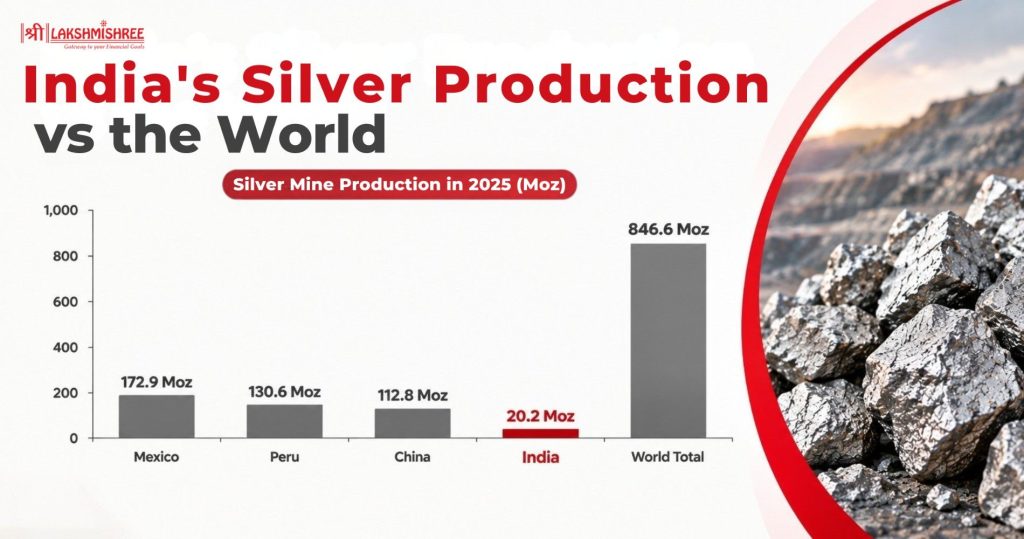
India's 2025 production therefore represented roughly 2.4% of global mine production. This difference in scale is important when assessing silver producers in India. The country's listed silver exposure is concentrated in a small number of companies rather than spread across a large silver-mining sector.
The list of silver mining companies in India available to stock-market investors is short. For the purpose of this article, the two relevant listed names are Hindustan Zinc and Vedanta.
| Company | Current Market Price* | Market Cap* | Silver Exposure | Business Model |
| Hindustan Zinc Ltd | ₹581.85 | ₹2.42 lakh crore | Direct and Significant | Silver is produced as a by-product of lead and zinc mining |
| Vedanta Ltd | Varies with market price | Varies with market price | Indirect, through Hindustan Zinc | Exposure through its stake in Hindustan Zinc |
*Current market price and market capitalization data is time-sensitive and can change later.
Related Reading: Gold vs Silver Investment in India 2026 | Best Silver ETFs in India 2026: Top Picks & Returns
Hindustan Zinc Limited is the most direct listed route to silver-mining exposure. The company operates an integrated zinc, lead and silver business, with mining and processing operations concentrated in Rajasthan.
Its major mining operations include Rampura Agucha, Sindesar Khurd, Zawar, Rajpura Dariba and Kayad. These operations feed the company's integrated processing and refining network.
Silver is an important part of the business, but Hindustan Zinc is not a pure-play silver company. Zinc and lead remain core commodities. Silver is produced alongside these metals as part of the company's integrated operations.
For FY2026, Hindustan Zinc reported 627 tonnes of silver production, compared with 687 tonnes in FY2025. The company said the lower output was linked to the mining sequence and lower silver input from mines.
The company currently lists an annual silver production capacity of 800 tonnes. It has also outlined a long-term plan to scale silver production capacity to 1,500 tonnes by FY2030.
Hindustan Zinc's silver exposure therefore comes with exposure to zinc and lead prices, mining costs, ore grades and operating performance. Investors should not treat HZL as a pure silver-price proxy.
Vedanta Limited is a diversified natural-resources company with businesses spanning metals, mining and energy. Its portfolio includes zinc, lead and silver through Hindustan Zinc, along with aluminium, oil and gas, iron ore, steel and other businesses.
Vedanta provides indirect silver exposure because of its controlling ownership in Hindustan Zinc. As of March 31, 2025, Vedanta's stake in HZL was 63.42%, following a stake sale during FY2024-25 to 61.82%.
This means that changes in Hindustan Zinc's silver business can affect Vedanta. However, Vedanta's overall stock performance also reflects its other businesses, commodity prices, financial structure and capital-allocation decisions.
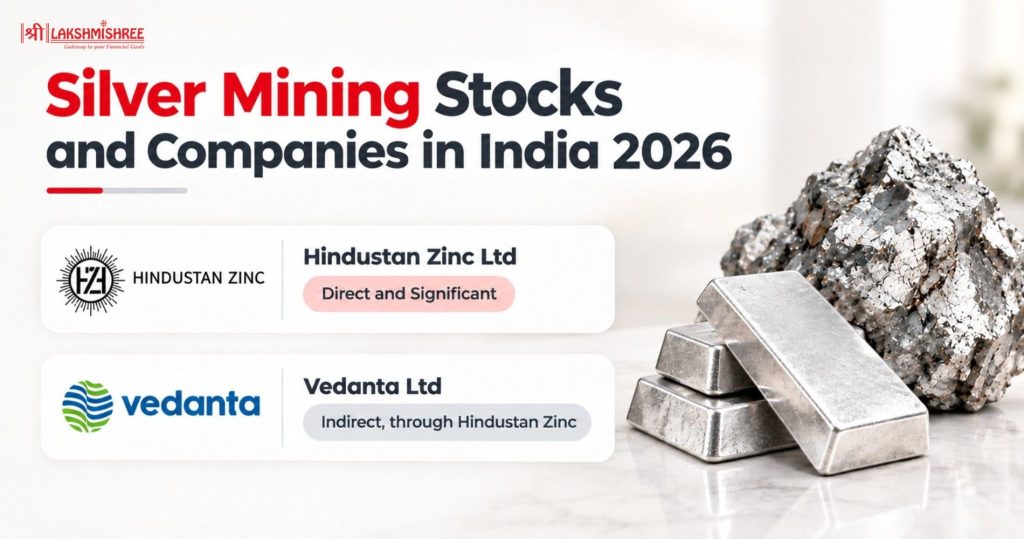
The main difference is the level of silver exposure. Buying Hindustan Zinc gives investors a more direct connection to its zinc-lead-silver mining and refining operations.
Buying Vedanta provides exposure to Hindustan Zinc as part of a much broader natural-resources portfolio. Therefore, Vedanta's performance cannot be considered a direct indicator of silver prices or silver production.
For investors researching silver companies in India, this distinction is important. The two stocks are linked, but their business exposure is not identical.
India's silver mining sector is also relatively concentrated, with silver often produced as a by-product of mining other metals rather than from large standalone silver mines.

| Factor | Direct Silver Investment | Silver Mining Stocks |
| What you own | Silver or an investment that tracks silver prices | Shares of a silver-mining or mining-related company |
| Main return driver | Change in silver prices | Silver prices plus company performance |
| Business risk | Not directly affected by mining operations | Affected by exploration, production and operating conditions |
| Production impact | Returns do not depend on mine production | Production levels can affect company revenue and performance |
| Price movement | Mainly influenced by silver-market factors | Influenced by silver prices and company-specific developments |
For more details on the different ways to invest in silver, read Silver ETFs vs Physical Silver: Which Is Better?
The Indian silver mining sector is much smaller than the country's broader metals and mining industry. Most domestic silver is produced as a by-product of lead and zinc mining, which explains the limited number of listed silver mining stocks in India.
Hindustan Zinc remains the key listed company for direct exposure to India's silver production, while Vedanta provides indirect exposure through its stake in Hindustan Zinc.
For investors researching silver stocks in India, it is important to understand that these companies are not pure-play silver businesses. Their performance can also depend on zinc, lead and other commodities, production volumes, operating costs and broader company-specific factors.
Investors comparing these stocks with direct silver investments should therefore consider the difference between owning a mining business and gaining exposure to the silver price itself.
Hindustan Zinc is the key listed company with direct exposure to silver production in India. Vedanta provides indirect silver exposure through its stake in Hindustan Zinc.
Hindustan Zinc is an integrated zinc, lead and silver producer. Silver is produced as a by-product of its lead and zinc mining and processing operations. The company reported 627 tonnes of silver production in FY2026.
Vedanta's silver exposure is primarily through Hindustan Zinc. Therefore, Vedanta is better described as a diversified company with indirect exposure to silver rather than a pure silver producer.
Silver often occurs naturally in lead and zinc ores. During the processing of these ores, silver can be recovered and refined into a saleable metal. Hindustan Zinc's operations follow this model.
There is a very limited listed universe of companies focused purely on silver mining in India. Silver production is commonly linked to the mining and processing of lead and zinc and other metals. This is one of the main reasons investors do not find a large selection of pure-play silver companies in India.
Hindustan Zinc is the major silver producer among the listed companies covered here. It reported silver production of 627 tonnes in FY2026. The company's silver production is integrated with its zinc and lead mining and processing operations.
Disclaimer: This article is intended for educational purposes only. Please note that the data related to the mentioned companies may change over time. The securities referenced are provided as examples and should not be considered as recommendations.