
Can a trader make money even if they win only 30 out of 100 trades? Yes, it is possible when the risk reward ratio is favourable and potential gains are appropriately balanced against potential losses.
Imagine two traders, each taking 100 trades. The first trader wins only 30 trades, while the second wins 60 trades. At first, it may seem that the second trader is more successful. However, the first trader could still earn more if the potential profit on each winning trade is significantly higher than the potential loss on each losing trade. This is where the risk reward ratio becomes important.
The ratio compares the potential loss of a trade with its potential profit. Traders can use it alongside win rate, stop loss, take profit, and position sizing to evaluate trades and build a more structured trading plan.
In this guide, we will explain the ratio, it's formula, how to calculate it, what makes a ratio practical, and how traders use it as part of risk management.
The ratio compares the potential amount a trader could lose with the potential amount they could gain from a trade.
For example, suppose you are willing to risk ₹500 on a trade for a potential profit of ₹1,000. The trade has a 1:2 risk reward ratio.
This means you are risking ₹1 for every ₹2 of potential reward.
Similarly, if you risk ₹500 to potentially make ₹1,500, the ratio would be 1:3.
The first number represents the potential risk. The second represents the potential reward.
The ratio is generally assessed before entering a trade. It can help you understand whether the potential reward justifies the amount you are planning to risk.
However, a higher ratio does not automatically make a trade better. The profit target still needs to be realistic, and the overall trade should fit the trader's strategy and risk-management plan.

Risk to Reward Ratio = Potential Loss ÷ Potential Profit
where:
Potential loss is the amount a trader could lose if the stop-loss level is reached.
It is determined by the difference between the planned entry price and the stop-loss price, along with the position size.
Potential profit is the amount a trader could potentially gain if the take-profit target is reached.
It is determined by the difference between the planned entry price and the target price, along with the position size.
The formula provides a way to compare these two amounts before entering a trade.
Suppose the stock’s current market price is ₹500.
The planned entry price is ₹500.
This is the price at which you intend to enter the position.
Suppose you place a stop loss at ₹480.
Now, suppose you set a take-profit target at ₹560.
The difference between the entry price and stop-loss price is:
₹500 − ₹480 = ₹20
Therefore, the potential risk is ₹20 per share.
The potential reward is:
₹560 − ₹500 = ₹60
Therefore, the potential reward is ₹60 per share.
Now compare the potential risk of ₹20 with the potential reward of ₹60.
₹20 : ₹60 = 1 : 3
Therefore, the trade has a 1:3 risk reward ratio.
In simple terms, you are risking ₹1 for a potential reward of ₹3.
Now suppose you buy 100 shares.
The potential risk becomes ₹2,000, while the potential reward becomes ₹6,000, before applicable trading costs.
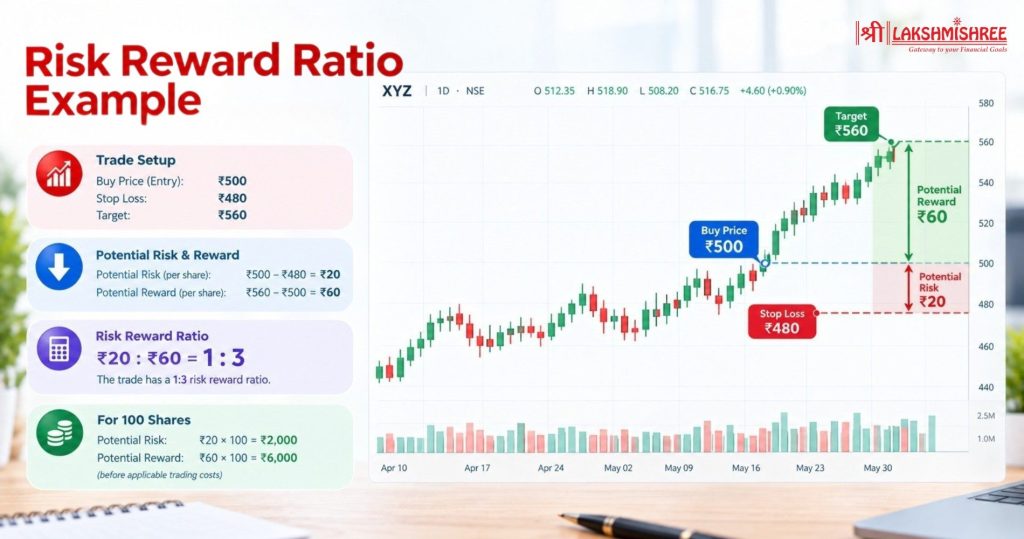
This example also shows why position size matters. The ratio stays the same, but the actual rupee amount at risk changes with the number of shares.
The same process can be applied to different markets and instruments. For short trades, the price direction is reversed, but the basic principle of comparing potential loss with potential profit remains the same.
Related Reading: Short Covering: Meaning, Example & Trading Strategy | Short Build Up Meaning in Stock Market
There is no single risk reward ratio that is suitable for every trader or trading strategy.
A ratio should be considered in the context of the overall trade setup. A few important factors can affect how useful a particular ratio may be.
The ratio is therefore best viewed as one part of a broader trading and risk-management process.
Read more about What is Positional Trading and How Does It Work?
The risk to reward ratio and win rate measure different aspects of a trading strategy.
The ratio compares the potential loss with the potential profit on a trade. Win rate measures the percentage of trades that end in profit.
Both can influence the overall performance of a strategy.
For example, consider a trader who risks ₹500 to potentially make ₹1,000 on each trade. This represents a 1:2 risk reward ratio.
If the trader wins 4 out of 10 trades, the four winning trades could generate ₹4,000 in potential gains. The six losing trades could result in ₹3,000 in losses.
In this simplified example, the gross result would be a ₹1,000 gain before trading costs and other charges.
This does not mean that a 1:2 ratio or a particular win rate guarantees profitability.
Trading expectancy looks at both winning and losing trades to estimate the potential overall outcome of a trading strategy. This is why risk to reward ratio and win rate should be considered together rather than viewed separately.
Both of these terms are sometimes used differently across trading resources.
A risk reward ratio may be written as 1:2, meaning ₹1 of potential risk for ₹2 of potential reward.
The same relationship can be described as a 2:1 reward-to-risk ratio, because the potential reward is twice the potential risk.
Therefore, it is important to check how a source defines the ratio before comparing figures.
The underlying relationship remains the same. The difference is mainly in which value is written first.

It can help traders plan and evaluate trades before entering a position.
Avoid these common mistakes when using the risk to reward ratio:
Learn more about the Common Investing Mistakes New Investors Make.
The risk reward ratio is a simple tool for comparing potential loss with potential profit before entering a trade.
Calculating the ratio involves identifying an entry price, stop-loss level, and potential profit target. It can then be considered alongside factors such as win rate, position sizing, trading costs, market conditions, and the overall trading strategy.
A favorable ratio alone does not make a trade profitable. The potential target should be realistic, the planned risk should be appropriate, and the trade should fit within a broader risk-management approach.
By understanding how the ratio works and using it consistently, you can make their trade planning more structured and have a clearer view of the potential risk and reward involved.
The risk to reward ratio compares the potential loss of a trade with its potential profit. For example, a 1:2 ratio means a trader is considering ₹1 of potential risk for ₹2 of potential reward.
Risk Reward Ratio = Potential Loss ÷ Potential Profit.
There is no universally suitable ratio. Its relevance depends on factors such as the trading strategy, win rate, market conditions, volatility, trading costs, position size, and the realism of the profit target.
A 1:2 ratio means the potential reward is twice the potential risk. Whether it is appropriate depends on the overall trading setup and strategy. The ratio alone does not determine whether a trade will be profitable.
No. A high risk reward ratio does not guarantee profits. A trade can still reach its stop loss even when the potential reward is much larger than the potential risk. Market conditions, execution, volatility, and the underlying strategy can all affect the outcome.
Disclaimer: This article is intended for educational purposes only. Please note that the data related to the mentioned companies may change over time. The securities referenced are provided as examples and should not be considered as recommendations.