

Gold continues to attract investors looking for diversification and exposure to precious metals. But buying gold is not the only way to participate in the sector. Gold mining stocks in India can offer exposure to companies involved in gold exploration, mine development and production. However, India's listed universe remains limited.
This guide focuses specifically on companies with direct or project-level gold mining exposure, rather than jewellery, gold-loan or other gold-related stocks.
India has a long history of gold mining, but domestic production remains small compared with the country's demand. The sector includes gold producers, exploration companies and diversified mining businesses with exposure to gold.
This distinction is important when looking at gold mining companies in India. A company involved in jewellery manufacturing, gold loans or gold trading is not necessarily a gold mining company. This article focuses on businesses with direct or meaningful exposure to gold exploration, mine development or production.
India's gold market is much larger on the demand and import side than on the domestic mining side. The World Gold Council estimates India's annual gold demand at around 800 tonnes, while domestic mine production accounts for only a small part of the country's supply. In Q2 2026, domestic mine production accounted for about 2% of India's gold supply, with imports providing the largest share.
| Gold Market Indicator | Approximate Annual Quantity | Reference |
| India's domestic mine production | Around 2 tonnes | World Gold Council |
| Gold consumption/demand | Around 800 tonnes | World Gold Council |
| Gold imports | Around 600 tonnes | World Gold Council |
| Unwrought non-monetary gold exports | 4.6 tonnes* | 2024 trade data |
*Exports of unwrought non-monetary gold are shown separately because India's overall gold-related exports also include jewellery and other products and therefore cannot be directly compared with mine production or bullion imports.
The difference between domestic production and consumption highlights why India depends heavily on imported gold. The World Gold Council reported that India's 2025 gold import bill was around US$59 billion, while import volumes declined by more than 20% from the previous year because of higher gold prices.
Indian consumers also remain significant participants in the global gold market. In 2025, India recorded 430.5 tonnes of jewellery demand and 280.4 tonnes of bar and coin investment demand. Gold ETF demand added further investment demand.
This creates an important contrast: India consumes a large amount of gold, but produces only a small quantity domestically.
The difference becomes clearer when India's production is compared with global mine output.
| Country/Region | Annual Gold Mine Production |
| World | 3,672 tonnes |
| India | Around 2 tonnes |
| China | Around 380 tonnes |
| Australia | Around 280 tonnes |
| Russia | Around 230 tonnes |
Global 2025 figures are based on World Gold Council/Metals Focus estimates. India's figure is rounded because domestic mine-production estimates vary by methodology and source.
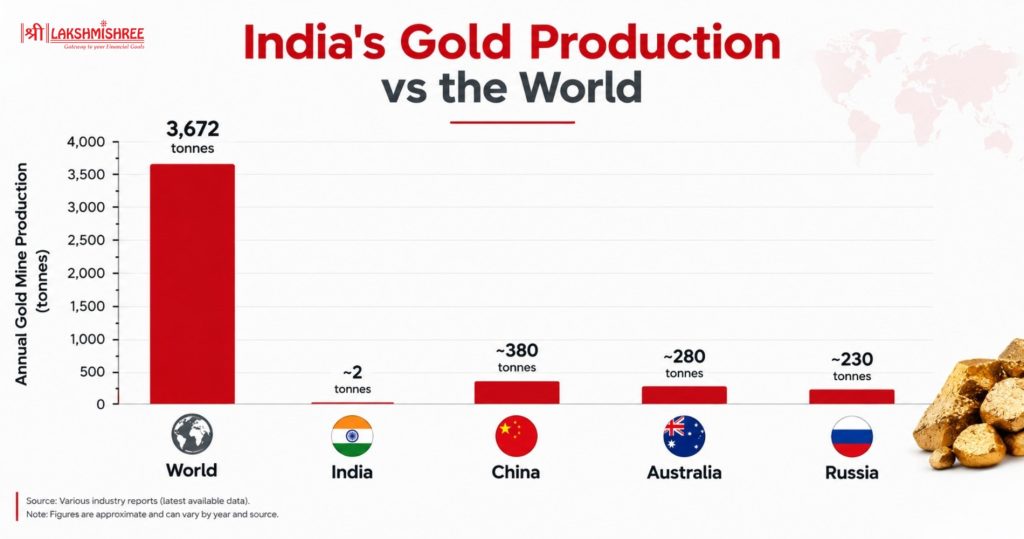
Global gold mine production was estimated at 3,672 tonnes in 2025. China remained the world's largest gold producer, accounting for about 10% of global output. India's domestic production is therefore only a very small fraction of global mine supply.
This production gap also helps explain why the Indian gold-mining sector has relatively few operating companies compared with countries that have large commercial gold-mining industries.
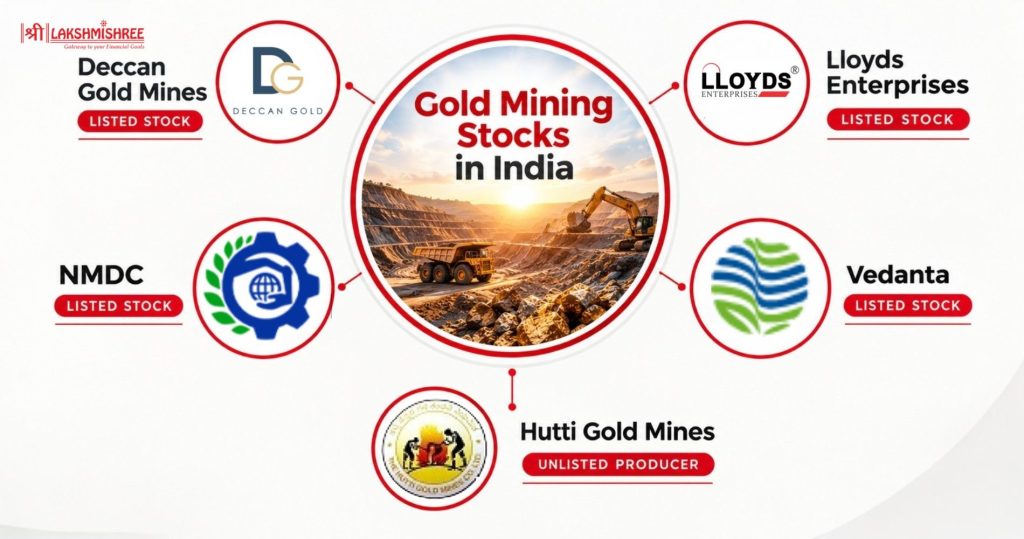
The gold mining sector in India includes a small number of listed companies with direct or indirect exposure to gold, along with unlisted producers. Some companies focus on gold exploration and mining, while diversified miners such as NMDC and Vedanta have gold as part of their wider mineral portfolio.
| Company | Current Market Price* | Market Cap* | 1-Year Share Price CAGR | 3-Year Share Price CAGR | 5-Year Share Price CAGR |
| Deccan Gold Mines Ltd | ₹220.70 | ₹4,385 Cr | 89.28% | 39.8% | 64.8% |
| Lloyds Enterprises Ltd | ₹70.69 | ₹10,526 Cr | 5.16% | 38.8% | 61.7% |
| NMDC Ltd | ₹80.35 | ₹70,642 Cr | 6.87% | 17.4% | 18.4% |
| Vedanta Ltd | ₹256.00 | ₹99,963 Cr | 61.43% | 43.7% | 18.0% |
*Current market prices and market capitalisation are market-linked and change regularly. Historical CAGR figures are calculated from the corresponding share-price returns reported over the stated periods. Past performance does not indicate future returns.
Deccan Gold Mines is one of the most direct listed gold-mining exposures in India. The company focuses on gold exploration, mine development and mining activities in India and overseas.
Its key Indian asset is the Jonnagiri Gold Project in Andhra Pradesh. The company also has gold exploration and development interests in countries including Kyrgyzstan, Tanzania and Finland.
Key Details:
Lloyds Enterprises is a diversified company with exposure to gold through its investment in the Jonnagiri Gold Project. Its gold exposure is therefore different from that of a pure gold-mining company.
The company made a strategic investment in Geomysore Services India Pvt. Ltd., the company associated with the Jonnagiri project. This gives Lloyds Enterprises project-linked exposure to gold mining while its broader business remains diversified.
Key Details:
NMDC is primarily a diversified mining company known for iron ore, but it also has exposure to gold through its Australian subsidiary, Legacy Iron Ore Limited.
Legacy Iron operates the Mt Celia Gold Project in Western Australia. NMDC's annual report has identified the start of gold production at Mt Celia as an important expansion of its mineral portfolio.
Key Details:
Therefore, NMDC should be viewed as a diversified mining company with gold exposure rather than a pure-play gold mining stock.
Vedanta is a diversified natural-resources company with businesses across metals and mining. Its gold exposure mainly comes through exploration and mineral-development activities rather than being its primary source of production.
The company has secured composite licences that include gold-bearing opportunities, with some blocks progressing through exploration.
Key Details:
Hutti Gold Mines Limited is different from the four listed companies above because it is not traded on NSE or BSE.
The company is owned by the Government of Karnataka and operates gold mines in the Raichur region of Karnataka. Its operations include the Hutti mine along with other gold-mining areas in the state.
Hutti is significant because it represents domestic gold production, rather than exploration exposure through a future project or gold operations outside India.
Key Details:
Since Hutti Gold Mines is unlisted, it does not have a publicly traded share price or market capitalisation and is therefore excluded from the stock-market comparison table.
India has substantial gold demand, but developing a successful gold mine involves several practical and financial challenges. These factors limit the number of companies willing or able to enter the sector.
These factors help explain why India's gold-mining universe is much smaller than its wider gold ecosystem, which includes imports, refining, jewellery, bullion trading and investment products.
The listed companies that do have gold exposure also differ considerably in their business models. Some have more direct exposure to gold mining, while others are diversified mining companies or have exposure through specific gold projects.
Deccan Gold Mines is often associated with the listed gold-mining space because its core business is focused on gold exploration and mining.
This is different from companies such as NMDC and Vedanta, whose businesses cover several commodities. Lloyds Enterprises also has broader business activities and its gold exposure comes through its investment in the Jonnagiri project.
Therefore, gold mining stocks in India should not be treated as a uniform category. The level and type of gold exposure can differ significantly from one company to another.
Related Reading: Best Gold ETFs in India to Invest in 2026 | Top IT Companies in India 2026: Rankings, Market Cap & Industry Leaders
Investing in gold and investing in gold mining stocks can provide exposure to the gold market, but the two work differently. Direct gold investments are linked mainly to the price of gold, while mining stocks represent ownership in companies whose performance also depends on production, costs and business operations.
| Factor | Direct Gold Investment | Gold Mining Stocks |
| What you own | Gold or an instrument that tracks gold prices | Shares of a gold-mining or mining-related company |
| Main return driver | Change in gold prices | Gold prices plus company performance |
| Business risk | Generally not linked to mining operations | Affected by exploration, production and operating risks |
| Production impact | Your return does not depend on a company's production | Higher production can potentially support company revenue |
| Diversification | Primarily exposure to gold | May provide exposure to gold and the wider mining business |
| Price movement | Mainly influenced by gold-market factors | Influenced by gold prices as well as company-specific developments |
For investors looking for exposure specifically to gold prices, direct gold investments and Gold ETFs provide a different structure from mining stocks. Gold mining stocks are more closely linked to the performance of the underlying mining businesses.
For more details on the different ways to invest in gold, read Digital Gold vs Physical Gold vs Gold ETF in India 2026.

India is one of the world's largest gold-consuming markets, but its domestic gold production remains relatively small. This gap between consumption and production has resulted in a gold market that relies heavily on imports, while only a limited number of companies are involved in domestic gold mining.
Among the listed companies, Deccan Gold Mines has a more direct gold-focused business model. Lloyds Enterprises has project-linked exposure through Jonnagiri, while NMDC and Vedanta provide gold exposure through their broader mining businesses. Hutti Gold Mines is an important domestic producer but remains unlisted.
Gold mining can offer opportunities through production growth, exploration and exposure to gold prices, but companies also face challenges such as exploration uncertainty, high capital requirements, regulatory approvals and operating costs.
For those researching the wider mining sector, gold is one of several commodities to consider. Silver, copper and other metal-mining companies can provide different forms of exposure to the global metals industry.
The listed gold-mining universe in India is relatively small and includes companies with different levels of exposure. Deccan Gold Mines has a more direct gold-focused business, while Lloyds Enterprises has project-linked exposure through Jonnagiri. NMDC and Vedanta provide gold exposure through their diversified mining businesses.
India's domestic mine production is small compared with its annual gold consumption. Recent industry estimates put Indian mine production at only a few tonnes per year, while annual gold demand is several hundred tonnes.
India has limited commercial gold production compared with its consumption. High exploration and development costs, long project timelines, regulatory requirements and uncertainty around commercially viable deposits make gold mining a challenging business.
Deccan Gold Mines is the country's only listed company specifically focused on gold exploration, according to its company disclosures. Other listed companies such as Lloyds Enterprises, NMDC and Vedanta have gold exposure but operate diversified businesses or have project-linked exposure.
No. Hutti Gold Mines is an unlisted company owned by the Government of Karnataka. It is an important domestic gold producer and therefore provides useful context when looking at India's overall gold-mining industry.
No. Gold ETFs generally provide exposure to gold prices, while gold mining stocks represent ownership in companies involved in gold exploration, mining or related activities. Mining stocks are therefore affected by both gold prices and company-specific business factors.
Disclaimer: This article is intended for educational purposes only. Please note that the data related to the mentioned companies may change over time. The securities referenced are provided as examples and should not be considered as recommendations.