

Understanding what is XIRR in mutual funds is the key to solving a common investor mystery: why your fund's factsheet shows a 15% return while your personal dashboard shows only 9%. You are not being misled. You are simply using the wrong yardstick for your SIPs.
While CAGR works for one-time lump-sum investments, XIRR is the only metric that accounts for the specific timing of your monthly cash flows, giving you the precise truth about your personal wealth-creation speed.
Related Reading: Exit Load In Mutual Funds
XIRR stands for Extended Internal Rate of Return and it is the only return metric that tells you the complete truth about your SIP performance.
Here is the simplest way to think about it. When you invest ₹5,000 every month in a mutual fund, each instalment goes in on a different date, grows for a different period, and gets redeemed at a different NAV. CAGR ignores all of this. It treats your entire investment as if it happened on day one.
XIRR does not work that way. It calculates a separate annualised return for every single cash flow - each SIP instalment, every top-up, every partial redemption. After processing all of this, it gives you one blended number that reflects your actual experience as an investor. That blended number is your XIRR.
SEBI-registered platforms in India are required to show XIRR on consolidated account statements precisely because it is the most accurate measure of personalised portfolio return. If you have ever compared your official consolidated statement to a fund's marketing factsheet and noticed a difference in the percentage, that difference is not an error. It is XIRR providing a precise audit of your actual cash flows versus a hypothetical market average.
This is the question nobody answers clearly and it is therefore a common source of anxiety for investors. Here is a direct side-by-side comparison using real numbers.
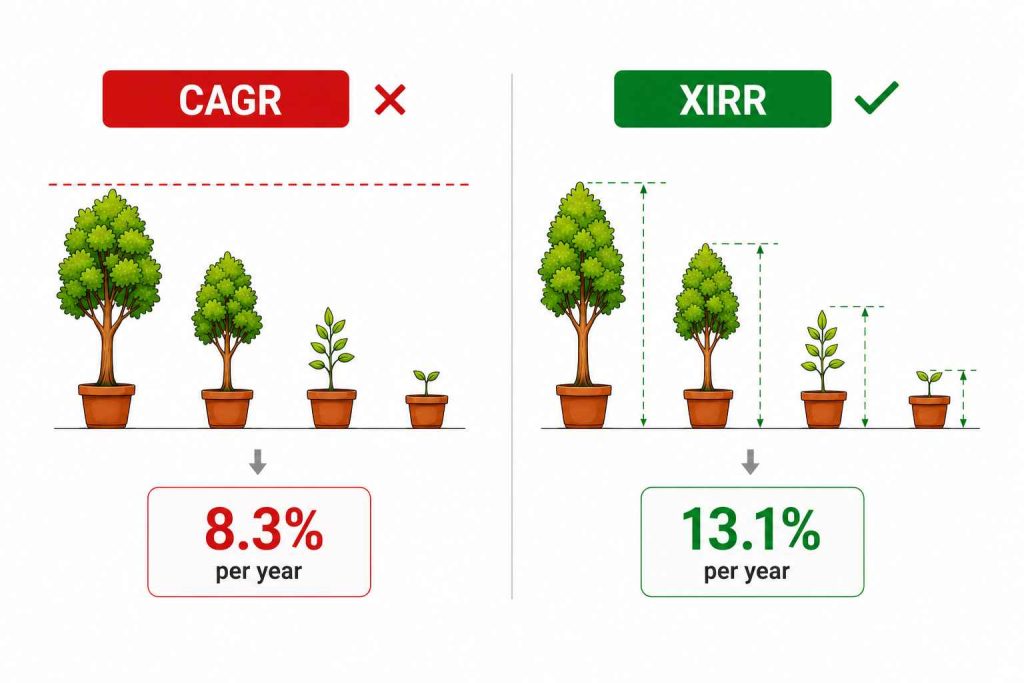
Assume you invested ₹5,000 per month in a large-cap mutual fund for three years.
Total invested: ₹1,80,000. Current value: ₹2,28,000.
| Metric | Calculation Basis | Number Shown |
| Absolute Return | (2,28,000 − 1,80,000) / 1,80,000 | 26.7% |
| CAGR | Treats full ₹1,80,000 as invested on day one | ~8.3% per year |
| XIRR | Each ₹5,000 instalment calculated separately | ~13.1% per year |
XIRR vs CAGR Table
The fund's own factsheet will show a 13–14% annualised return over three years. Your CAGR shows 8.3%. You feel shortchanged. But CAGR is simply the wrong tool for a SIP. Your XIRR of 13.1% is the correct comparison to the fund's stated return.
Why does CAGR understate the return? Because your first ₹5,000 invested three years ago has grown for 36 months. Your last ₹5,000 invested last month has grown for only one month. CAGR assumes all ₹1,80,000 sat in the fund for the full three years, which is mathematically false. XIRR accounts for the time each rupee actually spent in the market.
This distinction becomes even sharper if you made lump-sum top-ups or partial withdrawals along the way. CAGR cannot handle those at all. XIRR handles them natively.
You do not need to calculate XIRR manually. Every major Indian platform computes it automatically. But understanding the mechanics helps you read the number correctly.
XIRR solves for the rate r in this equation:
Sum of [ Cash Flow ÷ (1 + r)^(days/365) ] = 0
Each outflow, your SIP instalment, is a negative cash flow. Your current portfolio value is a positive cash flow dated today. The rate r that balances this equation is your XIRR.
Real example: A ₹5,000 SIP started in January 2022:
| Date | Cash Flow | Purpose |
| Jan 2022 | −₹5,000 | SIP instalment 1 |
| Feb 2022 | −₹5,000 | SIP instalment 2 |
| … | −₹5,000 | Other Monthly instalments |
| Dec 2024 | −₹5,000 | SIP instalment 36 |
| Dec 2024 | +₹2,28,000 | Current value (positive, dated today) |
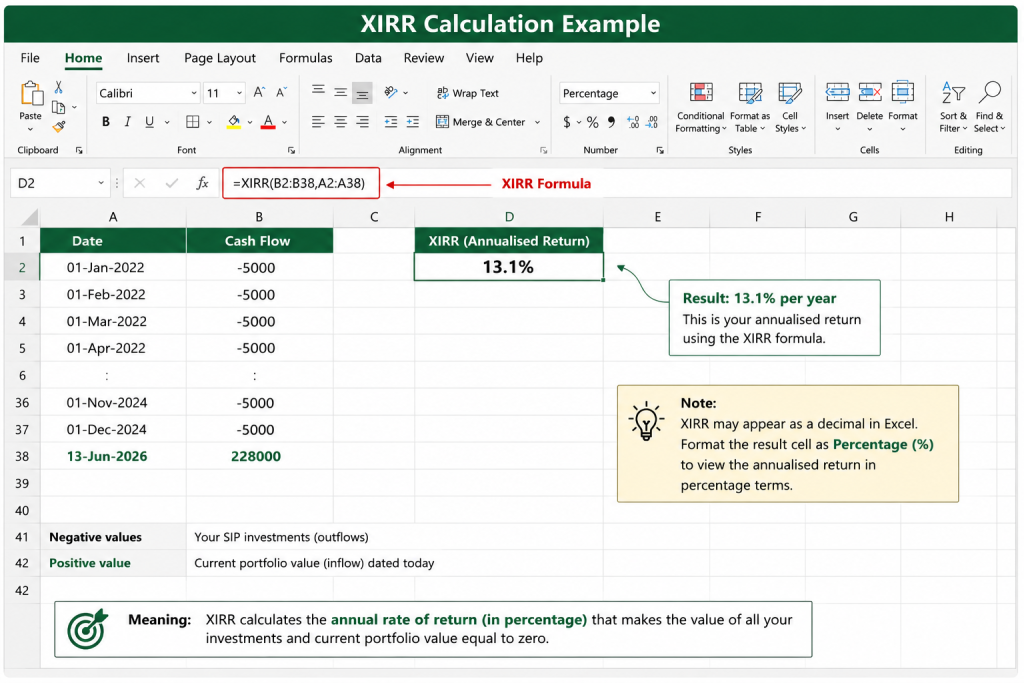
Run this through Excel's =XIRR() function or any platform's return calculator. The answer: approximately 13.1% per year.
This 13.1% is directly comparable to the fund's published annualised return. If the fund delivered 14% over the same period and your XIRR is 13.1%, the small gap is explained by the rupee-cost-averaging effect of SIP timing. This is because some months you bought at peaks and some at lows.
Excel / Google Sheets manual check: List all your SIP dates and amounts as negative values. Add your current portfolio value as a positive value dated today. Use =XIRR (values_range, dates_range). The formula returns a decimal, which you must then multiply by 100 for the percentage.
XIRR is the most accurate return metric available. But three common situations make it misleading. Every Indian retail investor should know these.
You started a SIP in 2020, paused it for eight months in 2022 due to a salary gap, then restarted. Your XIRR will look inflated if the pause happened during a market downturn, because cash flows during the dip are missing, and the eventual recovery appears as a larger gain relative to what you actually invested. The number is mathematically correct but does not reflect a deliberate strategy.
You redeemed your entire corpus in one month because markets hit a peak. XIRR will show an unusually high number for that period. This is accurate for that specific investment. But if you compare it to a peer who exited gradually over six months, your XIRR looks better even if the absolute gain was identical because a lump-sum exit concentrates the positive cash flow into a single high-value date.
XIRR is an annualised number. If your investment is less than 12 months old, XIRR annualises a partial year's gain into a full-year projection. A liquid fund that returned 6% in six months will show an XIRR of approximately 12% which is a projection, not a realised return. For investments under one year, always cross-check with absolute return.
The rule of thumb: trust XIRR fully for SIPs running longer than two years with no major interruptions. Treat it as directional, not definitive, for shorter or irregular investment histories.
To find your personal XIRR on Lakshmishree, follow these steps:
The XIRR shown on Varahi Wealth is calculated using the same methodology as any other consolidated statements. Every instalment date and amount is factored in, giving you the most accurate picture of your personal portfolio performance.
At Lakshmishree, we prioritize XIRR in our reporting because we believe investors deserve to know the internal truth of their capital, not just the market's headline numbers.
Indian investors often ask what XIRR number means their fund is performing well. Here are realistic benchmarks based on long-term historical data from NSE and AMFI.
| Fund Category | Expected XIRR (10-year SIP) | Context |
| Liquid / Overnight Funds | 5–6% | Better than savings account; not equity |
| Debt / Short Duration | 6–8% | Moderate; suitable for medium-term goals |
| Large-Cap Equity | 11–14% | Nifty 50 benchmark is the reference |
| Flexi-Cap / Multi-Cap | 12–16% | Broader market participation |
| Small-Cap Equity | 14–20% | Higher volatility; highest long-term XIRR |
| ELSS (Tax Saving) | 12–15% | 3-year lock-in; equity upside |
These are historical ranges, not guarantees. Market conditions, fund manager quality, and entry timing all affect your personal XIRR.
A common mistake is comparing your XIRR against the fund's point-to-point lump-sum return. That return assumes a single investment on day one. Your SIP-based XIRR will almost always differ (sometimes higher, sometimes lower) depending on how rupee-cost averaging plays out during your specific entry months.
The correct benchmark for your XIRR is: how did the fund's SIP return perform against its category average over the same period? AMFI's SIP return calculator provides this data by fund and period.
For understanding how direct plan choices affect your XIRR over time, read our guide on Regular vs Direct Mutual Fund.
The answer to what is XIRR in Mutual Funds: What It Really Means (And Why CAGR Gets It Wrong)answers is simple. Given that you put different amounts in on different dates, what single annualised rate explains where you ended up? No other metric does this for SIP investors.
Use it to compare your performance against the category average. If your XIRR is more than 3 percentage points below category over three years because that is when the fund deserves a second look.
If you want to track this without doing the calculation yourself, open your account on Shree Varahi. The XIRR is computed automatically for every scheme you hold.
XIRR is the annualised return on your mutual fund SIP. It calculates a separate return for every single instalment based on exactly how long that money stayed invested. This result is then blended into one number. This makes it far more accurate than CAGR for SIPs because it factors in the specific timing of every payment you made.
CAGR assumes you invested all your money at once on day one. XIRR treats each SIP instalment separately and gives you a blended annualised return accounting for when each rupee entered the fund. If you invest through SIP, XIRR is the number that correctly represents your personal experience.
XIRR ka matlab hai Extended Internal Rate of Return. Yeh aapke SIP ka woh annual return hai jo har instalment ki exact timing ko dhyan mein rakh kar calculate kiya jaata hai. Agar aap ₹5,000 har mahine lagaate hain, toh har instalment ka alag time period hota hai. XIRR, in sab ko combine karke, ek sahi annualised number deta hai. SIP investors ke liye yeh CAGR se kaafi zyada accurate hai.
A good XIRR depends on the fund category and market conditions. Historically, large-cap equity funds have delivered around 11–14% XIRR over long investment periods, while flexi-cap and small-cap funds may generate higher returns.
For investments longer than one year, XIRR provides a better measure of performance. For short-term investments, it is useful to review both XIRR and absolute returns together.
The difference occurs because XIRR in Mutual Funds is calculated using your actual SIP dates, investment amounts, and withdrawals. In contrast, a fund factsheet usually shows returns based on a hypothetical lump-sum investment. As a result, XIRR in Mutual Funds reflects your personal experience, while the fund's published return reflects the fund's overall performance.