
Stock market order types determine how your buy or sell instructions are executed on an exchange. Choosing the right order type can influence the price you pay or receive, the speed of execution, and the level of risk you take. Whether you're a beginner investor or an active trader, understanding different order types can help you execute trades more efficiently and make informed trading decisions in different market conditions.
A stock market order is an instruction given by an investor or trader to buy or sell a security through a broker or trading platform. Every trade begins with an order, which is sent to the stock exchange for execution.
Orders define how you want your trade to be executed. For example, you may want to buy or sell immediately at the current market price, trade only at a specific price, or exit a position automatically if the market moves against you.
Once an order is placed, it is forwarded to the stock exchange, such as the NSE or BSE, for processing. It remains pending until a matching buy or sell order is available.
When a matching order is found, the trade is executed. If the required conditions are not met, the order remains open until it is cancelled by the investor or expires based on its validity.
Choosing the right order type is just as important as choosing the right stock. Understanding different order types can help you:
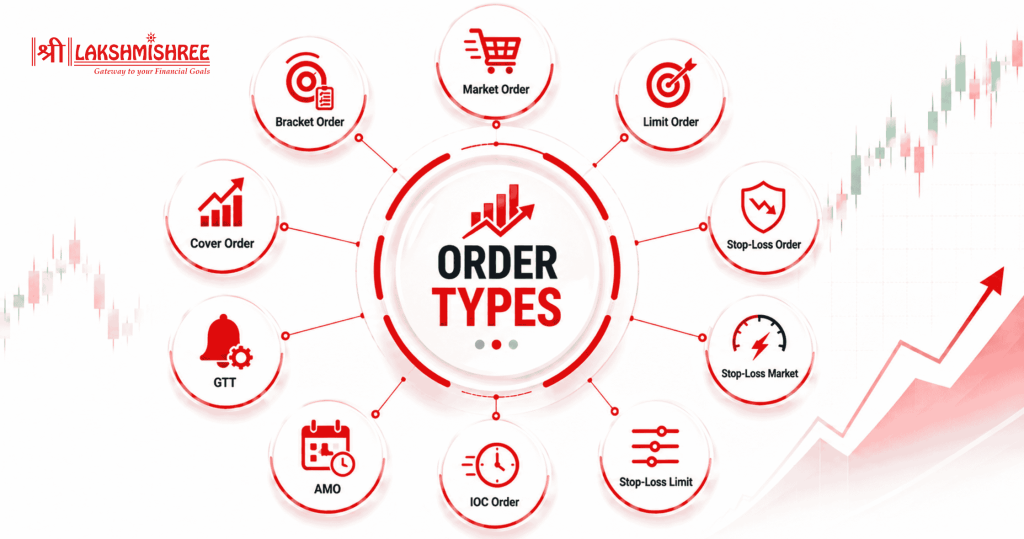
There is no single order type that works for every trade. Depending on whether you want quick execution, a specific buying or selling price, or better risk management, you can choose from different stock market order types. Below are the most commonly used order types and how they work.
A Market Order is an instruction to buy or sell a stock immediately at the best available market price. It prioritizes quick execution over price, making it one of the most commonly used order types.
When you place a Market Order, the exchange executes it against the best available buy or sell orders. The final execution price may differ slightly from the displayed price in volatile markets.
ABC Ltd. is trading at ₹1,200. You place a Market Order to buy 100 shares. The order is executed immediately at the best available market price.
A Limit Order allows you to buy or sell a stock at a price you specify. It provides better price control but does not guarantee execution.
A Buy Limit Order is placed below the current market price. It executes only if the stock falls to your specified price.
ABC Ltd. is trading at ₹1,200. You place a Buy Limit Order at ₹1,170. The order executes only if the stock reaches ₹1,170 or below.
A Sell Limit Order is placed above the current market price. It executes only if the stock reaches your target selling price.
ABC Ltd. is trading at ₹1,200. You place a Sell Limit Order at ₹1,250. The order will be executed only if the stock trades at ₹1,250 or higher.
A Stop-Loss Order helps limit potential losses by automatically triggering an order when a stock reaches a predefined price. It is widely used to protect capital and reduce emotional decision-making.
A Stop-Loss Order includes:
Suppose you buy shares of XYZ Ltd. at ₹500. To limit potential losses, you place a Stop-Loss Order with a trigger price of ₹470 and an order price of ₹468. If the stock price falls to ₹470, the stop-loss order is activated, and a sell order is placed at ₹468. The order will be executed if buyers are available at ₹468 or a higher price.
A Stop-Loss Market Order (SL-M) becomes a Market Order once the trigger price is reached. It focuses on quick execution rather than a fixed exit price.
A stock is trading at ₹850. You set an SL-M trigger at ₹820. When the stock reaches ₹820, the order is executed at the next available market price.
A Stop-Loss Limit Order (SL-L) becomes a Limit Order after the trigger price is reached. It offers better price control but does not guarantee execution.
You buy a stock at ₹900.
When the stock reaches ₹870, a Limit Order is placed at ₹868.
| Feature | SL-M | SL-L |
| Order Type | Market | Limit |
| Price Control | Low | High |
| Execution | Higher | Not Guaranteed |
An Immediate or Cancel (IOC) Order is an order that must be executed immediately, either fully or partially. If the entire quantity cannot be matched instantly, the unexecuted portion is automatically cancelled.
The exchange attempts to execute the order as soon as it is received. Any quantity that cannot be executed immediately is cancelled instead of remaining pending.
You place an IOC Order to buy 500 shares. If only 350 shares are available at your desired price, those shares are purchased immediately, while the remaining 150 shares are cancelled.
An After Market Order (AMO) allows investors to place buy or sell orders after the market closes. The order is stored by the broker and submitted to the exchange when the next trading session begins.
Instead of placing an order during market hours, you can place it after the market closes. The broker forwards it to the exchange when trading resumes.
You analyse a company's quarterly results after market hours and decide to buy its shares. You place an AMO, which is submitted when the market opens on the next trading day.

A Good Till Triggered (GTT) Order remains active until a predefined trigger price is reached or until it expires, depending on the broker's policy. It helps traders automate their entry or exit without monitoring the market continuously.
You set a trigger price for the order. Once the stock reaches that level, the order is automatically placed for execution.
A stock is trading at ₹950, but you want to buy it only if it falls to ₹900. You place a GTT Order with a trigger price of ₹900. When the stock reaches that price, the order is triggered automatically.
A Cover Order (CO) is an intraday order that requires traders to place a mandatory stop-loss along with the main order. It helps limit potential losses while trading.
When placing a Cover Order, you enter your trade along with a compulsory stop-loss order. If the market moves against your position, the stop-loss is triggered automatically.
Note: Cover Orders may not be available for all securities and are subject to broker and exchange policies.
A Bracket Order (BO) is an advanced order type that combines three orders in one: an entry order, a target order, and a stop-loss order. Once the entry order is executed, the target and stop-loss orders are placed automatically.
You buy a stock at ₹500.
If either the target or stop-loss is reached, the other order is automatically cancelled.
Note: Bracket Orders may not be available for all securities and are subject to broker and exchange policies.
| Order Type | Execution Speed | Price Control | Risk Control | Best For |
| Market Order | High | Low | Low | Immediate execution |
| Limit Order | Depends on price | High | Low | Trading at a preferred price |
| Stop-Loss Order | Trigger-based | Moderate | High | Limiting losses |
| Stop-Loss Market | High | Low | High | Quick exits |
| Stop-Loss Limit | Moderate | High | High | Controlled exits |
| IOC Order | Immediate | Moderate | Low | Intraday trading |
| AMO | Next trading session | Depends on order type | Low | After-market trading |
| GTT | Trigger-based | High | Moderate | Planned trades |
| Cover Order | High | Moderate | High | Intraday trading |
| Bracket Order | High | Moderate | High | Target-based trading |
Using the wrong order type can affect both trade execution and risk management. Here are some common mistakes to avoid:
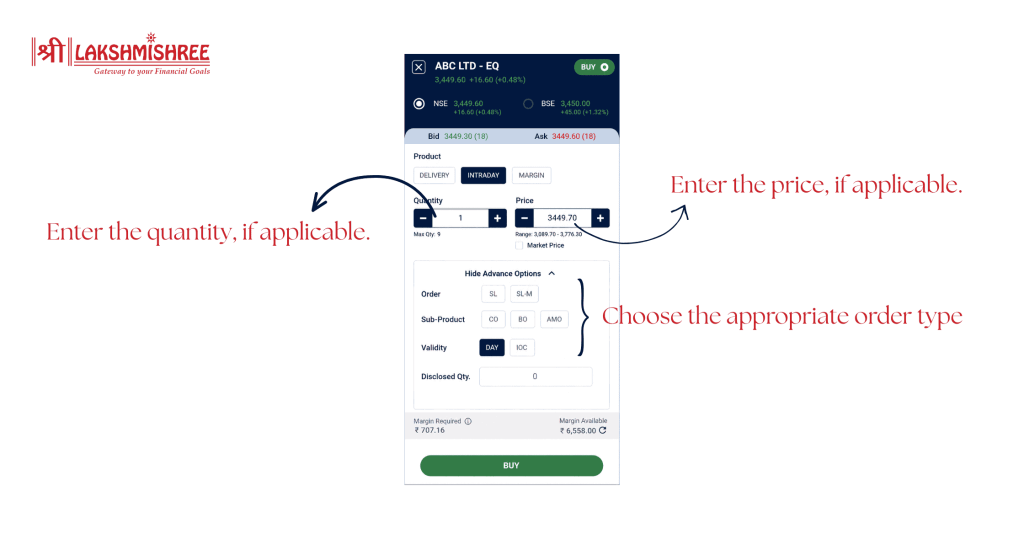
Placing an order through the Lakshmishree trading platform is simple.
Using the right order type can help you execute trades more efficiently while managing risk according to your trading strategy.
Understanding stock market order types is essential for every investor and trader. Whether your priority is quick execution, better price control, or effective risk management, choosing the right order type can improve your overall trading experience.
Beginners should start with commonly used order types such as Market Orders, Limit Orders, and Stop-Loss Orders, and gradually explore advanced options like IOC, AMO, GTT, Cover Orders, and Bracket Orders as they gain experience. By selecting the appropriate order type for different market situations and placing orders through the Lakshmishree trading platform, you can trade with greater confidence and discipline.
Stock market order types are instructions that determine how a buy or sell order is executed on the stock exchange.
Beginners generally start with Market Orders and Limit Orders because they are simple and widely used.
A Stop-Loss Order automatically triggers a buy or sell order when a stock reaches a specified trigger price, helping limit potential losses.
An AMO allows investors to place orders after market hours, which are submitted to the exchange when trading resumes.
A GTT (Good Till Triggered) Order remains active until a specified trigger price is reached or the order expires, depending on the broker's policy.
No. The availability of Cover Orders and Bracket Orders depends on the broker, the exchange, and the security being traded. Always check the features available on your trading platform before placing these orders.
Disclaimer: This article is intended for educational purposes only. Please note that the data related to the mentioned companies may change over time. The securities referenced are provided as examples and should not be considered as recommendations.