
Income tax on F&O trading in India is something every trader should understand, whether they are in profit or in loss. The good news is that the rules are simple once you know them. Even your losses can work in your favour.
SEBI studies show that over 90% of individual F&O traders have faced losses. Because of this, many assume there is nothing to report. That is a myth. Under Section 43(5) of the Income Tax Act, F&O income is treated as non-speculative business income. You report it under PGBP (Profits and Gains from Business or Profession), whether you made a profit or a loss.
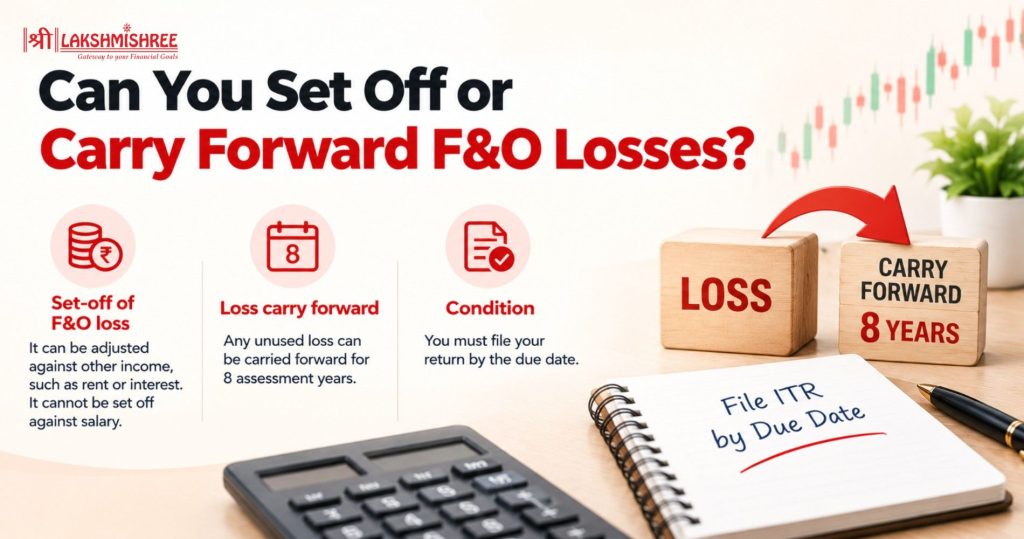
Reporting is not just a legal duty. It is also a smart move. Declared losses can be set off against other income. They can also be carried forward for up to 8 years. Skipping it can invite notices, because your trades appear in your AIS.
This guide explains F&O taxation in India in plain language. You will learn how profits are taxed, how to calculate turnover, which form to file and when an audit applies.
Once your F&O income is reported as business income, the next question is the tax rate. The answer is simple.
Your F&O profit is added to your other income for the year. The total is then taxed at your normal slab rate. There is no special flat rate for traders.
For example, say you earn ₹11 lakh from a job and make ₹3 lakh profit from F&O. Your total income becomes ₹14 lakh. Tax is calculated on that amount.
Your choice of tax regime also matters. Deductions like Section 80C are available only in the old regime. Taxpayers with business income also face limits on switching regimes. Check this with a CA before you decide.
Here is how F&O compares with other types of trading:
| Type of trading | Tax category | How it is taxed |
| F&O trading | Non-speculative business income | Slab rate |
| Intraday equity | Speculative business income | Slab rate |
| Delivery-based equity | Capital gains | Short-term or long-term rates |
The Income Tax Act, 2025 came into force on 1 April 2026. The classification of F&O income remains the same. Returns for FY 2025-26 are still filed under the older provisions.
Turnover decides two things. It tells you whether you need a tax audit and whether you can use presumptive taxation. This is where many beginners go wrong.
Turnover is not the total value of your contracts. As per the ICAI guidance note on tax audits, it is the sum of absolute profits and losses from each trade.
Premium received on selling options is not added to turnover. This rule has applied since AY 2022-23.
Why does this matter? Your contract value can run into crores, even with small trades. But your turnover for tax purposes may be only a few lakhs. Using the wrong number can create a false tax demand.
Take four trades in a year:
| Trade | Profit / Loss (₹) | Absolute value (₹) |
| Trade 1 | +5,000 | 5,000 |
| Trade 2 | –2,000 | 2,000 |
| Trade 3 | +3,000 | 3,000 |
| Trade 4 | –1,000 | 1,000 |
| Total | +5,000 (net profit) | 11,000 (turnover) |
Your net profit is ₹5,000. Your turnover is ₹11,000.
Your broker's P&L statement usually shows each trade's result. You can use it for this calculation.
Presumptive taxation under Section 44AD is an optional scheme. You declare a fixed share of your turnover as profit. You do not have to maintain full books of accounts.
Here is how it works:
Take our example. With turnover of ₹11,000, you would declare at least ₹660 as profit. This is true even if your actual profit is lower.
It depends on your trading results.
Check eligibility with a CA before choosing this route.
Since F&O is a business, you can deduct costs linked to it. Claiming these allowable expenses is one of the simplest ways to reduce income tax on F&O trading in India.
Common examples include:
Keep bills and invoices for each claim. Unsupported claims can be rejected during scrutiny.
Personal expenses are not allowed. If you use your phone for both work and trading, claim only the trading share.

Securities Transaction Tax (STT) is charged on F&O trades. Your broker collects it automatically.
The Union Budget 2026 raised STT on F&O from 1 April 2026.
| Segment | Earlier rate | New rate |
| Futures (sell side) | 0.02% | 0.05% |
| Options premium (sell side) | 0.10% | 0.15% |
| Options exercise | 0.125% | 0.15% |
Related Reading: STT Rates in India 2026: Equity, F&O & Intraday Charges
Most F&O traders should file the ITR-3 form. It is meant for people with business income.
ITR-4 is only for those who choose presumptive taxation under Section 44AD. It is not meant for traders who want to report actual losses.
Filing ITR-1 or ITR-2 is a common error. It can lead to a defective return notice. You would then have to correct and refile.
Follow these steps to complete your income tax on F&O trading in India filing without errors.
E-verification is important. A return without it is treated as not filed.

Audit rules are the part of income tax on F&O trading in India that worries most beginners. The good news is that a tax audit is not always needed. Under Section 44AB, it depends on your turnover and your tax scheme.
Many traders fear that a loss means an audit. That is a myth. A loss alone does not trigger one.
| Situation | Audit needed? |
| Turnover above ₹10 crore (with 95% or more digital transactions) | Yes |
| Turnover within the limit, no presumptive scheme used | Generally no |
| Opted for Section 44AD, then opted out within 5 years, with income above the exemption limit | Yes |
Since F&O trades settle through banks, they are normally digital. This is why the ₹10 crore limit usually applies.
If an audit applies, your CA must upload the audit report before you file your return. Plan for this in advance.
A loss is not wasted. You can use it to reduce your tax.
For example, say you lose ₹3 lakh in F&O and earn ₹5 lakh from rent. Your taxable rental income can come down to ₹2 lakh after set-off.
Filing late means you lose the right to carry the loss forward. This is one of the costliest mistakes a trader can make.
Intraday equity loss works differently. It is speculative, so it can only be set off against speculative income.
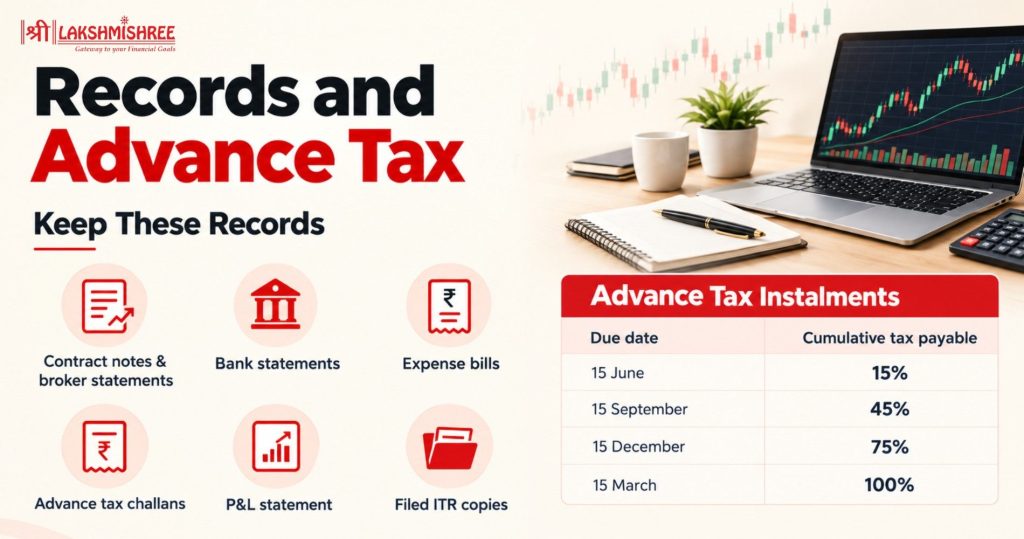
Good records make filing easy. They also protect you if you receive a notice.
Keep these documents safe:
Since F&O income is business income, no employer deducts tax for you. You must pay advance tax during the year if your total tax liability, after TDS, is ₹10,000 or more.
Advance tax is paid in four instalments. Each due date has a cumulative target:
| Due date | Cumulative tax payable |
| 15 June | 15% |
| 15 September | 45% |
| 15 December | 75% |
| 15 March | 100% |
“Cumulative” means the percentage covers the total paid up to that date, not a fresh amount each time. For example, if your yearly tax is ₹1,00,000, you should have paid ₹15,000 by 15 June and ₹45,000 in total by 15 September.
Paying advance tax on time keeps your income tax on F&O trading in India in order and helps you avoid interest. Since F&O income is uneven, revisit your estimate at each due date and adjust the next instalment.
Missing or underpaying instalments can lead to interest under Sections 234B and 234C. If you opt for presumptive taxation, you can pay the entire advance tax in one go by 15 March.
Many traders face notices because of simple errors. Avoid these:
Income tax on F&O trading in India is easier than it looks. Treat your income as non-speculative business income.Work out your turnover correctly. File ITR-3 form before the due date.
Keep your records and expense bills in order. Filing on time also keeps your loss carry-forward safe. If your case feels complicated, a chartered accountant can guide you.
Yes.A trading loss does not automatically exempt you from filing a return. Your filing obligation depends on your overall income and the applicable provisions. Filing within the prescribed deadline is generally necessary to carry forward eligible business losses.
F&O traders generally use ITR-3 to report income and losses from trading as a business, subject to the applicable filing rules.
No. F&O trading losses classified as non-speculative business losses cannot be set off against salary income. However, eligible losses may be adjusted against other permitted income, subject to applicable tax rules. Unadjusted losses may be carried forward if the prescribed conditions, including timely ITR filing, are met.
There is no separate flat tax rate for F&O profits. Net taxable income from eligible futures and options trading is generally treated as non-speculative business income and taxed according to the applicable income tax slab rates under the tax regime you choose. Eligible business expenses may be deducted when calculating taxable profit.
Yes. Eligible F&O business losses can generally be carried forward for up to eight assessment years under the applicable rules, provided the relevant conditions, including timely filing requirements, are met.
Disclaimer: This article is for general educational purposes and does not constitute tax or legal advice. Tax treatment depends on the applicable law and individual circumstances. Consult a qualified tax professional for advice specific to your case.