
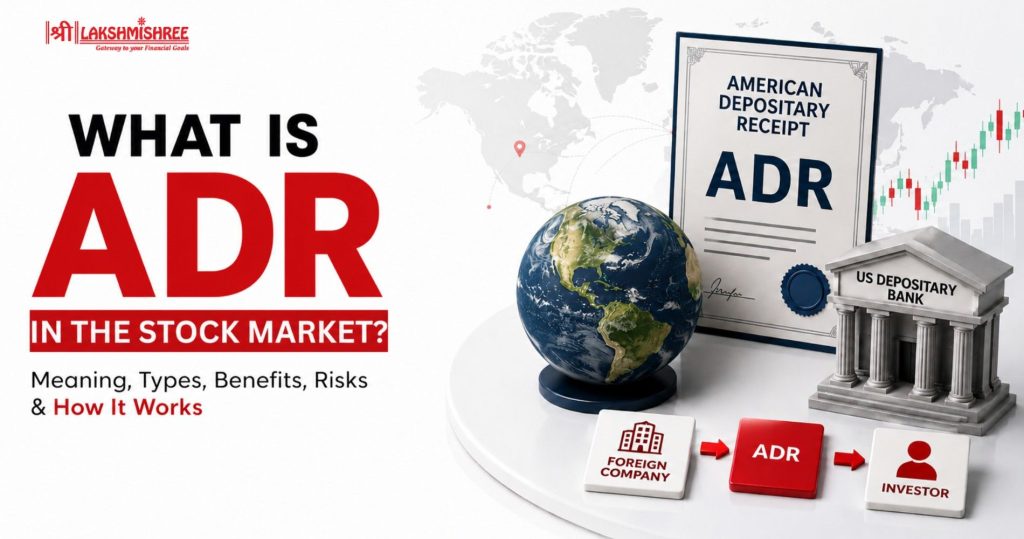
Investing is no longer limited to companies listed in your home country. Today, investors can explore businesses from different parts of the world and add international exposure to their portfolios. But buying foreign stocks directly may involve different exchanges, currencies, processes and found its home-country stock exchange difficult to access. This is where what is ADR in stock market becomes relevant. ADRs provide a way to access eligible foreign companies through the US market.
Let’s understand how they work, their types, benefits and risks.
An American Depositary Receipt is a US-traded security that represents an ownership interest in shares of a foreign company. These underlying shares are held by a custodian in the company’s home country, while a US depositary bank issues the ADRs.
In simple terms, ADRs allow investors to access eligible foreign companies through the US stock market without directly buying shares on the company’s home-country exchange.
They are generally traded in US dollars and may be listed on exchanges such as the NYSE or Nasdaq, or traded through the OTC market, depending on the ADR program.
Importantly, an ADR is not the foreign company’s ordinary share listed directly in the US. It is a separate security representing an interest in the underlying foreign shares.
Related Reading: What is a Depository in the Stock Market? | Depository Participant - Step-By-Step Guide
An American Depositary Receipt (ADR) allows investors to trade shares of a foreign company in the US market without directly purchasing the company’s shares on its home-country exchange.
The process works as follows:
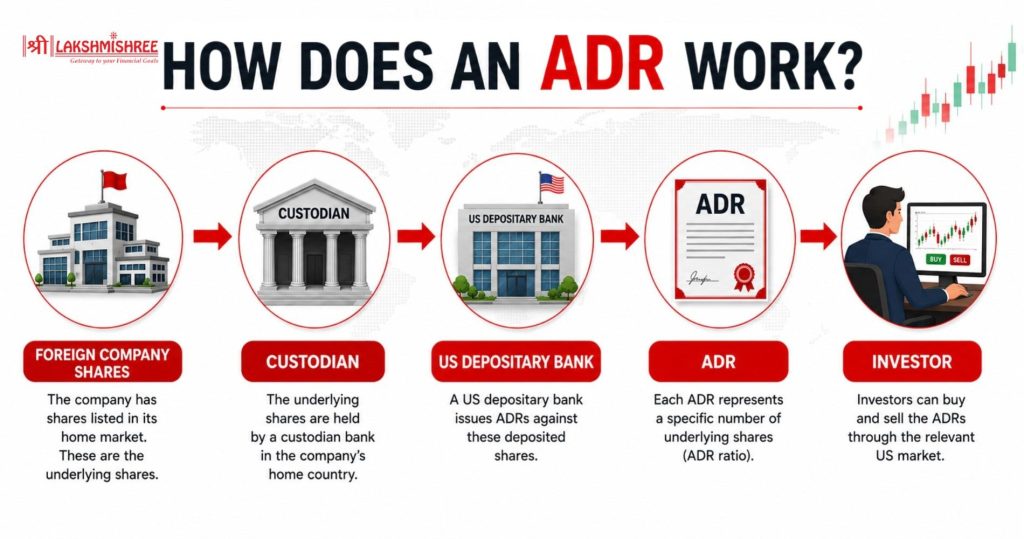
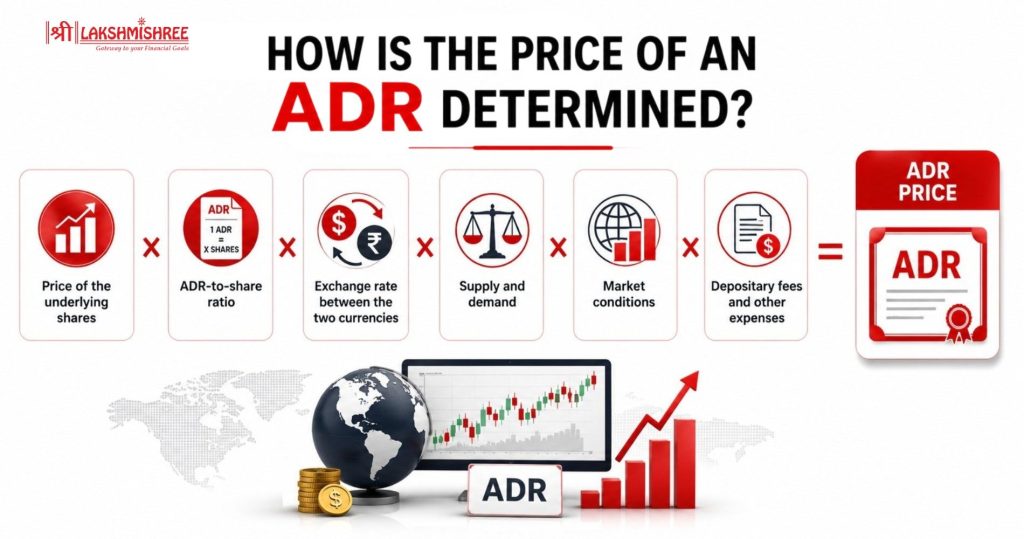
The price of an ADR is linked to the value of the underlying foreign shares, but it is not necessarily a one-to-one match. ADR pricing is influenced by factors such as the underlying share price, ADR ratio, exchange rate, supply and demand, market conditions, and applicable depositary fees or other expenses.
Suppose a foreign company's share is priced at ₹3,000, one ADR represents two underlying shares, and the USD/INR exchange rate is ₹85.
The approximate theoretical value of one ADR would be:
₹3,000 × 2 ÷ ₹85 = $70.59
Therefore, one ADR would have a theoretical value of approximately $70.59, before considering fees, currency fluctuations, market conditions, and other factors.
The actual ADR market price may differ from this theoretical value due to supply and demand, trading conditions, currency movements, and market sentiment. This is why investors should always check the ADR ratio before comparing an ADR's price with the price of its underlying foreign shares.
Depending on the ADR program, holders may also receive dividends, subject to applicable fees, taxes, and the terms of the program.
Level 1 ADRs are the simplest type of ADR program.
They establish a trading presence in the US but cannot be used by the foreign company to raise capital through the ADR program. Level 1 ADRs are traded in the OTC market rather than on a national US stock exchange. They may also be sponsored or, uniquely among the three levels, unsponsored.
For investors, this can mean less exchange visibility and potentially lower liquidity than exchange-listed ADRs.
Level 2 ADRs allow a foreign company to establish a presence on a US national securities exchange.
These ADRs can be listed on exchanges such as the NYSE or Nasdaq. They involve greater US regulatory and reporting requirements than Level 1 programs. However, they do not allow the company to raise capital through the ADR program.
Level 3 ADRs provide the foreign company with a way to establish a US market presence and raise capital through the ADR offering.
Because of this, Level 3 programs involve more extensive registration and disclosure requirements.
ADRs can also be classified as sponsored or unsponsored.
A sponsored ADR is established with the involvement of the foreign company and a depositary bank under a deposit agreement.
An unsponsored ADR, in contrast, can be established by a depositary institution without the direct participation of the foreign company. Level 1 is the only ADR level that can be unsponsored.
Trading an ADR is similar to buying and selling other US-listed securities.
For Indian investors, applicable overseas investment rules, taxes, currency conversion charges and brokerage fees should also be considered.

Currency Risk: Changes in exchange rates can affect the value of an ADR and the investor's overall returns.
Market Risk: ADR prices can fall due to changes in the company's performance, industry conditions or broader market movements.
Political and Regulatory Risk: Political or regulatory changes in the foreign company's home country can affect its business and stock value.
Liquidity Risk: Some ADRs may have lower trading volumes, making them harder to buy or sell at the desired price.
ADR Fees: Depositary banks may charge fees for maintaining the ADR program and processing certain transactions or dividends.
Delisting or Program Termination Risk: Changes or termination of an ADR program can affect investors and their ability to trade the security.
Tax Complexity: Dividends, capital gains and other tax obligations may involve rules from both the foreign country and the investor's home country.
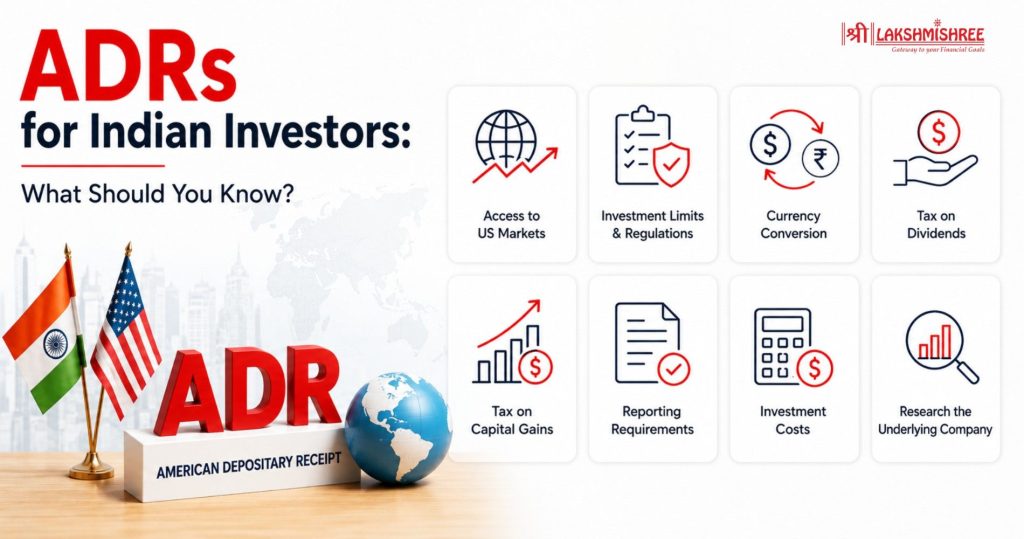
For Indian investors, ADRs can be a way to gain exposure to eligible foreign companies through the US market. Before investing, it is important to understand how ADRs fit into the Indian investor’s overall investment process.
Note: Tax and regulatory rules can change. Indian investors should verify the latest applicable requirements before making an ADR investment.
Understanding what is ADR in stock market can help investors explore international investment opportunities through the US market. ADRs provide access to eligible foreign companies and can support portfolio diversification.
However, investors should consider the ADR ratio, pricing, currency movements, fees, liquidity and tax implications before investing. For Indian investors, checking applicable investment and tax regulations is also important. Researching the underlying company and understanding the risks can help investors make informed investment decisions.
ADR stands for American Depositary Receipt. It is a US-traded security that represents an ownership interest in shares of a foreign company.
No. An ADR is a US-traded security that represents an interest in underlying shares of a foreign company. It is not the same as directly purchasing the company's ordinary shares on its home-country exchange.
A foreign company's shares are held with a custodian in its home country. A US depositary bank then issues ADRs representing those shares. Investors can buy and sell the ADRs through the relevant US market.
Yes. ADRs can be affected by market volatility, currency movements, political and regulatory changes, liquidity issues, fees and tax considerations.
Some ADRs pay dividends when the underlying foreign company distributes them. However, the amount received may be affected by applicable taxes, currency conversion and depositary fees.
Eligible Indian investors may be able to invest in ADRs through platforms or brokers that provide access to international securities. Before investing, they should check the applicable overseas investment, tax, reporting and currency-related requirements.
An ADS represents the ownership interest in the deposited foreign shares. An ADR is the receipt or certificate evidencing that interest. In everyday investing, however, the terms are often used interchangeably.
Disclaimer: This article is for educational and informational purposes only and does not constitute investment advice or a recommendation to buy or sell any specific security. Investing in stocks involves market risk. Past performance is not indicative of future results. Please conduct your own due diligence before making any investment decisions.