
DCF valuation helps investors assess what a company may be worth based on the cash it is expected to generate in the future. It considers the time value of money by converting future cash flows into their value today.
For stock market investors, this approach can help compare a company’s estimated intrinsic value with its current market price and identify whether the stock may be potentially undervalued or overvalued.
Related Reading: Current Market Price | P/B Ratio
DCF (Discounted Cash Flow) valuation estimates what an investment is worth today based on its expected future cash flows.
The basic principle is:
Future Cash Flows → Discount to Present Value → Estimated Intrinsic Value
It considers the time value of money. For example, ₹100 received today is generally more valuable than ₹100 received after three years because today’s money can potentially generate returns.
DCF valuation is commonly used for:
It is important to distinguish market price from intrinsic value. Market price is the current trading price, while intrinsic value is an estimate based on expected future financial performance.
DCF does not provide a guaranteed future stock price. Its result depends on the assumptions used.
Step 1: Estimate Future Cash Flows
Step 2: Calculate Present Value
Step 3: Calculate Terminal Value
Step 4: Discount Terminal Value
Step 5: Calculate Enterprise Value
Step 6: Calculate Equity Value
Step7: Calculate Intrinsic Value Per Share
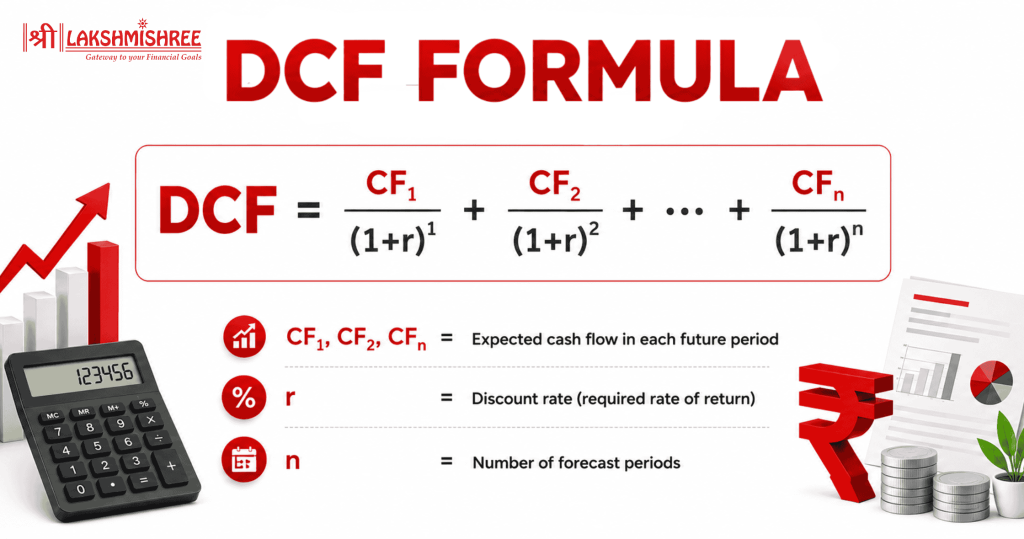
The basic DCF formula is:
DCF = CF₁/(1+r)¹ + CF₂/(1+r)² + … + CFₙ/(1+r)ⁿ
Where:
The formula discounts each future cash flow back to its present value.
Suppose ABC Ltd. is expected to generate free cash flows over the next five years at a 10% discount rate.
Estimate the cash the company is expected to generate during the forecast period.
| Year | Expected Cash Flow |
| Year 1 | ₹10,000 |
| Year 2 | ₹12,000 |
| Year 3 | ₹14,000 |
| Year 4 | ₹16,000 |
| Year 5 | ₹18,000 |
Next, we convert these future cash flows into their present value, which means what those future amounts are worth today.
This is done using a discount rate. The discount rate represents the return investors require for taking the risk of investing in the company.
Present Value = Future Cash Flow ÷ (1 + Discount Rate)ⁿ
The present value of each year's cash flow is then added together.
Terminal value estimates the company's value beyond the forecast period.
It can be calculated using:
Since terminal value represents a future amount, it is also converted into its present value using the discount rate.
Enterprise value represents the estimated value of the company's entire operating business, considering both its future cash flows and terminal value.
Enterprise Value = Present Value of Future Cash Flows + Present Value of Terminal Value

To find the value attributable to shareholders, we adjust enterprise value for the company's debt and cash.
Equity Value = Enterprise Value − Debt + Cash
Intrinsic value is the estimated fair value of the company's shares based on the DCF analysis.
It is calculated as:
Intrinsic Value Per Share = Equity Value ÷ Outstanding Shares
The estimated intrinsic value can then be compared with the stock's current market price.
WACC (Weighted Average Cost of Capital) is commonly used as the discount rate in company-level DCF valuation. It represents the average return expected by a company's debt and equity providers.
In simple terms, WACC helps reflect the cost and risk of financing the business. A higher WACC generally lowers the DCF value, while a lower WACC generally increases it.
Let us bring the calculation together with the example of ABC Ltd.
The company is expected to generate cash flows of ₹ 10,000 cr, ₹ 12,000 cr, ₹ 14,000 cr, ₹ 16,000 cr, and ₹ 18,000 cr over five years. With a 10% discount rate, the present value of these cash flows is approximately ₹51,631.
Assume the terminal value is ₹3,12,000. After discounting it to the present, its value becomes approximately ₹1,93,625.
Therefore:
Enterprise Value = ₹51,631 + ₹1,93,625
= ₹2,45,256
Now assume ABC Ltd. has ₹30,000 in debt and ₹20,000 in cash.
Equity Value = ₹2,45,256 − ₹30,000 + ₹20,000
= ₹2,35,256
If the company has 10,000 outstanding shares:
Intrinsic Value Per Share = ₹2,35,256 ÷ 10,000
= ₹23.53
Therefore, the estimated DCF value is ₹23.53 per share based on these assumptions.
This example shows why DCF valuation is sensitive to assumptions. A change in expected cash flows, growth rate or discount rate can significantly change the final value.
DCF valuation can help investors compare an estimated intrinsic value with the current market price.
| DCF Value vs Market Price | Possible Interpretation |
| DCF Value > Market Price | Potentially undervalued |
| DCF Value < Market Price | Potentially overvalued |
| DCF Value ≈ Market Price | Potentially fairly valued |
For example, if the estimated DCF value is ₹500 and the stock trades at ₹400, the stock may appear undervalued based on the assumptions.
However, this does not automatically mean an investor should buy it. The ₹500 estimate may change if revenue growth, margins, cash flows or the discount rate changes.
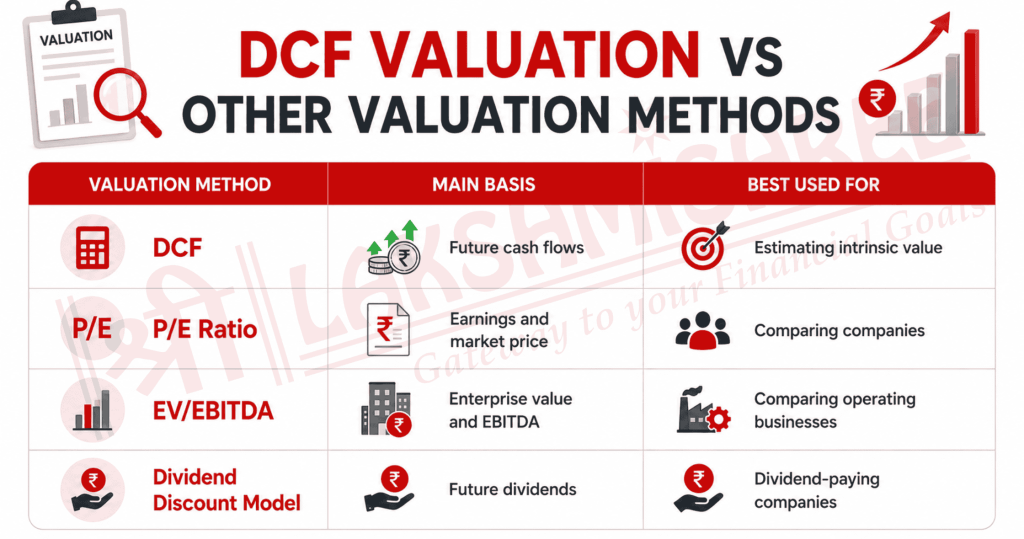
| Valuation Method | Main Basis | Best Used For |
| DCF | Future cash flows | Estimating intrinsic value |
| P/E Ratio | Earnings and market price | Comparing companies |
| EV/EBITDA | Enterprise value and EBITDA | Comparing operating businesses |
| Dividend Discount Model | Future dividends | Dividend-paying companie |
An investor can use DCF valuation to estimate a stock's intrinsic value and compare it with its market price.
For example, if the estimated intrinsic value is ₹800 and the stock trades at ₹600, the investor may investigate whether the difference represents a genuine opportunity or simply reflects overly optimistic DCF assumptions.
A stronger analysis can combine DCF with:
This provides a broader picture of the company's financial health and future prospects.
DCF valuation is a fundamental-analysis method for estimating a company’s intrinsic value from its expected future cash flows. It discounts these cash flows to their present value and considers value beyond the forecast period through terminal value.
However, DCF depends on its assumptions. Growth rates, cash flows, discount rates and terminal value can significantly affect the result.
For investors, DCF works best alongside financial analysis, industry research and other valuation methods. It should be used as a framework for informed decisions, not a guaranteed price target.
DCF valuation estimates what a company or investment may be worth today based on the present value of its expected future cash flows.
The basic formula is DCF = CF₁/(1+r)¹ + CF₂/(1+r)² + … + CFₙ/(1+r)ⁿ, where CF represents future cash flow and r represents the discount rate.
Yes. DCF can help investors estimate a stock's intrinsic value and compare it with its current market price. However, it should not be the only basis for an investment decision.
It may indicate that the stock is potentially undervalued based on the assumptions used in the DCF model. Investors should examine those assumptions before drawing a conclusion.
Neither method is universally better. DCF focuses on expected future cash flows, while P/E compares a company's market price with its earnings. Using both methods can provide a broader valuation perspective.
Disclaimer: This article is for educational and informational purposes only and does not constitute investment advice or a recommendation to buy or sell any specific security. Investing in stocks involves market risk. Past performance is not indicative of future results. Please conduct your own due diligence before making any investment decisions.