
When you look at a stock, the first thing you may notice is its price, recent movement, profit, but a good stock is not just about a famous company or a rising share price.
What matters is how well the company uses its money to generate profit. A business may earn high profits, but if it needs too much capital to earn them, it may not be as efficient as it looks.
This is where what is ROE becomes useful. ROE helps you understand whether a company is using shareholders’ money to proper use. For Indian investors, it can be an important ratio to check before buying a stock, especially when comparing companies from the same sector.
In this blog, we will understand what ROE means in the stock market, how it is calculated, why it matters, and how investors should use it before buying shares. Since ROE is one of the basic financial terms investors come across while learning stock analysis, understanding common stock market terminology can make these ratios easier to read.
ROE, or Return on Equity, is a financial ratio that shows how much return a company generates on its shareholders’ equity.
When you buy shares of a company, you become a part-owner of that business. So, it is important to know whether the company is using shareholders’ funds in the right way.
A company may use this money to run operations, expand the business, launch new products, repay debt, or generate profits. ROE helps investors understand how the company is using the equity available in the business to generate returns.
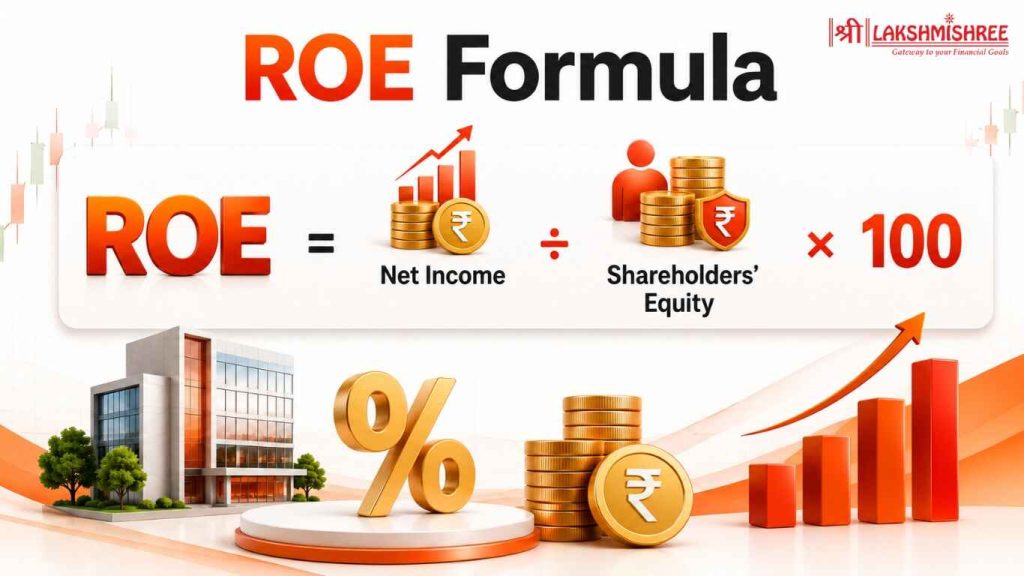
The formula for ROE is:
ROE = Net Income ÷ Shareholders’ Equity × 100
Here:
Net Income means the company’s final profit after expenses, interest, and taxes.
Shareholders’ Equity means the company’s net worth that belongs to shareholders. The same equity value is also used to understand book value per share.
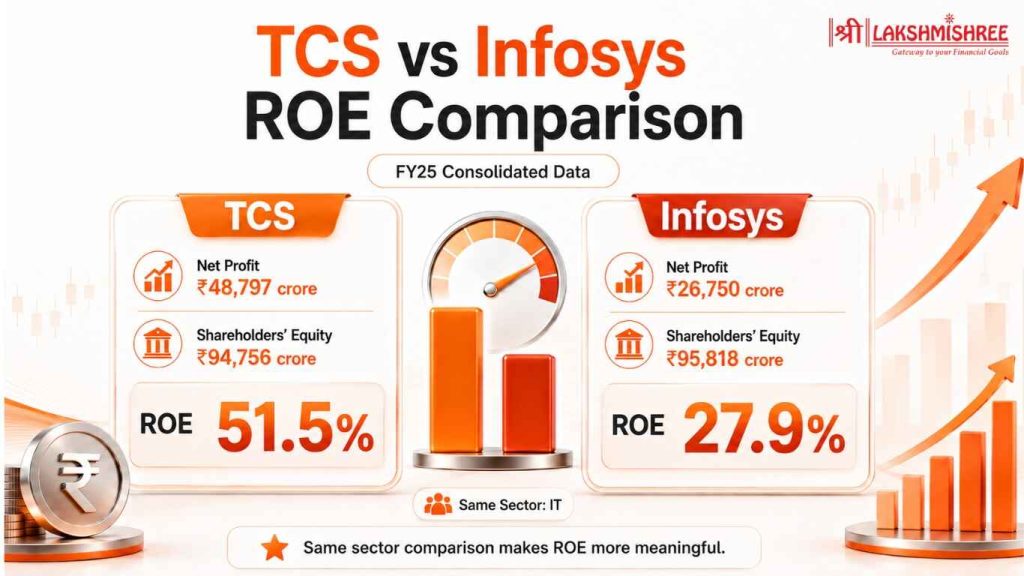
Let’s understand ROE with two IT companies, TCS and Infosys, using FY25 consolidated data.
| Particulars | TCS | Infosys |
| Net Profit | ₹48,797 crore | ₹26,750 crore |
| Total Assets | ₹1,58,649 crore | ₹1,47,795 crore |
| Total Liabilities | ₹63,893 crore | ₹51,977 crore |
| Shareholders’ Equity Method 1 | Total Assets – Total Liabilities | Total Assets – Total Liabilities |
| Shareholders’ Equity | ₹94,756 crore | ₹95,818 crore |
| Equity Share Capital | ₹362 crore | ₹2,073 crore |
| Reserves | ₹94,394 crore | ₹93,745 crore |
| Shareholders’ Equity Method 2 | Equity Share Capital + Reserves | Equity Share Capital + Reserves |
| Shareholders’ Equity | ₹94,756 crore | ₹95,818 crore |
| ROE Calculation | 48,797 ÷ 94,756 × 100 | 26,750 ÷ 95,818 × 100 |
| ROE | 51.5% | 27.9% |
Shareholders’ equity can be calculated in two ways:
Method 1:
Shareholders’ Equity = Total Assets – Total Liabilities
Method 2:
Shareholders’ Equity = Equity Share Capital + Reserves
Both methods give the same shareholders’ equity value. After that, ROE is calculated by dividing net profit by shareholders’ equity and multiplying it by 100.
In this example, TCS has an ROE of 51.5%, while Infosys has an ROE of 27.9%. This means TCS generated a higher return on its shareholders’ equity in FY25. However, this does not mean you should buy TCS only because its ROE is higher. ROE does not tell you which stock to buy. It only helps you understand how efficiently a company used its equity during that period.
You may want one fixed number to decide whether ROE is good or bad, but ROE does not work the same way for every company.
| ROE Range | What It May Indicate |
| Below 10% | Low return on shareholders’ equity |
| 10%–15% | Decent performance |
| 15%–20% | Good return, if consistent |
| Above 20% | Strong return, if supported by healthy fundamentals |
However, this table should not be used blindly. When you see a company with 20% ROE, don’t stop at the number. Check whether that return is stable and supported by healthy fundamentals. A good ROE depends on the type of business and the industry in which the company operates.
It can also be useful to compare ROE with the Price-to-Book Ratio, as both help investors understand how the market values the company against its book value.
ROE is useful because it helps investors look beyond the company’s stock price and profit numbers. It gives a clearer view of how the company is using shareholders’ equity to generate returns.
Here’s why investors check ROE before buying a stock:
Profit alone does not show the full picture. Two companies may earn the same profit, but the company that earns it with lower equity will have a better ROE. This helps you understand the quality of profits.
ROE becomes more meaningful when two companies from the same industry are compared. If one company consistently has higher ROE than its peers, it may indicate stronger operations, better margins, or better use of resources.
For long-term investors, one-year ROE is not enough. A company that maintains healthy ROE over several years may show better stability than a company whose ROE keeps changing sharply.
A rising stock price does not always mean the business is strong. ROE helps you focus on the company’s financial performance instead of only following market movement.
No, high ROE does not guarantee high stock returns.
ROE tells you about the company’s performance, but stock returns depend on valuation, growth, market conditions, and the price at which investors buy the stock.
Even a high-ROE company may give limited returns if the stock is already very expensive. On the other hand, a company with improving ROE and reasonable valuation may become more attractive for investors.
So, ROE should be seen as a business-quality indicator, not a guaranteed return number.
A high ROE may look attractive, but before you trust the number, check what is supporting it. In the Indian stock market, ROE becomes more useful when it is studied with consistency, debt levels, business growth, and cash flow.
Debt also matters here because higher borrowing can sometimes make ROE look better than it actually is. This is why the Debt to Equity Ratio should be checked along with ROE before judging a company’s financial strength.
The TCS and Infosys example above works well here because both companies belong to the IT sector. Since their business models are similar, the difference in ROE becomes easier to understand.
However, ROE should not be compared blindly across different industries. An IT company and a power or manufacturing company may have very different capital requirements, so their ROE numbers may not tell the same story.
That is why ROE works best when the comparison is made between companies with similar business models and industry conditions. Without that context, the number may look stronger or weaker than it actually is.
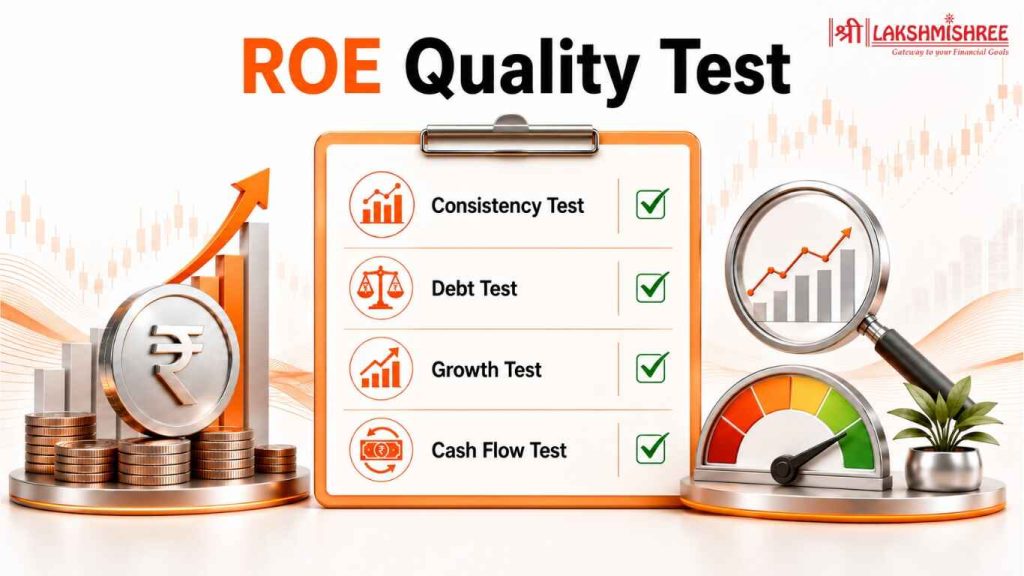
A useful way to read ROE is to ask a few follow-up questions instead of accepting the number directly.
| Test | What to Check | Why It Matters |
| Consistency Test | Has ROE remained stable over the years? | One good year may not show real business strength. |
| Debt Test | Is the company using too much debt? | Borrowing can increase ROE without showing real business strength. |
| Growth Test | Are sales and profits growing? | ROE is stronger when supported by business growth. |
| Cash Flow Test | Is the company generating healthy cash flow? | Profits should also convert into real cash. |
This test helps you understand whether ROE is backed by real business strength.
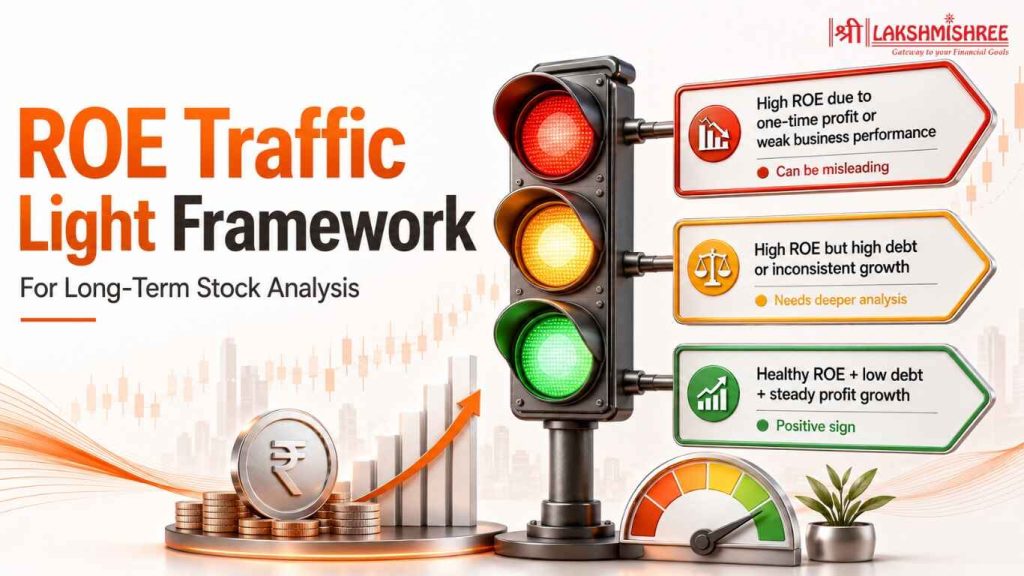
A simple way to judge ROE is to use a traffic light approach:
| Signal | ROE Situation | What It Means |
| Green | Healthy ROE + low debt + steady profit growth | Positive sign |
| Yellow | High ROE but high debt or inconsistent growth | Needs deeper analysis |
| Red | High ROE due to one-time profit or weak business performance | Can be misleading |
This framework helps you avoid treating ROE as just one number and focus on what is supporting it.
Once ROE, debt, growth, and cash flow are checked together, investors get a more balanced view instead of depending on one ratio.
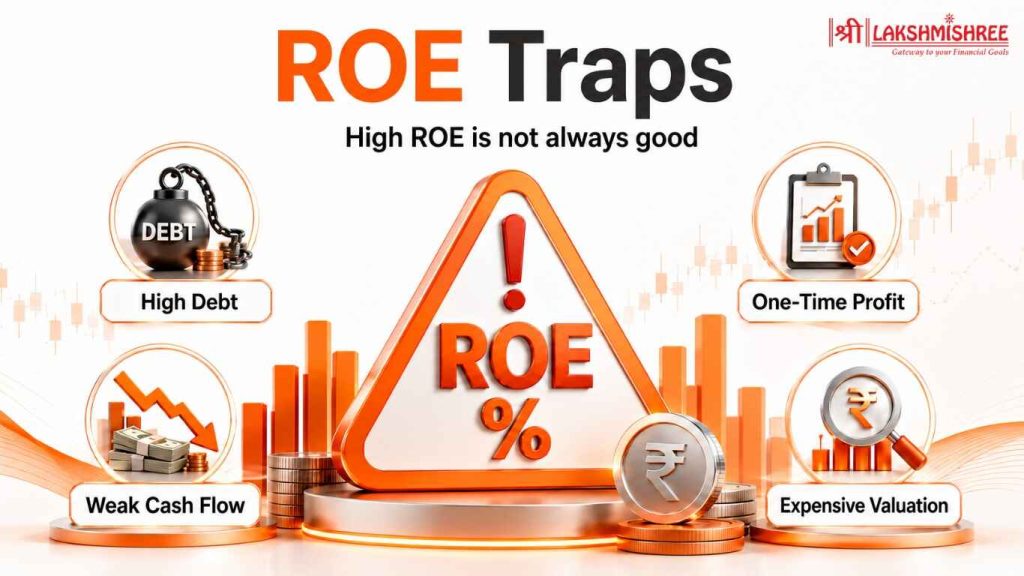
ROE is a useful ratio, but it can give the wrong impression when seen without context. An attractive ROE number may look positive at first, but the reason behind it matters equally.
Here are some common ROE traps investors should avoid:
A high ROE can be a positive sign, but it should not be your only reason to invest. You should also check debt levels, profit growth, cash flow, valuation, and industry position before making a decision.
A company may show higher ROE because of more debt. Borrowing can improve returns in good times, but it can also increase risk when business conditions weaken.
This is similar to trading on equity, where borrowed are used to lift shareholder returns, but the same approach can increase risk when earnings weaken.
If you look at only one year, you may mistake a temporary improvement for real business strength.
ROE should be compared within the same sector. For example, comparing an IT company with a power or infrastructure company may not give the right conclusion because both operate with different capital requirements.
A better approach is to compare companies with similar business models and industry conditions.
A company may report profit, but that profit should also convert into actual cash. If ROE looks good while operating cash flow is weak, you may need to check the quality of earnings more carefully.
Even a business with healthy ROE may not be a good investment if the stock is already too expensive. ROE shows business quality, but valuation helps you understand whether the price makes sense.
Valuation-based checks used in High Book Value Low PE Stocks can help investors see how price, earnings, and book value are read together before judging a stock.
ROE gives investors a way to look at a company’s performance beyond the profit number. It shows whether the returns are coming from proper use of shareholders’ equity or just from a large capital base.
ROE should not be judged alone. A high ROE becomes more meaningful when it is consistent, supported by business growth, backed by healthy cash flow, and not mainly driven by high debt.
For Indian investors, ROE should work as a starting point for stock analysis, not as the final reason to buy a stock. Valuation, industry comparison, debt levels, profit growth, and overall business quality should also be checked before making a decision.
In the end, ROE helps you ask a better question: not just whether a company is profitable, but whether that profit is coming from the right use of shareholders’ money.
ROE, or Return on Equity, measures the relationship between a company’s net profit and shareholders’ equity. It helps investors understand how well the company is generating returns from its equity.
The formula for ROE is:
ROE = Net Income ÷ Shareholders’ Equity × 100
Net income means the company’s final profit after expenses, interest, and taxes. Shareholders’ equity means the company’s net worth that belongs to shareholders.
The full form of ROE is Return on Equity. It is a profitability ratio used to check the return a company earns on shareholders’ equity.
There is no fixed ROE number that is good for every company. In general, ROE above 15% is often considered good if it is stable and supported by strong fundamentals. However, investors should compare ROE with companies from the same sector.
No, high ROE is not always good. Sometimes, ROE may look strong because of high debt, one-time profits, or a low equity base. Investors should also review debt levels, cash flow, profit growth, and consistency before depending on ROE.
Yes, ROE can be negative when a company reports losses or has negative shareholders’ equity. A negative ROE may indicate weak financial performance, but investors should understand the reason behind it before making any conclusion.
No, high ROE does not guarantee high stock returns. ROE shows business performance, while stock returns depend on valuation, future growth, market conditions, and the price at which investors buy the stock.
Investors should use ROE along with debt, profit growth, cash flow, valuation, consistency, and industry comparison. A stable ROE backed by strong fundamentals is more useful than a one-year spike.
Yes, ROE in share market and ROE in stock market mean the same thing. Both refer to Return on Equity, which helps investors understand how effectively a company uses shareholders’ equity to generate profit.
This article is for educational and informational purposes only and does not constitute investment advice or a recommendation to buy or sell any specific security. Investing in stocks involves market risk. Past performance is not indicative of future results. Please conduct your own due diligence before making any investment decisions. Lakshmishree Investment and Securities is a SEBI-registered entity.