

Every investor faces market uncertainty at some point, turning risk management into an important part of investing. Understanding what is hedging can help you protect your portfolio from adverse price movements while staying invested.
Think of it like buying insurance for your car, you hope you never need it, but it provides protection when things don't go as planned.
Whether you're trading stocks, derivatives, or managing business risks, this guide explains the meaning of hedging, its types, strategies, benefits, and practical examples.
Suppose you invest ₹1,00,000 in a company's shares. You are confident about the long term but concerned about short term volatility.
Ultimately, while hedging provides a safety net, it is important to remember that it may limit your potential gain by adding extra transaction costs or capping profits if the market moves strongly in your favour.

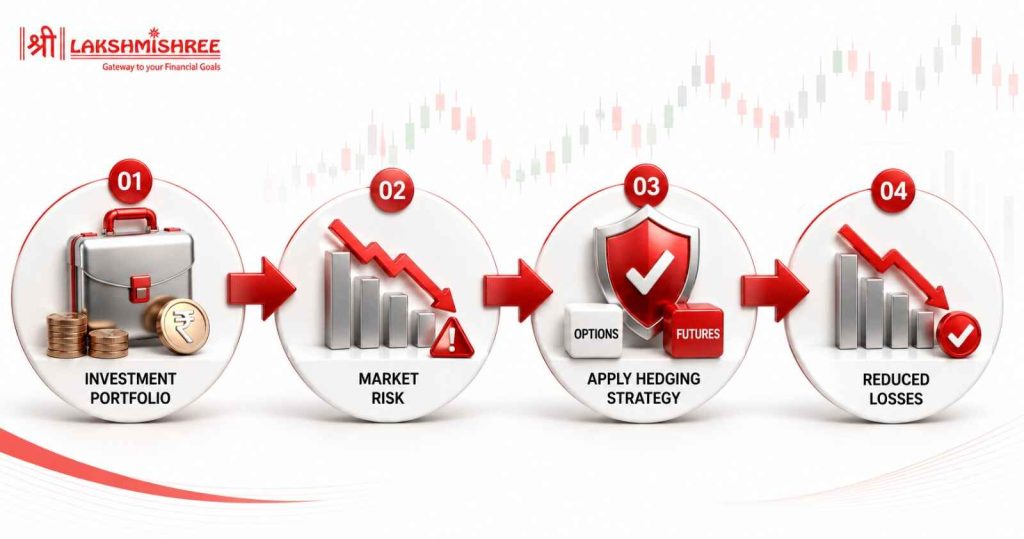
Simply put, hedging involves taking an additional position or using financial instruments to reduce the financial impact of adverse price movements. Its primary objective is to protect existing investments rather than maximise profits.
Investors use hedging instruments such as options, futures, forward contracts, and swaps to offset risks associated with stocks, commodities, currencies, or interest rates. While hedging cannot eliminate risk entirely, it helps reduce uncertainty and makes investment outcomes more predictable.
For example, a trader sells a Call Option and the exchange requires a margin of ₹1,50,000 because the position carries significant risk. To hedge the trade, the trader buys another Call Option with a higher strike price. Since the maximum potential loss is now limited, the margin requirement may reduce to around ₹40,000–₹60,000, depending on the strategy and exchange rules. This allows the trader to manage risk while using capital more efficiently.
Hedging is not limited to investors. Businesses also use it to manage risks such as fluctuating fuel prices, foreign exchange rates, and raw material costs. Whether you are an investor or a business owner, the objective remains the same, to reduce financial uncertainty and manage risk more effectively.
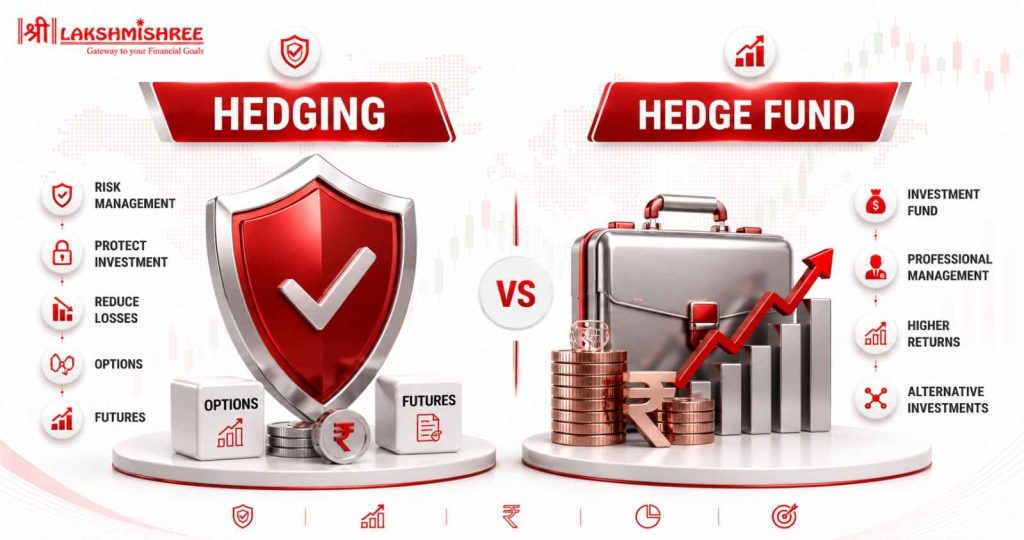
Many of you assume that hedge funds and hedging mean the same thing because of their similar names. However, they are very different concepts.
A hedge fund is a privately managed investment fund that pools money from accredited or institutional investors. Hedge funds use a wide range of investment techniques including leverage, short selling, arbitrage and derivatives to generate returns. While some hedge funds use hedging strategies to reduce risk, many also take aggressive positions to maximise profits.
In simple terms, hedging is a strategy, whereas a hedge fund is an investment vehicle that may or may not use hedging techniques.
| Hedging | Hedge Fund |
| A risk management strategy | A professionally managed investment fund |
| Used by individuals and businesses | Primarily for accredited and institutional investors |
| Focuses on reducing investment risk | Focuses on generating higher returns using various strategies |
| Uses options, futures, swaps, and forwards | May use derivatives, leverage, arbitrage, and short selling |
Options hedging uses call and put options to reduce the impact of adverse price movements. Since options give investors the right, but not the obligation, to buy or sell an asset at a predetermined price, they are widely used to manage downside risk while maintaining investment flexibility. If you're new to derivatives, understanding the basics of options trading can help you see how these contracts are used for both risk management and trading.
Futures hedging involves standardised contracts that lock in the price of an asset for a future date. It is commonly used by investors and businesses to hedge stocks, commodities, currencies, and market indices against price volatility.
Forward contracts are customised agreements between two parties to buy or sell an asset at a fixed price on a future date. They are commonly used by businesses to manage currency and commodity price risks.
Currency hedging helps businesses and investors reduce the impact of exchange rate fluctuations. It is particularly useful for exporters, importers, and investors with overseas exposure.
Commodity hedging helps businesses manage the risk of fluctuating prices for raw materials such as crude oil, metals, and agricultural products. By locking in prices or using derivatives, businesses can improve cost certainty and better manage financial risk. If you're new to commodities, explore our guide on how to trade in the commodity market to understand how commodity markets and contracts work.
Interest rate hedging uses financial instruments such as swaps and futures to reduce the impact of changing interest rates on loans and other debt obligations.

Like any investment strategy, hedging offers several benefits, but it also has certain limitations. Understanding both sides can help you decide whether a particular hedging strategy aligns with your financial goals and risk tolerance.
Not every investor needs to hedge. Whether hedging is appropriate depends on your financial goals, investment horizon, and risk tolerance.
Investors who may benefit from hedging include:
| Investor Type | Why Hedging Helps |
| Long term investors | Protects portfolios during temporary market corrections |
| Active traders | Manages short term market risk |
| Businesses | Reduces exposure to commodity, interest rate, and currency fluctuations |
| Importers & Exporters | Helps manage foreign exchange risk |
| Concentrated investors | Limits risk from a single stock or sector |
Although hedging isn't required at all times, it can be particularly useful in certain market conditions. You may consider hedging when:
The right timing depends on your investment objective and risk management strategy.
Futures and options are among the most widely used hedging instruments in financial markets. These strategies help investors manage downside risk while maintaining exposure to potential gains.
A protective put involves buying a put option while holding the underlying stock. It acts like insurance by limiting potential losses if the share price falls.
Example: You own shares of ABC Ltd. trading at ₹1,000 and purchase a put option with a strike price of ₹950. If the stock declines sharply, gains from the put option help offset part of the loss. If the stock rises, you get benefits from the appreciation after accounting for the option premium.
A covered call involves selling a call option against shares already owned. Investors earn additional income through the option premium while accepting a cap on potential upside gains.
Example: An investor owns 100 shares of XYZ Ltd. at ₹500 each and sells a call option with a strike price of ₹540. If the share price remains below ₹540, the investor keeps both the premium and the shares. If it rises above ₹540, the shares may be sold at the agreed price.
A long short strategy combines buying securities expected to perform well with short selling securities expected to underperform. This helps reduce dependence on overall market direction.
Example: An individual believes one banking stock is undervalued while another is overvalued. They buy the undervalued stock and short the overvalued one. If the analysis proves correct, gains from one position help cushion losses in the other.
Cross hedging is used when a direct hedging instrument isn't available. Instead, investors hedge using another asset whose price generally moves in a similar direction.
Example: A food manufacturer wants to hedge sunflower oil prices but suitable contracts are unavailable. It may use soybean oil futures because both commodities often exhibit similar price movements.
Indian investors can use hedging in the stock market through regulated derivative products available on exchanges such as the National Stock Exchange (NSE) and Bombay Stock Exchange (BSE). These products allow traders and investors to reduce market risk without selling their existing investments.
Indian investors can hedge their positions using different categories of derivatives available on recognised exchanges. These include:
For example, suppose an investor owns shares worth ₹5 lakh and expects short term uncertain market conditions due to an upcoming RBI policy announcement. Instead of selling the portfolio, the investor can purchase Nifty Put Options. If the market falls, the gain from the option can offset a portion of the portfolio's losses, helping preserve capital.
Before using derivatives for hedging, investors should understand the associated costs, margin requirements, and regulatory guidelines issued by SEBI and the RBI. Selecting the right strategy depends on investment objectives, risk tolerance, and market outlook.
While hedging is an effective risk management technique, it isn't the only way to reduce investment risk.
Diversification involves spreading investments across different sectors and asset classes instead of concentrating money in a single investment. This reduces the impact of poor performance in any one asset. If you're new to this concept, you can also explore our Portfolio Diversification: A Beginner's Guide to understand how diversification helps build a more balanced investment portfolio.
Asset allocation distributes investments across equities, debt, gold, and cash based on an investor's goals and risk profile. A balanced allocation can help reduce overall portfolio volatility. If you're looking to diversify across multiple asset classes through a single investment, explore our guide on Multi-Asset Allocation Funds to understand how these funds work and who they are suitable for.
Over time, market movements can alter your original asset allocation. Periodically rebalancing your portfolio helps maintain your desired level of risk.
Understanding what is hedging is essential for anyone looking to manage investment risk more effectively. Whether you are investing in stocks, trading derivatives, or running a business exposed to commodity or currency fluctuations, hedging can help reduce the impact of adverse market movements.
Although no investment strategy is completely risk-free, hedging can help minimise potential losses and improve portfolio stability during uncertain market conditions.
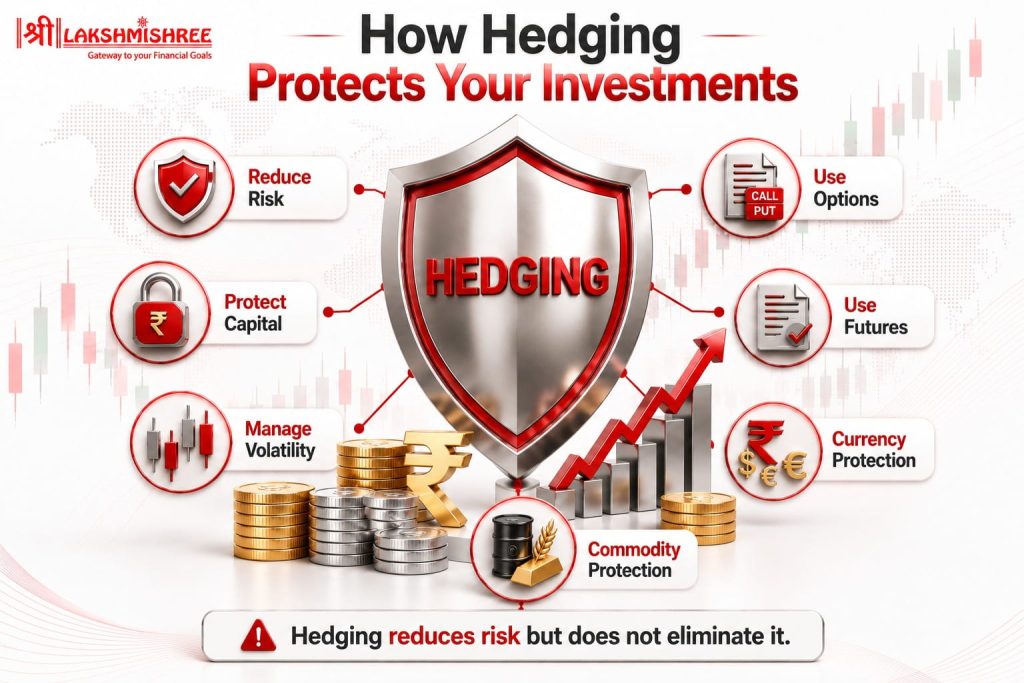
Hedging is a risk management strategy that uses financial instruments to reduce potential losses caused by adverse market movements.
Hedging works by taking another investment position that gains value when the original investment loses value, helping reduce the overall impact of market fluctuations.
There is no single best hedging strategy, as the right approach depends on your financial goals and the type of asset you are protecting. Some of the most commonly used strategies include protective puts, covered calls, currency hedging, futures hedging, and portfolio diversification.
No. Hedging helps reduce specific risks but cannot eliminate them entirely. Market conditions, costs and strategy selection all influence the effectiveness of a hedge.
Disclaimer: This article is intended for educational purposes only. Please note that the data related to the mentioned companies may change over time. The securities referenced are provided as examples and should not be considered as recommendations.