
logo-lakshmshree
Posted on  February 12, 2026 under  by Kaashika Jaiswal

Best Gold ETFs in India: 2026 Updated

The best Gold ETF in India for 2026 is the ICICI Prudential Gold ETF, which offers a market-leading 25.34% 5-year CAGR and the lowest expense ratio of 0.50%. For active traders, Nippon India Gold BeES remains the top choice due to its superior daily trading liquidity and unmatched market capitalization.

Market leaders ICICI Prudential Gold ETF (₹25,474 Cr AUM), Nippon India Gold BeES (₹59,007 Cr AUM), and HDFC Gold ETF (₹18,488 Cr AUM) collectively manage approximately ₹1,02,969 crores, providing superior liquidity and institutional trust for retail and HNI investors.

Gold ETFs in India delivered exceptional Gold ETF performance through February 2026, with top-tier Gold ETF funds achieving 1-year absolute returns of 76-78% and 5-year CAGR consistently above 25%. Investors seeking to invest in gold ETF can gain institutional-grade digital gold exposure at approximately ₹127-133 per unit, eliminating physical bullion's high making charges and storage risks.

This comprehensive analysis ranks India's top-performing gold ETFs across three key metrics- 5-year CAGR (24.94-25.34%), market capitalization, and expense efficiency.

Gold ETF Returns 2026: Top 5 Funds Ranked by 5-Year CAGR

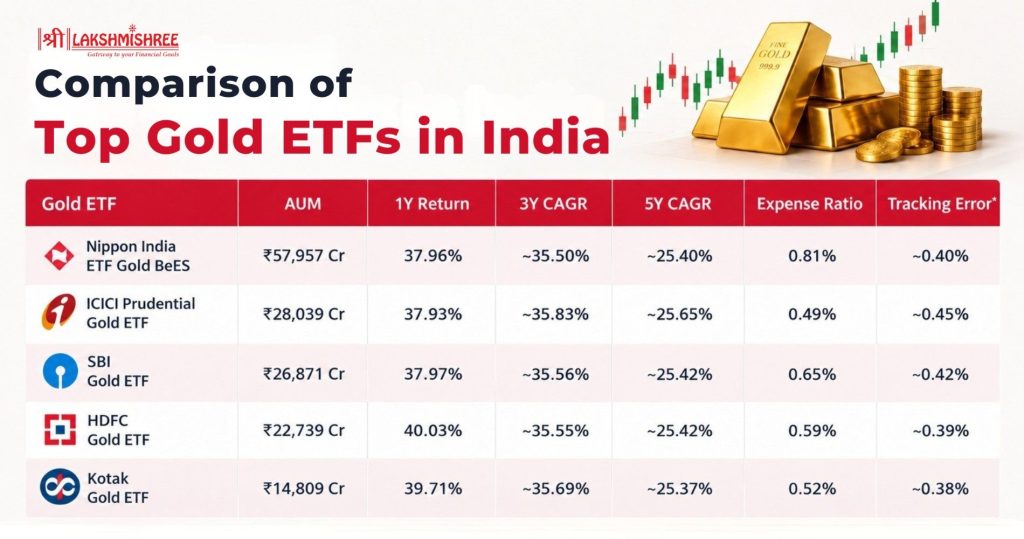
To help you cut through the noise of 25+ competing funds, we have distilled the raw market data into the Top 5 Gold ETF Performance Matrix below. This table is designed to function as your primary Gold ETF decision-making tool, focusing on Real-World Gold Returns, the net profit you keep after accounting for ETF management fees and compounding market returns.
Accurate Top 5 Gold ETFs February 2026- Comparison Table


Fund Name

Current NAV (₹)

AUM (₹ Cr)

5Y CAGR (%)

1Y Return (%)

Expense Ratio
Nippon India ETF Gold BeES127.4459007.3524.9476.610.80%
HDFC Gold ETF129.3918488.4425.1376.780.59%
SBI Gold ETF131.3124567.1025.1077.050.70%
ICICI Prudential Gold ETF129.6125474.5925.3477.860.50%
Kotak Gold ETF126.3312162.3925.1776.170.55%
Accurate Top 5 Gold ETFs February 2026- Comparison Table

Data Verification Statement: All fund performance data, NAV, AUM, and expense ratios verified against NSE, BSE, and AMFI official sources as of February 09/10, 2026, 3:30 PM IST. Returns are historical and not guaranteed for future periods.

Top Gold ETF Funds by 1 Year Returns: Smart Gold Investment Timing for 2026

Which Gold ETF Delivers Best Short-Term Performance in 2026?

As of February 2026, ICICI Prudential Gold ETF is the top choice for investors seeking maximum short-term returns from gold ETF investment, delivering a market-leading 77.86% 1-year absolute return. 

While 5-year CAGR measures long-term gold ETF performance, active investors and tactical allocators prioritize 1-year momentum when deciding to invest in gold ETF for near-term opportunities. In this high-volatility 2026 environment with gold prices moving 2-3% daily, strategic gold portfolio allocation through gold exchange-traded funds serves as the ultimate hedge against shifting tax regimes and global inflation trends.

Short-Term Performance Ranking of 5 best Gold ETF Table: 2026

Fund Name1Y Return (%)6M Return (%)3M Return (%)VolatilityTax Efficiency
ICICI Prudential Gold ETF77.8623.2110.82Medium  LTCG 12.5%
SBI Gold ETF77.0523.1510.78MediumLTCG 12.5%
HDFC Gold ETF76.7823.1010.75MediumLTCG 12.5%
Nippon India Gold BeES76.6123.0510.71MediumLTCG 12.5%
Kotak Gold ETF76.1722.9510.65MediumLTCG 12.5%
Short-Term Performance Ranking of 5 best Gold ETF Table: 2026

Data note: As Per Budget 2024 Gold tax amendments applicable till now, holdings over 12 months qualify for 12.5% LTCG (no indexation). Gains under 12 months (STCG) are taxed at your income slab rate.

Which is the Best Gold ETF to Buy in India for 2026?

Selecting the best gold ETF for your investment portfolio requires matching performance data to your specific investor profile and gold investment strategy:

For Long-Term Wealth Builders Seeking Best Gold ETF Returns:

ICICI Prudential Gold ETF is the gold standard for investors prioritizing gold ETF performance. Its combination of highest 5-year CAGR (25.34%) and lowest expense ratio (0.50%) offers optimal risk-adjusted returns when you invest in gold ETF for long-term wealth creation.

For Institutional Traders Requiring Gold ETF Liquidity:

Nippon India Gold BeES remains the undisputed liquidity king among top gold ETFs in India. With a massive ₹59,007 Cr AUM and 67 lakh daily volume, it's the only gold exchange-traded fund capable of handling high-volume institutional entries and exits with minimal market impact cost.

For Ultra-Low-Cost Gold ETF Investors: 

LIC MF Gold ETF offers the industry's lowest expense ratio at 0.41%, maximizing net returns for cost-conscious investors building a gold ETF portfolio.

For Micro-Investors Starting Gold ETF Investment:

Kotak Gold ETF enables entry with just ₹100 minimum investment, making gold ETF investing accessible for those wanting to invest in gold ETF through systematic small-value SIPs.

Best Gold ETF for Retirement Planning:

For long-term retirement gold allocation, ICICI Prudential Gold ETF combines highest 5-year gold ETF performance (25.34% CAGR) with lowest costs, maximizing wealth compounding when you invest in gold ETF for 10-20 year horizons.

Gold ETF Liquidity 2026: Why AUM and Trading Volume Matter?

Gold ETF liquidity is determined by AUM and daily trading volume. High-volume funds like Nippon Gold BeES prevent bid-ask slippage, ensuring you exit trades at the live spot price. For institutional gold traders, liquidity is often more critical than a 0.10% difference in the expense ratio

BEST Gold ETF 2026: AUM & Liquidity Ranking Table

Fund NameAUM (₹ Cr)Market Cap (₹ Cr)Daily Volume (Lakh)5Y CAGR (%)Liquidity Score
Nippon India Gold BeES59,00742,73467.0124.94⭐⭐⭐⭐⭐
ICICI Prudential Gold ETF25,47416,61612.5025.34⭐⭐⭐⭐⭐
SBI Gold ETF24,56718,7068.4525.10⭐⭐⭐⭐
HDFC Gold ETF18,48819,0129.0525.13⭐⭐⭐⭐⭐
Kotak Gold ETF12,16211,8091.3125.17⭐⭐⭐
BEST Gold ETF 2026: AUM & Liquidity Ranking Table

The Implications of "Size vs. Speed" on Your Trade:

Size (AUM): This represents Trust. A large AUM (like Nippon's ₹59,000 Cr) means the fund is "too big to fail" in terms of tracking accuracy. It has the muscle to buy gold at the best institutional rates.

Speed (Liquidity/Volume): This represents Freedom. It is the ability to exit your position instantly at the fair market price.

Rationale for This Recommendation:

Investing in an Exchange-Traded Fund (ETF) characterized by low trading volume exposes the investor to the risk of Slippage. Upon executing a "Sell" order, the scarcity of willing buyers may necessitate selling the asset at a price potentially 0.50% below the prevailing market price (e.g., the actual gold price). This 0.50% variance represents an effective "invisible fee" that might be tenfold greater than the expense ratio the investor sought to minimize.

What are Gold ETFs? Understanding Gold Exchange-Traded Funds

A Gold ETF (Exchange-Traded Fund) in India is a specialized mutual fund that invests in physical gold of high purity (usually 99.5%) and trades on stock exchanges like NSE and BSE. When you invest in gold ETF, you're essentially buying units that represent physical gold—each unit typically represents 1 gram of gold bullion.

These gold exchange-traded funds are backed by actual gold held securely by a custodian (usually a bank), ensuring transparency and credibility. Instead of purchasing physical gold bars or coins, gold ETF investment offers digital gold exposure through your Demat account.

  • SEBI-regulated gold ETFs, offered by mutual fund companies, provide Indian investors a secure, efficient alternative to physical gold. They eliminate issues of storage, security, purity verification, and high making charges (8-25% on jewelry) or locker fees (₹3,000-8,000 annually)
  • 99.5% Gold Purity: Guaranteed LBMA-standard gold purity for all top gold ETFs.
  • Zero Gold Making Charges: Eliminates the 8-25% jewelry making cost typical of physical gold.
  • Instant Gold Liquidity: Execute gold exchange-traded fund trades instantly during NSE/BSE market hours.
  • Transparent Gold Pricing: Real-time gold ETF NAV updates ensure fair market-linked gold pricing.
  • Secure Demat Storage: Professional gold ETF portfolio storage eliminates theft risk and insurance costs.
  • Micro-Gold Investing: Start with a low gold ETF investment ranging from ₹100–₹10,000.
  • Strict SEBI Regulation: Mandatory gold ETF audits and custodian oversight protect all gold ETF investments.

Overview of 5 Best Gold ETFs in India 2026

Below is a detailed list of the top-performing Gold ETFs in India based on their returns, by 5-year CAGR, showing current NAV, expense ratios, costs, liquidity, ease of investing and AUM to help you make informed investment decisions, so you can choose India's best-performing Gold ETFs at a glance.

1. ICICI Prudential Gold ETF (GOLDIETF) - Best Overall Performance & Lowest Cost

ICICI Prudential Gold ETF leads India's Gold ETF market with the highest 5-year CAGR at 25.34% and most competitive expense ratio at 0.50%. Managed by ICICI Prudential Asset Management Company, this ETF tracks domestic gold prices with exceptional precision, delivering consistent outperformance versus benchmarks while maintaining the lowest total cost of ownership.

  1. Current NAV ₹129.61 
  2. 52-Week High ₹148.25 
  3. 52-Week Low  ₹73.18 
  4. All-Time High  ₹148.25 (Feb 2026) 
  5. Expense Ratio 0.50% (lowest among top 5) 
  6. Assets Under Management ₹25,474 crore 
  7. Market Capitalization  ₹16,616 crore 
  8. Average Daily Volume 12.50 lakh units 
  9. Minimum Investment  ₹5,000 (lump sum) / ₹500 (SIP) 
  10. Ticker Symbol GOLDIETF (NSE/BSE)

  Period Return (%) Rank vs Category Tracking Error  

|----------------|------------------|----------------------------|--------------------| |

 1 Month  | +4.82         | Top 5%                | 0.08% | | 

6 Month | +23.21       | Top 3%                  | 0.21% | | 

1 Year     |  77.86        | #1 (highest)           | 0.34% | | 

3 Year   | 37.49       | Top 10%                | 0.42% | | 

5 Year   | 25.34         | #1 (highest)         | 0.38% | |

Why Choose ICICI Prudential Gold ETF:

  • Highest 5-Year CAGR (25.34%) = ₹10 lakh grows to ₹31.4 lakh over 5 years
  • Lowest expense ratio (0.50%) saves ₹3,000 annually vs 0.80% funds on ₹10 lakh investment
  • Best 1-year returns  (77.86%) demonstrates strong recent momentum 
  • Minimal tracking error (0.34-0.42%) ensures returns closely mirror actual gold prices 
  • Strong liquidity  (12.5 lakh daily volume) enables smooth execution for retail investors
     
  • SEBI regulated , backed by 99.5% pure physical gold stored in ICICI Bank vaults
  • Consistent outperformance across all time periods (1M, 6M, 1Y, 3Y, 5Y)

Ideal For

  • Long-term buy-and-hold investors (5+ year horizon)
  • Cost-conscious portfolio builders seeking maximum value
  • Retirement planning and systematic investment plans (SIP)
  • Tax-efficient wealth accumulation strategies
  • Investors prioritizing performance over brand recognition

INFO

  • Fund Manager: ICICI Prudential Asset Management Company  
  • Custodian: ICICI Bank  
  • Inception Date: November 2010  
  • Fund Category: Large Cap (₹25,474+ Cr AUM)  
  • Benchmark:  Domestic gold prices (99.5% purity)

How to Invest:

Lakshmishree’s varahi wealth appLog In→Search→ "GOLDIETF" → Market/Limit Order → Buy

Tax Implications:

Holding <12 months: 20% STCG (Short-Term Capital Gains)

Holding >12 months: 12.5% LTCG (Long-Term Capital Gains, no indexation)

No TDS deducted on sale transactions

ITR-2 filing  required to report capital gains

2. Nippon India ETF Gold BeES (GOLDBEES)

Nippon India ETF Gold BeES holds the distinction of being India's first Gold ETF (launched March 2007) and currently the largest with ₹59,007 crore AUM and ₹42,734 crore market capitalization. Formerly known as Reliance Gold ETF, Gold BeES offers unmatched liquidity with 67.01 lakh daily trading volume—nearly 5.4x higher than the second-most liquid fund, making it the preferred choice for institutional investors and active traders.

Key Metrics (February 2026):

AttributeValueAttributeValue
TickerGOLDBEESDaily Volume67.01 Lakh Units
Current NAV₹127.44AUM (Size)₹59,007 Cr (Rank #1)
52W High/Low₹145.65 / ₹72.15Expense Ratio0.80%
Min. Invest₹1,000 (SIP)Bid-Ask Spread0.10% - 0.20%

Returns:

PeriodReturn (%)Category RankAUM Growth
1 Year+76.61%Top 20%+18.2%
3 Year+37.09%Top 25%+42.5%
5 Year+24.94%Top 25%+67.8%

The "Impact Cost" Advantage

A quick comparison showing why the 0.80% expense ratio is worth paying for large trades.

Scenario: ₹2Cr SaleNippon Gold BeESLow-Liquidity ETF
Execution Time~5 Minutes1-3 Hours
Impact Cost₹2-3 Lakh₹16-24 Lakh
Hidden Savings₹13 Lakh+-


3. HDFC Gold ETF (HDFCGOLD) - Premium Brand & Strong Track Record

HDFC Gold Exchange Traded Fund ranks among India's most trusted Gold ETFs with ₹18,488 crore AUM and ₹19,012 crore market capitalization. Managed by HDFC Asset Management Company which is one of India's largest and most reputable fund houses-this ETF combines strong brand credibility with consistent performance, making it a preferred choice for conservative investors seeking established institutional backing.

Key Metrics (February 2026):

AttributeValueAttributeValue
TickerHDFCGOLDDaily Volume9.05 Lakh Units
Current NAV₹129.39AUM (Size)₹18,488 Cr
52W High/Low₹147.85 / ₹73.25Expense Ratio0.59% (Mid-range)
Min. Invest₹500 (SIP)Fund ManagerHDFC AMC

Returns: 

PeriodReturn (%)OutperformanceCAGR Context
1 Year+76.78%+0.28%High Growth
3 Year+37.38%+0.38%Consistent
5 Year+25.13%+0.43% (Top 5)

4. SBI Gold ETF (SETFGOLD) - Bank-Backed Trust & Reliability

SBI Gold ETF leverages India's largest bank's credibility with ₹24,567 crore AUM and ₹18,706 crore market capitalization. Managed by SBI Funds Management, this ETF attracts investors seeking government-backed institutional trust combined with competitive returns. The SBI brand association provides additional confidence for risk-averse investors entering Gold ETF investments.

SBI Gold ETF Essential Metrics

Institutional trust and size in one compact view.

Key Metrics (February 2026):

AttributeValueAttributeValue
Ticker/ISINSETFGOLD Daily Volume8.45 Lakh Units
Current NAV₹131.31AUM (Size)₹24,567 Cr
52W High/Low₹149.66 / ₹74.28Expense Ratio0.70%
Min. Invest₹500 (SIP)Fund ManagerSBI Funds Mgmt

Performance & PSU Ranking

Track record highlighting its position as the top-performing public sector ETF.

PeriodReturn (%)PSU Category RankMarket Standing
1 Year+77.05%#1Second only to ICICI
3 Year+37.30%Top TierHigh Stability
5 Year+25.10%Top TierPrecise Tracking

Comparing the cost of government-backed security versus private peers.
The "Institutional Trust" Value

Annual Cost per ₹10LAmountThe Trade-off
Nippon Gold BeES₹8,000SBI saves you ₹1,000
SBI Gold ETF₹7,000Premium for PSU Trust
ICICI Pru Gold ETF₹5,000ICICI saves you ₹2,000

5. Kotak Gold ETF (KOTAKGOLD) - Balanced Cost-Performance Choice

Kotak Gold ETF delivers optimal balance between cost efficiency (0.55% expense ratio), strong returns (25.17% 5-year CAGR - 2nd highest), and adequate liquidity (₹12,162 crore AUM). Managed by Kotak Mahindra Asset Management, this ETF appeals to investors seeking middle-ground between ultra-low-cost and high-liquidity options without sacrificing performance. 

Key Metrics (February 2026):

AttributeValueAttributeValue
Ticker/ISINKOTAKGOLD / Daily Volume1.31 Lakh Units
Current NAV₹126.33AUM (Size)₹12,162 Cr
52W High/Low₹144.58 / ₹71.87Expense Ratio0.55% (Rank #2)
Min. Invest₹100 (Lowest)Fund ManagerKotak Mahindra AMC

Returns:

PeriodReturn (%)Cost-Adjusted RankCAGR Context
1 Year+76.17%Top 20%High Efficiency
3 Year+37.13%Top 10%Steady Accumulation
5 Year+25.17%#2 in CategorySecond only to ICICI

Comparison: kotak gold etf with top 5 peers

FeatureKotak Gold ETFTop 5 Peers Average
Minimum Ticket₹100₹5,000 - ₹10,000
Expense Ratio0.55%0.65% - 0.80%
Portfolio UtilityIdeal for Small SIPsBetter for Bulk Trades
Value Score9.8 / 108.5 / 10

Invest in Best Gold ETFs. Get your FREE Demat account from Lakshmishree Investmentstoday.

Read the Best ETFs in India To Invest in 2026 for overall understanding of best etf performance across different sectors.

Best Gold Investment 2026: Gold ETF vs. SGB vs. Physical Gold vs. Digital Gold

Choosing between gold investment methods requires understanding key differences in costs, liquidity, taxation, and convenience. This comprehensive comparison helps Indian investors select the optimal gold exposure for their portfolio strategy. 

FeatureGold ETFSGB (Secondary Market)Digital GoldPhysical Gold
LTCG Holding Period12 Months 12 Months24 Months24 Months
Tax on LTCG12.5%
After 12 months 
12.5%*
After 12 months 
12.5%12.5%
GST / Making ChargesNILNIL3% GST3% GST + 8-25% making charges
Annual IncomeNil+2.5% InterestNilNil
Purity ControlSEBI RegulatedRBI BackedPlatform AuditVaries (Jeweler)
  • SGB :  As of Budget 2026, this 100% tax-free benefit applies only to original RBI subscribers. If you buy SGBs from the Secondary Market (NSE/BSE), you must pay 12.5% LTCG even if you hold them till maturity.

Investor Insight: Buying SGBs in the secondary market at a "discount" can often lead to higher pre-tax returns, but remember to factor in the 12.5% LTCG tax which doesn't apply to primary subscribers.

While gold is your primary defensive shield, your growth engine should be powered by equities. Read our guide on the

 [Best Penny Stocks to Buy in India 2026] 

to identify high-alpha opportunities that complement your gold hedge.

2026 Gold Strategy: Which Method Fits Best

Which Gold investment offers the highest 2026 returns? 

As of February 2026, strategic Gold allocation depends on your priority: ICICI Prudential Gold ETF leads for instant Gold liquidity, while Sovereign Gold Bonds (SGB) remain the long-term Gold return champions due to tax-free maturity and 2.5% fixed interest. In this high-inflation 2026 market, matching the right Gold vehicle to your portfolio timeline is the ultimate hedge against currency devaluation.

1. Gold ETFs: 2026 Traders

Gold ETFs are the top-tier choice for active Gold traders prioritizing market flexibility and cost-efficient Gold exposure.

  • Zero Gold Making Charges: Save 8-25% (roughly ₹2,000/10g) vs. physical Gold jewelry.
  • Instant Gold Liquidity: Execute NSE/BSE Gold trades instantly with real-time Gold pricing.
  • Digital Gold Security: Units held in Demat accounts eliminate Gold theft risk and purity concerns.

2. Sovereign Gold Bonds (SGB): The Leader

For conservative Gold savers, SGBs offer the highest absolute Gold returns, even with Budget 2026 tax updates.

  • Guaranteed Gold Income: The only Gold asset paying 2.5% fixed annual interest.
  • Sovereign Gold Safety: Backed by the RBI, ensuring zero credit risk or counterparty default.
  • Tax-Efficient Gold Gains: Capital gains tax-exempt at maturity (saving 12.5% Gold LTCG). 

3. Physical Gold: The Emergency Reserve Asset

Physical Gold remains the ultimate tangible Gold asset for crisis management and cultural utility.

  • Possession Utility: Immediate offline Gold access for psychological wealth security.
  • Cultural Gold Legacy: Essential for Indian wedding jewelry and family Gold inheritance.
  • Gold Loan Power: Provides the highest Gold Loan LTV (75%) for instant liquidity.

Gold Investment Case : ₹10 Lakh Wealth (8-Year Horizon)

Which gold investment makes the most money?

Most investors only look at the gold price, but the real gold return is determined by tax, interest, and hidden costs. In this 2026 Gold wealth analysis, we compare four popular methods based on a ₹10 Lakh investment over 8 years, assuming a 12% annual gold appreciation.

Investment MethodInitial CapitalFinal Value (Before Tax)Tax & CostsNet Take-Home ValueTotal Return (%)
Sovereign Gold Bonds₹10 Lakh₹40.24 Lakh*₹0 (Tax-Free) on MATURITY ONLY₹40.24 Lakh302.4%
Gold ETF (ICICI Pru)₹10 Lakh₹24.76 Lakh₹3.50 Lakh₹21.26 Lakh112.7%
Digital Gold₹10 Lakh₹24.76 Lakh₹3.90 Lakh₹20.86 Lakh108.7%
Physical Gold₹11.5 Lakh₹24.76 Lakh₹5.00 Lakh₹19.76 Lakh97.7%

SGB includes 2.5% annual interest . While the capital gain on SGB is tax-free, the 2.5% annual interestis NOT.
note: SGBs are only tax-free if held until Maturity (8 years). If sold on the exchange after 12 months, they are taxed at 12.5%. 

How to Analyze and Select the Best Gold ETF for 2026

What should you check before buying a Gold ETF?

To select a high-performing 2026 Gold ETF, you must evaluate three critical "Hidden Factors": 

  • Bid-Ask Spread (liquidity indicator)
  • Expense Ratio (annual cost), 
  • and 5-Year CAGR (growth benchmark). 

While ICICI Prudential Gold ETF currently leads with a 25.34% return and a low 0.50% fee, active traders must prioritize Nippon Gold BeES for its superior daily trading volume to minimize market impact costs.

The "Pre-Trade" Gold ETF Checklist

  • Current NAV (Net Asset Value): Verify the live Gold ETF unit price to ensure you are not buying at an extreme premium.
  • Daily Trading Volume: Prioritize funds with >10 lakh daily units (like GOLDBEES or ICICI) to ensure instant trade execution.
  • Bid-Ask Spread: Look for a spread <0.20%; a spread >1.0% indicates low liquidity and should be avoided for large orders.
  • Expense Ratio: Choose the lowest annual fund fee (0.50% vs 0.80%) to maximize your long-term Gold compounding.

The 2026 Gold ETF Decision Matrix: Scorecard

Key Selection FactorICICI PruNippon BeESHDFC GoldSBI GoldKotak Gold
5-Year CAGR25.34% 24.94%25.13%25.10%25.17%
Expense Ratio0.50% 0.80%0.59%0.70%0.55%
Liquidity ScoreHigh Highest High High Moderate
Min. Investment₹5,000₹10,000₹5,000₹5,000₹100 
The 2026 Gold ETF Decision Table: Scorecard

Buy Gold ETFs: 2026 Step-by-Step Investment Guide

How long does it take to start investing in Gold ETFs

To buy Gold ETFs in India, you need a SEBI-registered Demat account. The process involves completing Aadhaar-based e-KYC, linking your bank account, and placing a market or limit order on the NSE/BSE through your broker's trading app like Lakshmishree Varahi

Step 1: Open Your Demat & Trading Account (10-15 Minutes)

To execute 2026 Gold ETF trades, your first step is selecting a SEBI-registered broker (like Lakshmishree) to host your digital Gold assets. The account opening process is now entirely digital via e-KYC.

Mandatory Gold ETF KYC Documents:

  • PAN Card: The primary mandatory Gold investment document for tax compliance.
  • Aadhaar Card: Used for instant digital e-KYC verification and address proof.
  • Bank Proof: A cancelled cheque or statement to link your Gold fund transfers.
  • Digital Photo: A recent passport-size photograph for profile authentication.
  • Income Proof: (Optional) Only required if you plan to trade Gold Futures or Options.

Complete the Digital Account Opening Process (15-20 Minutes)

How do I activate a Gold ETF trading account? The 2026 Gold ETF account opening is a 100% paperless SEBI-mandated digital journey. Follow these six steps to activate your Lakshmishree trading profile instantly:

  • Register on the Lakshmishree portal by providing your mobile number for instant OTP verification.
  • Verify PAN and Aadhaar through the secure Aadhaar-based e-KYC link for identity validation.
  • Complete the Live Video KYC by recording a 3-minute video to confirm your digital identity.
  • Upload your bank proof and digital signature to enable seamless Gold fund transfers.
  • E-sign your application using Aadhaar-based authentication to eliminate all physical brokerage paperwork.
  • Receive your trading ID via email within 24 hours to begin your Gold ETF investment.

Gold ETF Taxation 2026: STCG and 12.5% LTCG Rules

How can I save tax on Gold ETF returns?

Under the Budget 2026 tax rules, Gold ETFs are the most tax-efficient "paper gold" vehicle because they qualify for LTCG in just 12 months. To maximize your after-tax Gold ETF returns, you must strategically time your exit. Selling after 366 days drops your tax liability from your Income Tax Slab Rate (up to 30%) to a flat 12.5% LTCG.

Strategic Gold ETF Tax Optimization (2026 Updated)

  • The 12-Month "Tax Cliff" Savings: Holding your Gold ETF investment for 13 months instead of 11 months can save you ₹37,500 for every ₹5 Lakh profit. This is because the rate shifts from 20% STCG (fixed for listed non-equity) to 12.5% LTCG.
  • Tax-Loss Harvesting: You can offset Gold ETF gains by selling underperforming stocks in your portfolio. This reduces your net taxable Gold profit, effectively lowering your Gold ETF taxation burden.
  • Income Splitting / Low-Income Years: If you are an HNI in the 30% bracket, consider making the Gold ETF investment in the name of a spouse or child (above 18) who is in a lower tax bracket to utilize their basic exemption limit.
  • Staggered Redemptions: Instead of selling your entire Gold ETF portfolio in one financial year, spread the sale over March 31st and April 1st to utilize two years of tax slabs.

If you find gold's volatility too high, consider diversifying into other precious metals. Our deep dive into the

 [Best Silver ETFs in India 2026

explains how silver acts as both an industrial asset and a wealth protector.

Reporting Gold ETF Gains: ITR-2 Filing Steps

  • Form Selection: Use ITR-2 specifically, as ITR-1 does not support capital gains from Gold ETF.
  • Schedule CG (Capital Gains): Navigate to the "Listed Securities" section. Enter your Gold ETF fund name, units sold, and the acquisition cost.
  • Zero TDS Advantage: Unlike physical gold sales exceeding ₹2 Lakh, there is no TDS on Gold ETF sales, meaning you get the full amount in your bank and pay tax only during advance tax or final ITR filing.

Gold ETF Tax vs. Others: 2026 Efficiency Score

Asset ClassHolding Period for LTCGLTCG Tax RateAnnual Interest Tax
Gold ETF12 Months12.5%NIL
Fixed DepositsN/ASlab Rate30% (Annually)
Physical Gold24 Months12.5%NIL
Digital Gold24 Months12.5%NIL
Best Penny Stocks To Buy in India 2026
Best Silver ETFs in India 2026 for Investment
Best ETFs in India To Invest in 2026

Conclusion: Choosing the Right Gold ETF for Your 2026 Goals

Conclusion: Selecting the Best Gold ETF for Your 2026 Portfolio

Gold exchange-traded funds in India have proven their value through February 2026, delivering exceptional 76-78% annual returns while providing essential portfolio stability during market volatility. For investors looking to invest in gold ETF for both wealth creation and portfolio diversification, understanding the nuances of gold ETF performance, costs, and tax efficiency is critical for maximizing returns.

Among the top performers, ICICI Prudential Gold ETF emerges as the optimal choice for most investors building a gold portfolio, combining the highest 5-year gold ETF performance (25.34% CAGR), lowest expense ratio (0.50%), and best 1-year returns (77.86%). This combination of superior gold ETF returns and minimal costs makes it the preferred gold exchange-traded fund for long-term wealth accumulation.

For investors prioritizing maximum liquidity in their gold investment strategy, Nippon India Gold BeES offers unmatched trading volume (67 lakh units daily) and India's largest Gold ETF AUM (₹59,007 crores), making it ideal for active traders and large position sizes exceeding ₹1 crore who require instant gold ETF execution.

HDFC Gold ETF and SBI Gold ETF provide balanced alternatives for conservative investors who want to invest in gold ETF through established banking brands, offering strong track records and government-backed institutional support that appeals to risk-averse gold portfolio builders.

Kotak Gold ETF stands out for micro-investors entering gold ETF investment with the lowest minimum requirement (₹100), perfect for those starting gold exchange-traded fund SIPs, while delivering the second-highest 5-year gold ETF performance (25.17% CAGR) at competitive cost (0.55% expense ratio).

The ideal approach to gold investment combines gold ETF allocation (10-12% of total portfolio) with Sovereign Gold Bonds for long-term holdings, creating comprehensive gold exposure that balances instant liquidity, cost efficiency, and tax optimization. This dual strategy provides tactical flexibility through gold exchange-traded funds while maximizing total returns via SGBs' tax-free maturity gains and 2.5% annual interest.

Final Recommendations for Gold ETF Investment:

For Most Investors: Start with ICICI Prudential Gold ETF (best gold ETF performance + lowest cost)

For Active Traders: Choose Nippon Gold BeES (highest gold ETF liquidity)

For Beginners: Begin with Kotak Gold ETF (₹100 minimum to invest in gold ETF)

For Optimal Portfolio: Allocate 10-12% to gold (65% gold ETF + 25% SGB + 10% physical gold)

For Tax Efficiency: Hold gold exchange-traded funds >12 months (12.5% LTCG vs 20% STCG)

By following these evidence-based guidelines for gold ETF investment and maintaining disciplined portfolio rebalancing, you can harness the wealth preservation and growth potential of gold exchange-traded funds while minimizing costs and tax liabilities in your 2026 gold portfolio strategy.


Important Considerations for Gold ETF Investment:

  1. Past Gold ETF Performance: Historical returns mentioned are not indicative of future gold ETF results. Gold exchange-traded fund performance varies based on gold price movements and market conditions.
  2. Gold Investment Risks: Gold ETF investments are subject to:
  • Gold price volatility (24-28% annual fluctuations)
  • Currency risk affecting gold ETF returns
  • Liquidity risk during extreme market conditions
  • Tracking error in gold exchange-traded funds
  1. Tax on Gold ETF: Tax treatment reflects current Indian laws as of February 2026. Consult tax professional for personalized gold ETF tax advice.
  2. Suitability of Gold Investment: Gold ETFs may not suit all investors. Consider your financial goals, risk tolerance, and existing gold portfolio composition before you invest in gold ETF.
  3. Professional Advice for Gold Portfolio: Before making any gold ETF investment decisions, consult SEBI-registered investment advisor and review complete fund documentation.
  4. Data Accuracy for Gold ETF: While efforts ensure accuracy, investors should independently verify current gold ETF NAV from NSE/BSE before investing in gold exchange-traded funds.

Risk Warning for Gold Investment: Gold ETF investments can decline in value. You may receive less than invested. Don't invest in gold exchange-traded funds with money you cannot afford to lose or need in short term (<3 years).

Regulatory: This gold ETF article is not created, reviewed, or endorsed by SEBI, AMFI, NSE, BSE, or any fund house.

Which is the best Gold ETF to invest in India for February 2026?

ICICI Prudential Gold ETF ranks as the best gold ETF for most investors in February 2026, combining the highest 5-year gold ETF performance (25.34% CAGR), lowest expense ratio (0.50%), and best 1-year returns (77.86%). When you invest in gold ETF for long-term wealth creation, this combination delivers superior after-cost returns—₹10 lakh invested 5 years ago in this gold exchange-traded fund would have grown to ₹31.4 lakh today

What is the minimum investment required to invest in gold ETF?

Minimum investment to start gold ETF investing varies by fund and platform: Lump Sum Gold ETF Investment:
Kotak Gold ETF: ₹100 (lowest minimum for gold exchange-traded fund investing) ICICI Prudential, HDFC, SBI Gold ETF: ₹5,000 (~38-40 units)
Nippon India Gold BeES: ₹10,000 (~78 units at ₹127 NAV)

How are gold ETF returns taxed in India in 2026?

In 2026, Gold ETF taxation depends on your holding period. Profits from units held for over 12 months are taxed as Long-Term Capital Gains (LTCG) at a flat 12.5% without indexation. Profits from units held for less than 12 months are Short-Term Capital Gains (STCG), taxed at your individual income tax slab rate.

Can I do intraday trading with gold ETF?

Yes, intraday trading is fully permitted on all gold ETFs during NSE/BSE market hours (9:15 AM to 3:30 PM). You can buy and sell the same gold exchange-traded fund multiple times within a single day without taking delivery, just like stock trading.

Gold ETF vs Sovereign Gold Bonds: Which is better for gold investment?

Choose Sovereign Gold Bonds (SGB) if your goal is maximum total returns and you can commit to an 8-year horizon. SGBs are ideal for wealth preservation and retirement planning. Choose Gold ETFs only if you require instant liquidity, active trading flexibility, or a shorter holding period (1-5 years).

Disclaimer: This article is intended for educational purposes only. Please note that the data related to the mentioned companies may change over time. The securities referenced are provided as examples and should not be considered as recommendations.


Kaashika

Written by Kaashika Jaiswal

Kaashika is a social media strategist and financial content creator at Lakshmishree. She specialises in simplifying complex IPO and stock market concepts into clear, easy-to-understand content. Having created over 500+ pieces of financial content across reels, blogs, website posts and digital creatives, Kaashika helps audiences connect with the world of finance in a more accessible and engaging way.

Open Your Trading Account


Social Share

CIN No U74110MH2005PLC157942     |    Member Ship Details     |    BSE-3281     |    NSE-12817     |    MCX-55910     |    DP:IN-DP-CDSL-490-2008     |    DPID:12059100    |    SEBI Regn. No.: INZ000170330     |    Mutual Fund: ARN-77739    |    Research Analyst: registration number INH000014395
logo-lakshmshree-white
Lakshmishree Investment & Securities Ltd. was incorporated in 2005. We are a Corporate Member of NSE, BSE, MCX and Depository Participant with CDSL.
Most Popular in LISL
Copyright @ 2024 © Lakshmishree Investment & Securities Ltd. All Right Reserved.