

The share market is a place where investors buy and sell shares of listed companies. Understanding what is share market helps beginners learn how businesses raise capital, how share prices change, and how people participate in a company's growth.
This guide explains the basics of the Indian share market and how new market entrants can approach it.
The share market is a financial marketplace where you can buy and sell shares of publicly listed companies. A share represents a unit of ownership in a company. When you buy shares, you become a shareholder and may benefit if the company performs well.
Companies use the share market to raise capital for business expansion, new projects, research, and other corporate needs. Investors participate because they may earn returns through an increase in share prices or dividends declared by companies.
The terms share market and stock market are commonly used interchangeably. Both generally refer to the marketplace where one trade shares and other securities.
The Indian share market connects companies seeking capital with investors looking for opportunities. It operates through stock exchanges, stockbrokers, clearing corporations, and depositories under the regulatory framework of the Securities and Exchange Board of India (SEBI).
The main participants include:
You typically place order through a broker's website or app. When compatible buy and sell orders match, a trade is executed and settled under applicable rules. Share prices fluctuate with demand and supply, company earnings, economic conditions, interest rates, and market sentiment.
To learn how to get started, read our guide on how to invest in the share market. You can also explore what is a Demat account to understand how shares are held electronically.
The regular equity trading hours on NSE are 9:15 AM to 3:30 PM IST, Monday to Friday, excluding exchange holidays. The pre-open session generally begins at 9:00 AM, while closing procedures follow the regular session.
Trading hours vary by market segment. For example, NSE equity derivatives generally trade from 9:15 AM to 3:30 PM, with applicable segment-specific schedules to be checked on the exchange website. Commodity and currency derivatives follow their respective timings. Special sessions, such as Muhurat trading, may have separate schedules.
Check the official NSE market timings and exchange holiday calendar before trading. Orders placed during market hours are not guaranteed to execute; execution depends on price, quantity, and order matching.
The share market has two main segments: the primary market and the secondary market.
The primary market is where companies or other eligible issuers offer new securities to investors. An Initial Public Offering (IPO) is a common example.
When a company launches an IPO, individuals can apply for shares under the offer terms. If shares are allotted, they receive them in their Demat accounts after the relevant process is completed.
The money raised through a fresh issue goes to the issuing company, subject to the offer structure. An offer for sale (OFS), however, involves existing shareholders selling their shares, so the proceeds go to those selling shareholders.
The secondary market is where investors buy and sell securities that have already been issued. NSE and BSE are major examples of stock exchanges operating in India in this segment.
Suppose you buy shares of a listed company through your broker and later sell them to another investor. That transaction takes place in the secondary market.
Unlike a fresh issue, the proceeds from a normal secondary-market sale go to the selling investor, not directly to the company.
Both markets play important roles. The primary market helps eligible issuers raise capital, while the secondary market provides investors with a platform to trade existing securities.
India has two prominent stock exchanges: the National Stock Exchange of India (NSE) and BSE Limited (formerly the Bombay Stock Exchange).
Both provide electronic trading platforms for listed securities. They operate under the applicable regulatory framework and have their own listing and trading systems.
NSE is a major Indian stock exchange known for its electronic trading infrastructure. It offers trading in several categories of securities and publishes market indices used by investors to track market performance.
Its benchmark index, the Nifty 50, tracks a diversified group of 50 major companies listed on NSE.
BSE is one of India's oldest stock exchanges. It provides a platform for trading eligible listed securities and offers market information through its trading systems and indices.
Its widely followed benchmark index, the S&P BSE Sensex, tracks 30 major companies selected under the index's methodology.
Both exchanges facilitate securities trading, but they have different listing sets, indices, trading systems, and market data. A company's shares may be listed on one or both exchanges, depending on its listing status.
Investors should compare the available bid and ask prices, liquidity, and applicable charges when placing an order. The choice of exchange does not remove the investment risk associated with the underlying shares.
The stock market offers access to different financial instruments, each with its own features, potential returns, and risks. Understanding these instruments can help beginners identify options that align with their financial goals and risk tolerance.
Equity shares represent ownership in a company. Market participants may benefit from capital appreciation and dividends, depending on the company's performance and dividend decisions. However, share prices can also decline.
Bonds and debentures are debt instruments through which governments or companies raise money from investors. They may provide interest income, but one should consider credit risk, interest-rate risk, and the terms of each instrument.
Mutual funds pool money from multiple participants and invest it in shares, bonds, or other assets according to the scheme's objectives. Most mutual fund units are bought or redeemed through the fund.
ETFs are investment funds whose units trade on stock exchanges. They may track an index, a basket of securities, or another underlying asset, depending on the fund's structure. Market participants can trade ETF units through a trading account during applicable exchange hours.
Derivatives are contracts whose value depends on an underlying asset, such as a share, market index, currency, or commodity. They can be complex and may involve substantial losses, particularly when leverage is involved.
Commodities include assets such as gold, silver, crude oil, and agricultural products. In India, eligible commodity derivatives are traded on recognised exchanges. Their prices can fluctuate due to supply and demand, weather conditions, geopolitical developments, and global economic trends.
REITs allow investors to gain exposure to income-generating real estate through listed units, without directly purchasing an entire property. Their value and distributions can fluctuate with property performance, interest rates, and market conditions.
InvITs provide exposure to infrastructure assets, such as roads and power transmission projects, through a trust structure. Listed InvIT units may offer distributions and potential capital appreciation, but returns are not guaranteed.
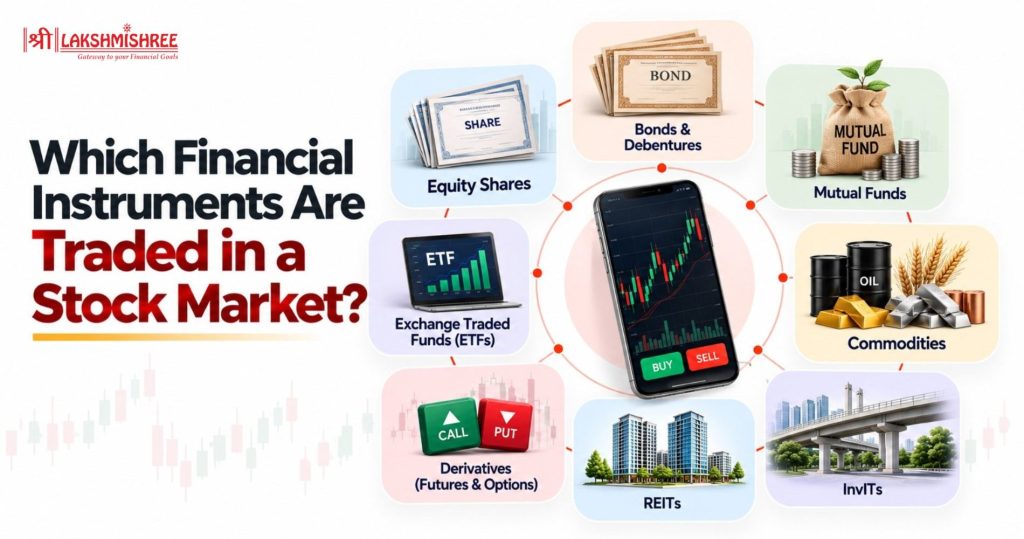
The availability and trading arrangements of these instruments depend on the exchange, listing status, and applicable regulations. Before investing, review the product's structure, costs, liquidity, and risks.
Nifty 50 and Sensex are stock market indices that help investors understand how a selected group of companies is performing.
An index works like a market indicator. It does not represent every listed company, but it offers a useful snapshot of a particular segment of the market.
For example, if an index rises, it generally indicates that the combined performance of its constituents has improved under the index's calculation method. If it falls, the selected companies have generally experienced negative performance over that period.
However, a rising index does not mean every stock is gaining value. Individual shares can move differently from the broader market.
Investors often use indices to understand market trends, compare portfolio performance, and follow financial news. They can also invest in eligible index-tracking products, such as index mutual funds and exchange-traded funds, after understanding their costs and risks.
Share prices can fall because of poor business performance, economic uncertainty, changing interest rates, or negative market sentiment. Those investing in shares may lose part or all of the money invested in an individual company.
Other risks include limited liquidity in certain shares, overconcentration in one sector, and making decisions based on rumours.
Beginners should invest according to their financial goals and risk tolerance. Avoid borrowing money to invest or relying on promises of guaranteed returns.
Understanding what is share market is the first step towards making informed investment decisions. The Indian share market provides a platform for companies to raise capital and for individuals to participate in business growth through share ownership.
Before investing, learn how exchanges work and research the risks associated with shares. Start with clear financial goals, use registered intermediaries, and avoid decisions based on rumours or promises of guaranteed returns.
A strong foundation in share market basics can help beginners approach investing with greater confidence and a more disciplined mindset.
The share market is a place where one buy and sell shares of listed companies. Buying shares gives an investor ownership in the company, subject to the rights attached to those shares.
Market users place orders through stockbrokers, and matching buy and sell orders result in trades on stock exchanges such as NSE and BSE. Trades are then cleared and settled under the applicable rules.
Yes. Beginners can start by learning the basics, completing KYC, opening the required accounts with registered intermediaries, and researching investments. They should understand the risks before investing.
A Demat account is generally required to hold listed shares electronically. Investors should confirm the applicable requirements and account arrangements with their registered intermediary.
Yes. Share prices can fall, and investors may lose some or all of their investment in a company. Diversification and research can help manage certain risks, but they cannot eliminate market risk.
NSE and BSE are separate stock exchanges in India. Both facilitate trading in listed securities and publish benchmark indices, including Nifty 50 and Sensex, respectively.