
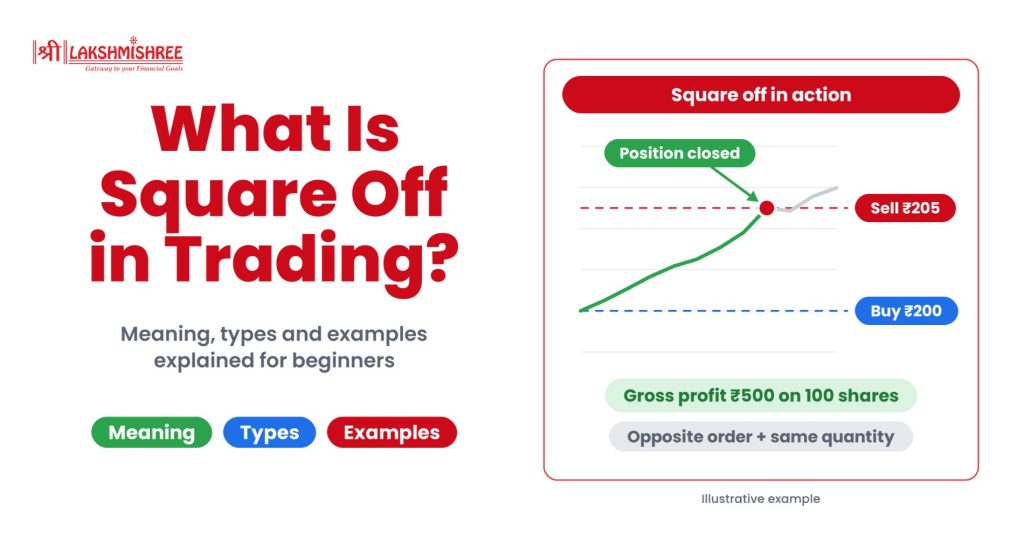
If you have ever traded on a mobile app, you have probably seen the words “square off” next to your open trade. Many of us tapped it, or let it happen, without knowing why. So, what is square off in trading, and why does every broker talk about it? It is the step that closes your trade and fixes your profit or loss.
This guide explains it in simple words, along with its types, auto square off, benefits, tax and risks.
It means closing an open position. An open position is a trade you have started but not yet ended.
You close it with an opposite order for the same quantity. After that, your position becomes zero. You no longer carry any risk in that stock or contract. Your profit or loss is now fixed.
It is most common in intraday trading. Here, you must close the trade on the same day. It also applies to futures and options and to commodity trades.
Squaring off is not always selling. If you started with a short sale, you do it by buying back.
Related Reading: Short Build Up Meaning in Stock Market | Short Covering: Meaning, Example & Trading Strategy
Let's see how it works with real numbers.
Say you buy 100 shares at ₹200 in the morning. This is a long position, because you expect the price to rise. By afternoon, the price reaches ₹205, so you sell all 100 shares. Your position is now zero. You have squared off.
Look at what you did. Your first order was a buy. Your closing order was a sell for the same number of shares. That is the whole rule: an opposite order plus the same quantity. The opposite order reverses your first action. The same quantity makes sure nothing stays open.
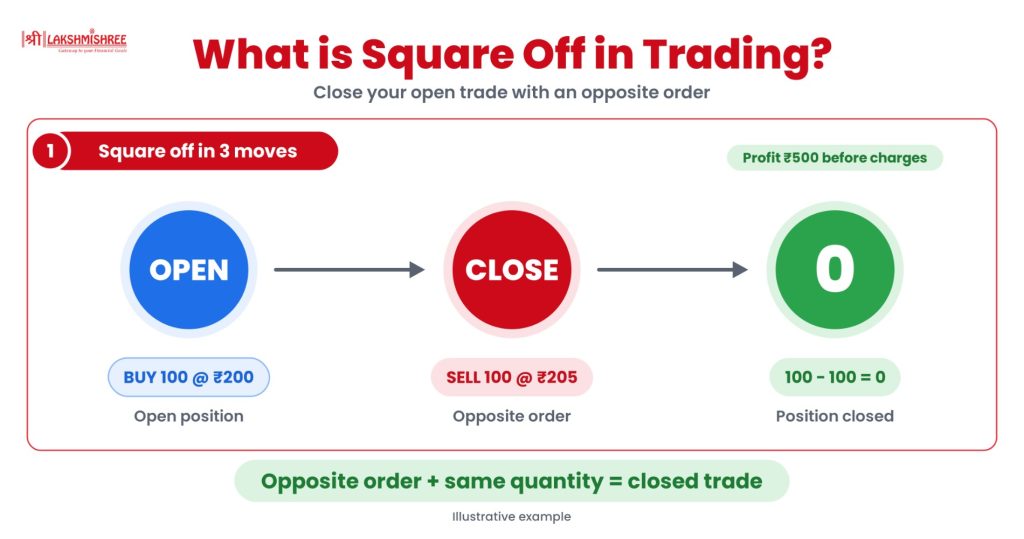
Your gross gain here is ₹500, before charges. If the price had fallen to ₹195 instead, the same step would lock in a loss of ₹500. Squaring off does not guarantee a profit. It only ends the trade.
The same logic works in reverse. Say you start with short selling: you sell 100 shares at ₹200, expecting the price to fall. When it drops to ₹195, you buy back the same 100 shares. Your position is zero again, and you earn ₹500 gross. If the price had risen to ₹205, you would have booked a loss of ₹500. The table below sums up these pairs.
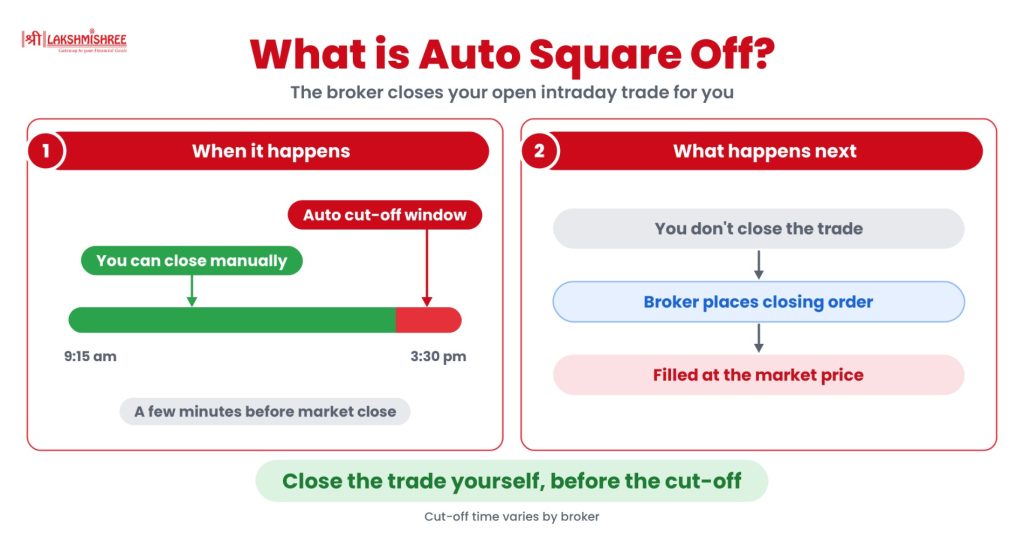
It is when your broker closes your open intraday position for you. It happens if you have not closed it yourself.
Brokers do this to manage risk. It also stops an intraday trade from turning into a delivery trade without enough funds.
The timing is usually a few minutes before the 3:30 pm market close. It varies by broker, and some brokers also set different times for different segments. Check your broker's cut-off time before you trade.
If you do nothing, the broker places the closing order at the prevailing market price. You do not get to pick the price.
Some brokers also charge an extra fee for this automatic exit. Read your broker's brokerage charges page to know the exact cost.
The safest approach is simple. Close the trade yourself, well before the cut-off.
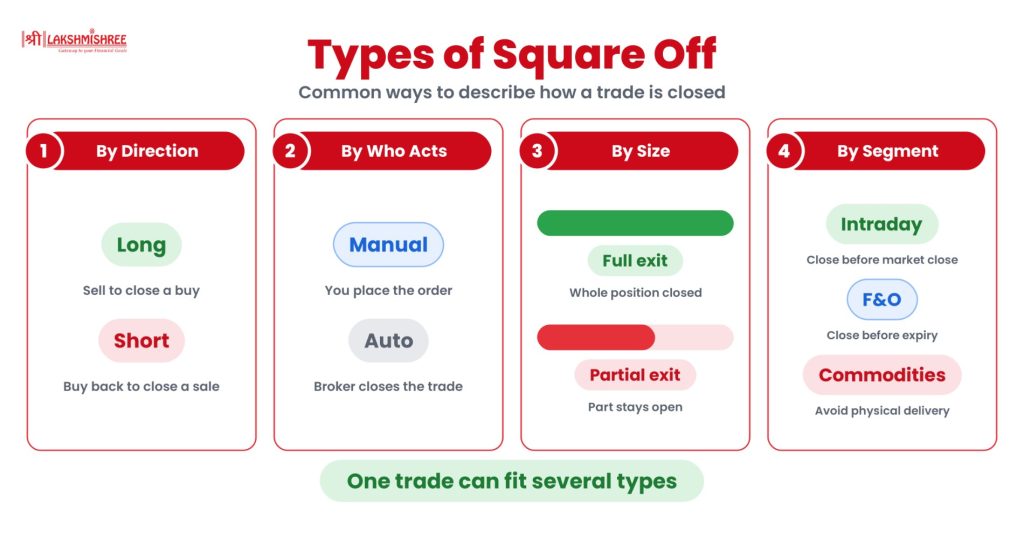
There is no official list of types. These are common ways traders describe how a position gets closed.
A long square off means selling what you bought. A short one means buying back what you sold. Both close the open position.
In a manual square off, you place the closing order. You choose the time and the price. In an automatic exit, your broker closes the trade near market close.
A full exit closes the entire position. A partial one closes only part of it. Traders use partial exits to book some profit and keep the rest open.
Check that your order is fully filled. A partial fill can leave a part of the trade open.
In intraday trading, you close the trade before the market closes. In futures and options, you can close any day before expiry. In commodities, traders often do it to avoid physical delivery.
One trade can fit several types. For example, you may manually close off a full long intraday position.
Also Read: What is Positional Trading and How Does It Work?
Squaring off helps you manage risk and capital. Here is how it helps.
Tax depends on the type of trade you squared off. The act of squaring off itself is not taxed.
Profit from squared-off intraday equity trades is treated as speculative business income. It is taxed at your income tax slab rate.
Losses can be set off only against speculative profits. They can be carried forward for 4 years. This is called loss carry forward.
Futures and options income is non-speculative business income. It is also taxed at your slab rate.
Losses can be carried forward for 8 years. They cannot be set off against salary income.
Delivery-based equity is usually taxed as capital gains, not business income. It is not a square off trade.
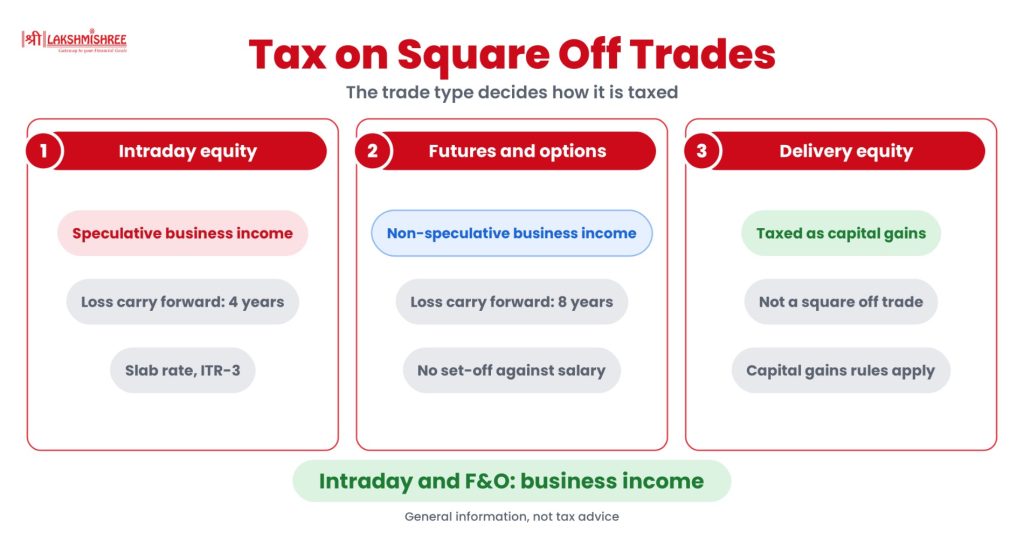
Tax rules change from time to time. This is general information, not tax advice. Please consult a chartered accountant.
Related Reading: Income Tax on F&O Trading in India: Rules, ITR & Audit | LTCG vs STCG Tax in India 2026: Rates, Rules & How to Pay Less
Squaring off is simple. Mistakes still happen, especially for beginners.

So, what is square off in trading? It is the step that closes your open trade and fixes your profit or loss. You place an opposite order for the same quantity, and your position becomes zero. Whether you buy first or sell first, the idea stays the same.
Squaring off is more than a technical term. It protects you from overnight surprises, frees up your margin and keeps your trading disciplined. It also decides how your income is taxed, so it helps to know the difference between intraday, futures and options, and delivery trades.
Know your broker's cut-off time. Understand the tax on your trades. Plan your exit before you enter, and set a stop-loss order so you are not guessing under pressure.
Before your next trade, read your broker's policy. A few minutes of reading can save you from avoidable charges and costly mistakes. Start with small quantities, practise the process and build confidence step by step.
It means closing an open trade. You do this by placing an opposite order for the same quantity. After that, you hold no position and your profit or loss is fixed.
Not always. If you bought first, squaring off means selling. If you sold first through short selling, it means buying back.
It usually happens a few minutes before the 3:30 pm market close. The exact time differs by broker and segment, so check with yours.
Your broker will usually close it at the market price near the cut-off. Some brokers may also charge a fee for this.
The profit from a squared-off trade is taxable. Intraday equity profit is speculative business income. Futures and options profit is non-speculative business income. Please consult a chartered accountant.
Disclaimer: This article is intended for educational purposes only. Please note that the data related to the mentioned companies may change over time. The securities referenced are provided as examples and should not be considered as recommendations.