

When talking about bonus share vs stock split, many investors think both corporate actions are the same because it increases the number of shares they own.
However, they work differently and have different effects on a company's financial statements. Understanding these differences can help you interpret corporate announcements and make informed investment decisions.
In this guide, you'll learn how bonus shares and stock splits work, their key differences, and what they mean for shareholders through simple explanations and practical examples.
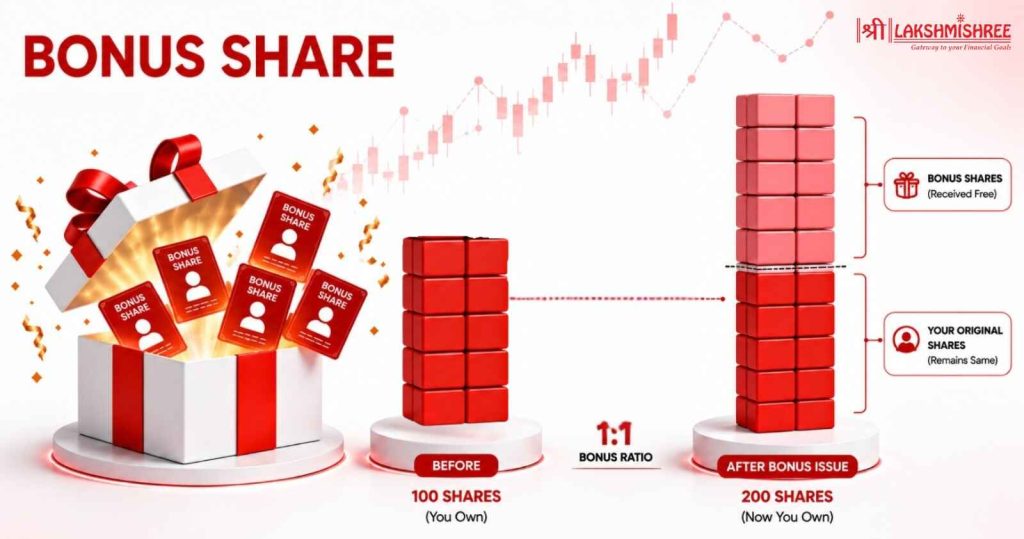
Bonus shares are additional shares that a company gives to its existing shareholders free of cost. Instead of paying cash dividends, the company issues extra shares by converting a part of its accumulated reserves into share capital.
A bonus issue follows a simple process:
Although you receive more shares, your investment value generally remains unchanged immediately after the bonus issue because the share price adjusts accordingly.
Suppose you own 100 shares of ABC Ltd., trading at ₹200 per share.
The company announces a 1:1 bonus issue, meaning you'll receive one additional share for every share you already own.
| Particulars | Before Bonus Issue | After 1:1 Bonus Issue |
| Shares Held | 100 | 200 |
| Market Price per Share | ₹200 | ₹100* |
| Total Investment Value | ₹20,000 | ₹20,000 |
*Approximate adjusted price.
A stock split is a corporate action in which a company divides its existing shares into multiple shares by reducing their face value. Unlike a bonus issue, no reserves are converted into share capital.
Here's what happens during a stock split:
Companies often announce stock splits after a significant rise in their share price to improve affordability and trading activity.
Suppose you own 100 shares of XYZ Ltd.
Each share has:
The company announces a 2-for-1 stock split, reducing the face value from ₹10 to ₹5.
| Particulars | Before Stock Split | After 2-for-1 Stock Split |
| Shares Held | 100 | 200 |
| Face Value | ₹10 | ₹5 |
| Market Price per Share | ₹500 | ₹250* |
| Total Investment Value | ₹50,000 | ₹50,000 |
*Approximate adjusted price.

| Parameter | Bonus Shares | Stock Split |
| Meaning | Free additional shares issued to existing shareholders | Existing shares are divided into more shares |
| Purpose | Reward shareholders and capitalize reserves | Reduce share price and improve affordability |
| Face Value | Remains the same | Reduces according to the split ratio |
| Number of Shares | Increases | Increases |
| Share Capital | Increases | Remains unchanged |
| Reserves | Decrease as they are converted into share capital | No impact |
| Market Capitalization | Generally remains the same immediately | Generally remains the same immediately |
| Liquidity | Usually improves | Usually improves |
| Cost to Shareholder | No additional cost | No additional cost |
| Taxation | Capital gains tax may apply when shares are sold | Cost of acquisition is adjusted after the split |
| Impact on EPS | EPS decreases due to higher share count | EPS decreases due to higher share count |
| Impact on Share Price | Price adjusts after the bonus issue | Price adjusts after the split |
Despite their differences, bonus shares and stock splits have several things in common.
A bonus issue can benefit both companies and shareholders.
Companies usually announce stock splits after a sharp rise in their share price.
Some key benefits include:

The tax treatment of bonus shares and stock splits differs. Understanding these rules can help investors calculate capital gains correctly.
Note: Tax laws may change over time. Investors should refer to the latest Income Tax provisions or consult a tax professional.
For bonus shares:
For a stock split:
For a better understanding of how short-term and long-term capital gains are taxed on equity investments, read our detailed guide on LTCG vs STCG Tax in India, which explains the applicable tax rates, holding periods, and capital gains calculations.
The simple answer is no.
Neither action creates instant wealth because the market price adjusts in line with the increase in the number of shares.
However, they may indirectly benefit investors if:
Over the long term, wealth creation depends on the company's earnings, growth, and business fundamentals, not the corporate action itself.
When talking about bonus share vs stock split, it is important to understand that both corporate actions increase the number of shares but achieve different objectives.
A bonus issue converts reserves into share capital and rewards shareholders with additional shares. A stock split reduces the face value of shares to improve affordability and liquidity. While both can create positive market sentiment, they do not immediately increase shareholder wealth.
Instead of viewing these announcements as standalone investment signals, consider the company's financial health, growth prospects, and long-term performance before making an investment decision.
Neither is inherently better. Bonus shares reward shareholders by capitalizing reserves, while stock splits improve affordability. The better choice depends on the company's objective and your investment goals.
Receiving bonus shares is generally not taxable. However, capital gains tax may apply when you sell them, subject to the applicable tax rules.
No. Immediately after the split, the market capitalization generally remains the same because the increase in the number of shares is offset by a lower share price.
Companies split their stock to reduce the market price per share, improve liquidity, and make the stock more accessible to retail investors.
Yes. A company can announce both corporate actions, although they are typically undertaken at different times to achieve different objectives.
A bonus issue may indicate that a company has accumulated healthy reserves and is confident about its financial position. However, it should not be the only factor considered before investing. Always evaluate the company's fundamentals and future growth potential.
Disclaimer: This article is intended for educational purposes only. Please note that the data related to the mentioned companies may change over time. The securities referenced are provided as examples and should not be considered as recommendations.