

The Closing Auction Session (CAS) is the final stage of the trading day that determines the official closing price of eligible securities through an auction-based price discovery mechanism. Introduced by SEBI to replace the earlier VWAP-based methodology for eligible securities, it aims to improve the accuracy, transparency, and fairness of closing price discovery.
This guide explains how this works, its timings, benefits, and why it is important for market participants.
CAS is a dedicated trading session conducted immediately after the regular market closes to determine the official closing price of eligible securities. Unlike continuous trading, where orders are executed as they are received, CAS first collects eligible buy and sell orders and then matches them at a single equilibrium price.
The objective of the Closing Auction Session is to establish a closing price that accurately reflects the overall demand and supply for a security at the end of the trading day. Since all eligible orders are considered together, the auction-based mechanism provides a fairer and more transparent price discovery process.
Earlier, the official closing price for eligible securities was determined using the Volume Weighted Average Price (VWAP) of trades executed during the final minutes of continuous trading. While the VWAP method served as a benchmark, it could be influenced by concentrated trading activity near the market close. To improve the reliability of closing prices, SEBI introduced the Closing Auction Sessionframework in January 2026, replacing the earlier VWAP-based methodology for eligible securities. The auction-based approach enhances transparency, efficiency, and fairness while reducing the possibility of end-of-day price manipulation.
The official closing price plays an important role in the securities market, as it is used for benchmark index calculation, mutual fund NAVs, ETF valuation, portfolio valuation, and the settlement of certain derivatives contracts. This makes the Session an important component of India's price discovery framework.
The session begins immediately after the regular trading session ends and follows a structured sequence prescribed by the stock exchanges.
| Phase | Current Timing | Purpose |
| Market Close | 3:30 PM | Regular equity trading session ends. |
| Order Entry Period I | 3:30 PM – 3:35 PM | Eligible orders can be placed, modified, or cancelled as permitted by the exchange. |
| Order Entry Period II | 3:35 PM – 3:40 PM | Final order collection phase with limited order actions. |
| Order Matching & Trade Confirmation | Immediately after order collection | The exchange determines the equilibrium price and executes matching orders. |
| Publication of Official Closing Price | After auction completion | The official closing price is published for eligible securities. |
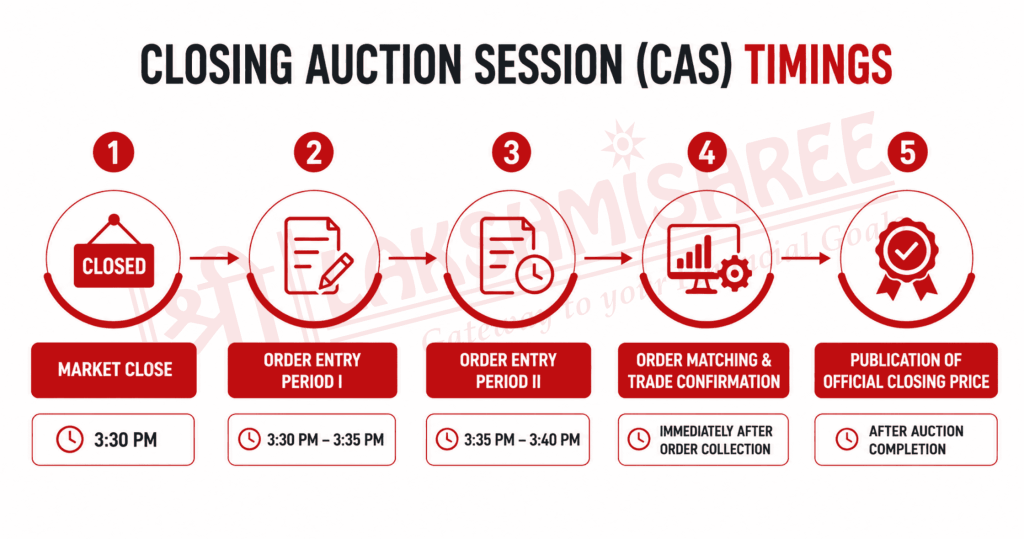
Note: The above timings reflect the current exchange framework. SEBI or the stock exchanges may revise the Closing Auction Session schedule from time to time. Investors should always refer to the latest exchange notifications before participating.
The Session follows a structured auction process to determine a single equilibrium price, which becomes the official closing price for an eligible security.
The Closing Auction Session currently applies only to securities identified by the stock exchanges under the SEBI framework. The eligibility criteria are determined by the exchanges based on factors such as liquidity and trading activity and may be revised from time to time. As the framework evolves, additional securities may also become eligible for the auction.
The stock exchanges permit specific order types during the Closing Auction Session:
The exchange determines the official closing price through an auction-based price discovery process using the following steps:
The Closing Auction Session can be summarised in the following steps:
Understanding the concept becomes easier with a simple example.
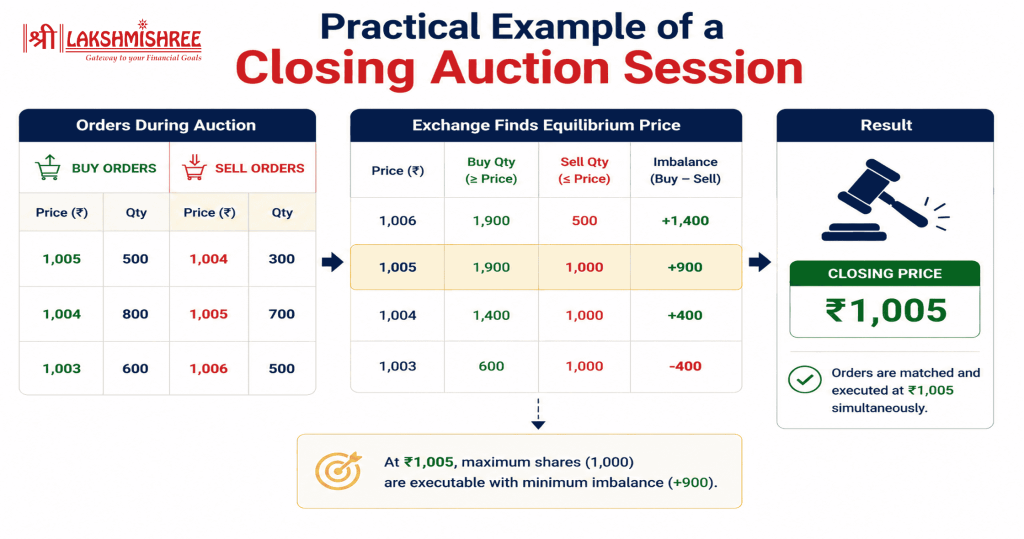
Assume the following buy and sell orders are placed during the auction:
| Buy Orders | Quantity | Sell Orders | Quantity |
| ₹1,005 | 500 | ₹1,004 | 300 |
| ₹1,004 | 800 | ₹1,005 | 700 |
| ₹1,003 | 600 | ₹1,006 | 500 |
During the order collection period, the exchange continuously calculates an indicative equilibrium price based on the available buy and sell orders.
Suppose the matching engine determines that ₹1,005 is the price at which the maximum number of shares can be executed while leaving the minimum order imbalance. All eligible buy and sell orders that qualify at this price are matched and executed simultaneously.
As a result, ₹1,005 becomes the official closing price of the security, even if the last traded price during continuous trading was different. This is because the Closing Auction Session determines the closing price through an auction-based equilibrium mechanism rather than the final trade of the day.
Before the introduction of the Closing Auction Session framework, the official closing price for eligible securities was calculated using the Volume Weighted Average Price (VWAP) of trades executed during the final minutes of continuous trading. Under the revised SEBI framework, the closing price is determined through an auction-based equilibrium price, making the process more transparent and representative of overall market demand and supply.
| Feature | Earlier VWAP Method | Closing Auction Session |
| Closing Price Basis | Volume Weighted Average Price | Auction-based Equilibrium Price |
| Price Discovery | Continuous Trading | Single Auction |
| Transparency | Moderate | High |
| Institutional Execution | Moderate | Better |
| Price Manipulation Risk | Comparatively Higher | Lower |
| Market Efficiency | Good | Improved |
It provides a more reliable closing price by considering all eligible buy and sell orders together, reducing the influence of isolated trades near the market close.
If you plan to participate in the Closing Auction Session, consider the following best practices:
Investors participating in the Session should avoid these common mistakes:

The Closing Auction Session (CAS) is an important part of the equity trading process that determines the official closing price of eligible securities through an auction-based mechanism. Introduced by SEBI to replace the earlier VWAP-based methodology for eligible securities, it enhances the transparency, fairness, and efficiency of closing price discovery.
Since the official closing price is used for benchmark indices, mutual fund NAVs, ETF valuation, portfolio reporting, and derivatives settlement, understanding how the Closing Auction Session works can help investors make more informed trading decisions. Whether you are a retail or institutional investor, knowing the auction process and exchange guidelines can help you participate more effectively.
The CAS is a dedicated auction conducted after the regular trading session to determine the official closing price of eligible securities. Instead of continuous trade execution, buy and sell orders are collected and matched at a single equilibrium price.
The Closing Auction Session begins after the regular market closes. It includes designated phases for order entry, order modification (where permitted), order matching, and publication of the official closing price. The exact timings are prescribed by the stock exchanges and may be revised by SEBI or the exchanges from time to time.
The exchange determines the closing price by identifying the equilibrium price at which the maximum number of shares can be traded while minimizing order imbalance. This price becomes the official closing price for the security.
Only securities notified as eligible by the stock exchanges participate in the CAS. The list of eligible securities may change based on exchange criteria and regulatory guidelines.
Yes. Retail investors can participate in the Closing Auction Session through their trading accounts, subject to the exchange's order types, timings, and auction rules.
The Closing Auction Session generally allows market orders, limit orders, and order modifications or cancellations during the permitted order entry period, in accordance with the rules prescribed by the stock exchanges.
Disclaimer: This article is intended for educational purposes only. Please note that the data related to the mentioned companies may change over time. The securities referenced are provided as examples and should not be considered as recommendations.