

When placing a trade in the stock market, choosing the right stock is only one part of the process. The way your order is executed can also influence the outcome of your trade. That's why trading platforms offer different order types and order validity options, each designed for a specific purpose.
One such option is the Immediate or Cancel (IOC) Order. While it may seem technical at first, the concept is quite simple. For beginners wondering what is IOC Order and how it works, the concept is quite simple. An IOC Order is designed for traders who want their order to be executed immediately rather than remain pending in the market.
Understanding how an IOC Order works is important because using the wrong order validity can lead to an order staying active longer than intended or missing a trading opportunity altogether.
An IOC Order is an order validity option that instructs the trading system to execute your order immediately, either fully or partially. If the entire order cannot be executed instantly, the unexecuted portion is cancelled automatically instead of remaining active in the market.
IOC stands for Immediate or Cancel. As the name suggests, the order must either be executed immediately or cancelled for the quantity that cannot be matched.
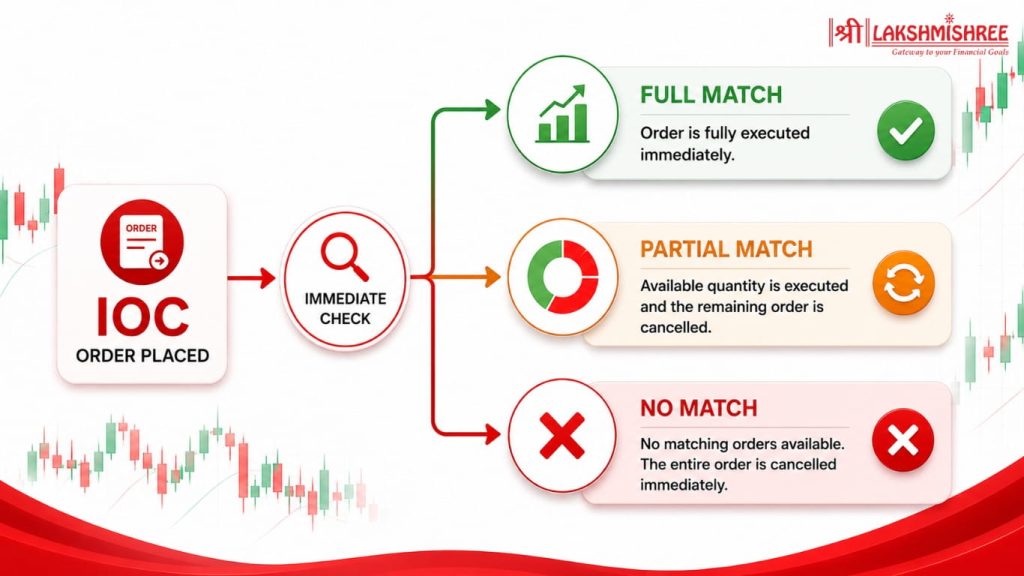
When you place an IOC Order, the trading system instantly checks whether matching buy or sell orders are available at your specified price or better.
There are three possible outcomes:
Suppose you place an IOC Buy Order for 100 shares of a company at ₹500 per share.
Traders choose an IOC Order when quick execution matters more than waiting for the complete order quantity to be filled.
Some of the common reasons traders prefer an IOC Order include:
An IOC Order can be useful in situations where timing matters and you do not want the order to remain active in the market.
Some common situations include:
An IOC Order is not suitable for every trading situation. If immediate execution is not your priority, other order validity options may be more appropriate.
You may want to avoid using an IOC Order in the following situations:

Both IOC Orders and Day Orders are order validity options, but they behave differently once they are placed. The key difference lies in how long the order remains active in the market.
| Feature | IOC Order | Day Order |
| Execution | Executed immediately, either fully or partially | Remains active until executed, cancelled, or the trading session ends |
| Order Validity | Valid only for immediate execution | Valid for the entire trading day |
| Unexecuted Quantity | Cancelled immediately | Continues to remain active until the end of the trading day or until cancelled |
| Best Suited For | Traders who want immediate execution | Traders who are willing to wait for their order to be executed |
Choose an IOC Order if immediate execution is your priority and you do not want your order to remain pending in the market.
Choose a Day Order if you are comfortable waiting for the market to match your order during the trading session.
Placing an IOC Order is straightforward on most trading platforms. While the interface may differ from one platform to another, the overall process remains largely the same.
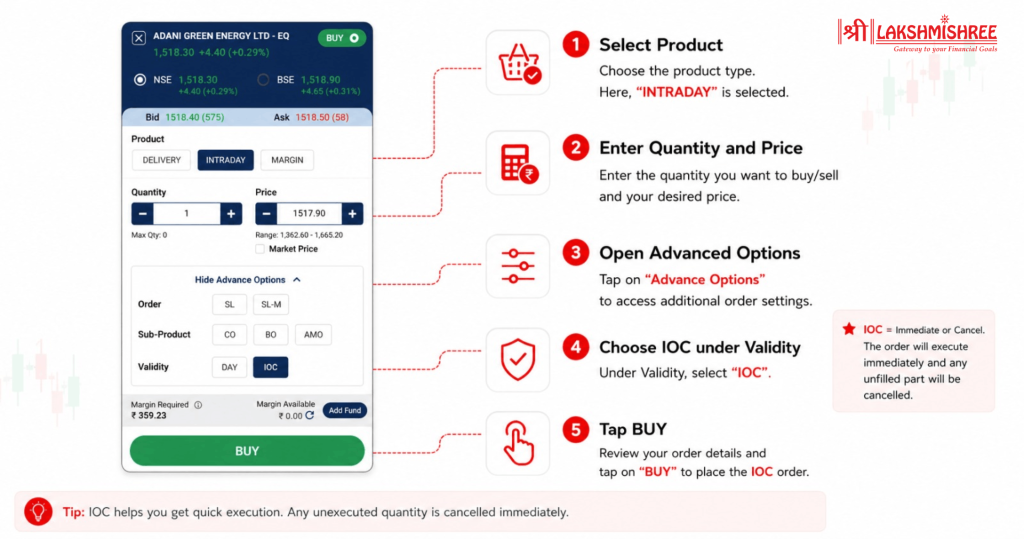
Note: The location of the Order Validity option may vary depending on the trading platform you use. Refer to the screenshots below for a visual guide.
An IOC (Immediate or Cancel) Order is a useful order validity option for traders who want immediate execution without leaving their orders pending in the market. Depending on the availability of matching orders, an IOC Order may be executed fully, partially, or cancelled if no matching orders are found.
However, like any other order type, an IOC Order should be used based on your trading objective. While it is suitable for situations where quick execution is important, it may not always be the right choice for every trade.
By understanding how IOC Orders work and when to use them, traders can make more informed decisions and choose the order validity option that best aligns with their trading strategy.
Beginners can also refer to SEBI’s investor education resources to build a better understanding of securities trading.
An IOC (Immediate or Cancel) Order is an order validity option that is executed immediately, either fully or partially. If the order cannot be executed instantly, the unexecuted quantity is cancelled automatically.
IOC stands for Immediate or Cancel. It means the order must be executed immediately, and any unmatched quantity is cancelled instead of remaining active in the market.
Yes. If only part of the order can be matched, that portion is executed immediately, while the remaining quantity is cancelled automatically.
If no matching buy or sell orders are available at your specified price, the IOC Order is cancelled immediately without any execution.
An IOC Order is valid only for immediate execution, whereas a Day Order remains active until it is executed, cancelled, or the trading session ends.
Yes. An IOC Order can be placed for delivery trades if it is supported by your broker. However, it is generally more useful in situations where immediate execution is important.
Most modern trading platforms offer IOC as one of the available order validity options. However, the availability and placement of this option may vary depending on the broker or trading platform.
Yes. Beginners can use IOC Orders once they understand how they work. However, they should choose this order validity only when immediate execution is required and they do not want the order to remain pending.
Disclaimer: This article is intended for educational purposes only. Please note that the data related to the mentioned companies may change over time. The securities referenced are provided as examples and should not be considered as recommendations.