
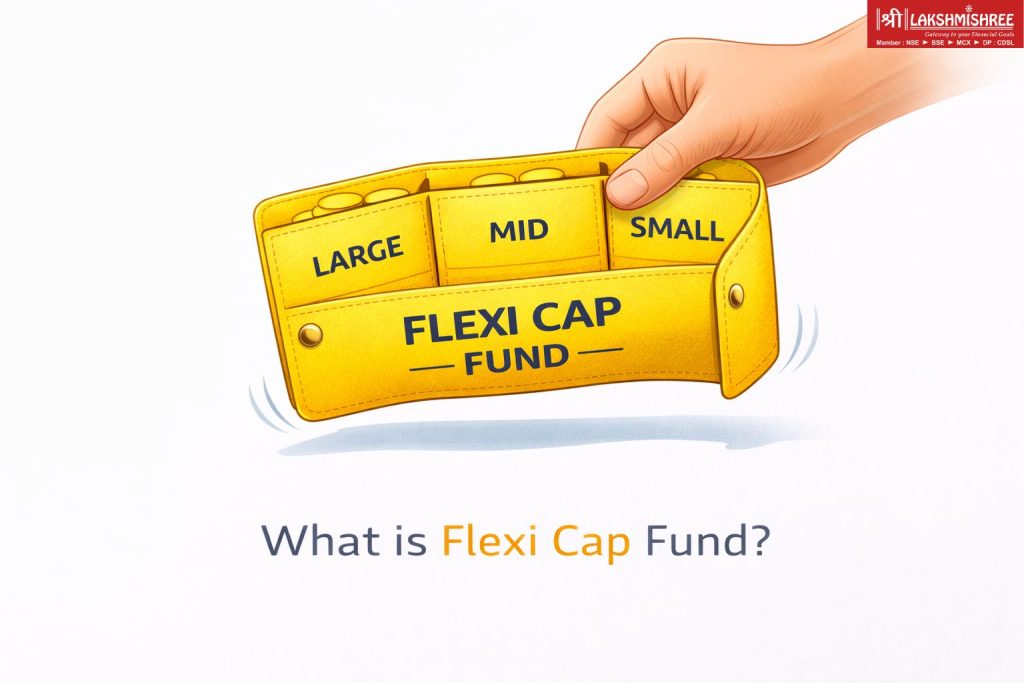
You open your mutual fund app. You see the Flexi Cap Fund in the categories.
You think: “What does flexi cap even mean? Is it different from large-cap? Mid-cap? Should I invest?”
Here’s the simple answer:
A flexi cap fund is a mutual fund that invests in companies of ALL sizes-large, medium, and small without any fixed restrictions. The fund manager has complete freedom to decide how much to invest in each category based on where they see the best opportunities.
Think of it like this:
Think of this guide as your Master key to unlock how these flexible funds work and the tax benefits they offer in 2026. We’ll break down the difference between flexi cap and large cap, mid cap, or small cap funds, highlighting the benefits and drawbacks.
A flexi cap fund is an equity mutual fund that can invest across large-cap, mid-cap, and small-cap stocks without any minimum allocation requirements. Fund managers have complete freedom to shift money between company sizes based on valuations, market conditions, and growth opportunities.
An open-ended dynamic equity scheme investing across large cap, mid cap, small cap stocks. The only rule: Minimum 65% of total assets must be in equity and equity-related instruments.
It highlights that while the fund is "open-ended" and "dynamic" (meaning it can change size and shape anytime), it must always keep at least 65% of its money in the stock market to qualify for equity tax benefits.
What this means in simply:
This is what makes flexi cap different from every other equity fund category.
Flexi means the manager has the freedom to move money wherever the growth is. Cap refers to the size of the company. It’s a strategy that adapts to the market, using stable giants for safety and smaller, fast-growing firms for profit.
The fund that can be changed easily, i.e. it can FLEX, among different types of stocks:
No fixed percentages. Changes based on opportunities.
Market capitalization = Total value of a company’s shares
Formula: Share Price × Total Number of Shares
Example:
Reliance Industries:
Dixon Technologies:
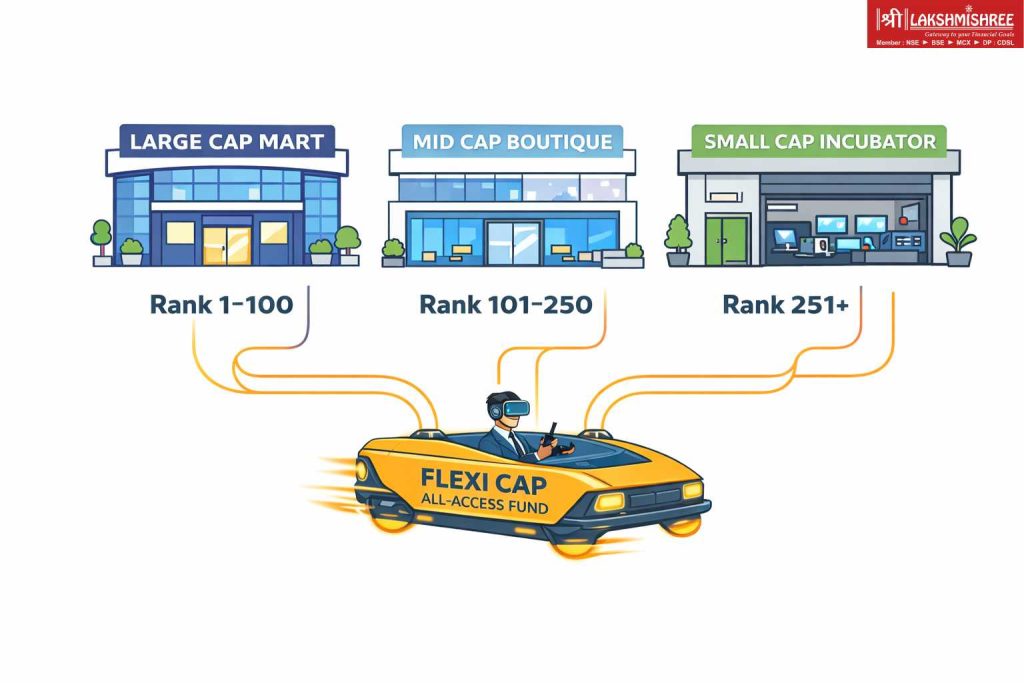
SEBI classifies companies into three categories:
| Category | Ranking by Market Cap | Examples (March 2026) |
|---|---|---|
| Large Cap | Top 100 companies | Reliance, TCS, HDFC Bank, Infosys |
| Mid Cap | Rank 101 to 250 | Dixon, Persistent Systems, Coforge |
| Small Cap | Rank 251 and below | Rail Vikas Nigam, Happiest Minds |
Imagine it is March 2024, and the market is shifting. Here is exactly how a Flexi Cap manager move your money from expensive stocks into better deals and what happens to your returns when they do.
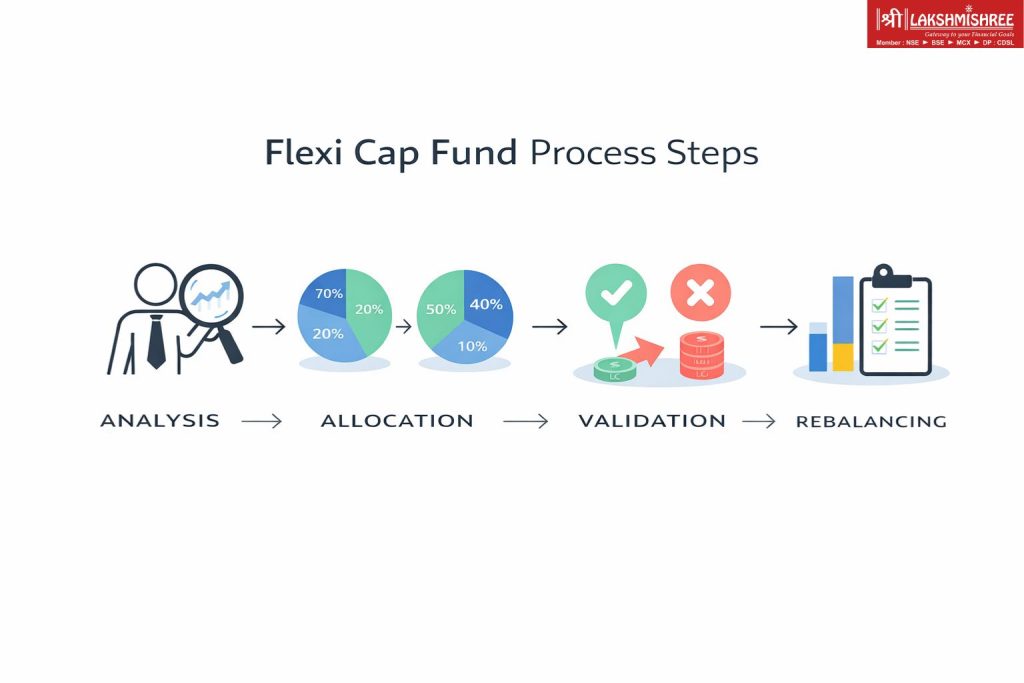
Let’s follow a typical flexi cap fund’s journey:
March 2024 scenario:
Fund manager takes a decision: "Large caps are overpriced. I’ll reduce allocation in these large caps.”
Old portfolio (February 2024) allocation:
New portfolio (March 2024) allocation:
This happens over days/weeks through buying and selling stocks.
Scenario A - If Fund Manager Was Right about his decision:
Fund manager’s flexibility captured an extra 5.5% returns.
Scenario B - If Fund Manager decision was Wrong (it is possible):
Fund underperforms. Risk of active management.
Unlike you (who might check portfolio once a month or every day but don't know the next steps ), fund managers:
This active management is what you’re paying the expense ratio for.
A Large Cap Fund is built for safety, focusing only on India’s top 100 giant companies. In contrast, a Flexi Cap Fund is made for speed; it has the freedom to shop across the entire market, grabbing profit wherever it finds it. the profit could be from a big, famous brand or a fast-growing medium-sized star. Let’s clear it up:
| Aspect | Flexi Cap Fund | Large Cap Fund |
|---|---|---|
| Investment Universe | All company sizes | Only top 100 companies |
| SEBI Requirement | 65% equity (no cap restriction) | 80% in large cap stocks |
| Risk | Moderate to High | Moderate |
| Returns Potential | Higher (can capture mid/small cap rallies) | Moderate (limited to large caps) |
| Volatility | Higher | Lower |
| Best For | Growth + some stability | Stability + steady growth |
When flexi cap wins: Mid/small caps are rallying (2024-25 example: mid caps +42% vs large caps +18%)
When large cap wins: Market uncertainty, corrections (large caps fall less)
A Mid Cap Fund targets high growth by focusing only on medium-sized companies. they are the "next generation" of market leaders. In contrast, a Flexi Cap Fund focuses on balance; it can switch between these fast-growing stars and stable giants to give you a smoother ride when the market gets uneven.
| Aspect | Flexi Cap Fund | Mid Cap Fund |
|---|---|---|
| Investment Focus | Flexible across all caps | 65%+ in mid cap stocks (rank 101-250) |
| Downside Protection | Can shift to large caps during crash | Stuck in mid caps |
| Upside Potential | Captures mid cap rallies partially | 100% exposure to mid cap gains |
| Volatility | Moderate-High | Very High |
| Best For | Balanced growth seekers | Aggressive investors |
When flexi cap wins: Market corrections (shifts to large caps for safety)
When mid cap wins: Strong mid cap rally (100% exposure in mid cap vs flexi cap’s 30-40%)
A Multi Cap Fund is built for forced diversification, as SEBI rules mandate they must always hold at least 25% each in Large, Mid, and Small companies. In contrast, a Flexi Cap Fund is built for total freedom; it allows the manager to move 100% of your money into safer, large companies if they sense a market crash is coming.
This is the most confusing comparison because they sound similar, lets understand this with a table:
| Aspect | Flexi Cap Fund | Multi Cap Fund |
|---|---|---|
| SEBI Mandate | 65% equity, no cap restriction | 75% equity + 25% minimum EACH in large/mid/small |
| Flexibility | Complete freedom | Restricted by 25-25-25 rule |
| Manager Decision | Can go 100% large cap if needed | Cannot go below 25% in any category |
| Risk Management | Dynamic (can reduce risk by shifting to large caps) | Forced diversification |
| Best For | Active management believers | Want automatic diversification |
Key difference in one example:
Market scenario: Small caps crash -30%, large caps stable.
Flexi cap manager: Exits small caps completely, moves to large caps (protects capital)
Multi cap manager: Stuck with 25% in small caps (mandatory SEBI rule), suffers loss
This flexibility is why flexi cap funds gained ₹2.3 lakh Crore AUM since 2020.
Wondering if you should invest all at once or bit-by-bit? See our analysis on
SIP vs. Lump Sum Investment
to find the best strategy for current market conditions.
Choosing a Flexi Cap Fund is like hiring a professional navigator for your investment journey. Instead of you having to guess when to move your money between big, stable companies and fast-growing small ones, a seasoned fund manager does this for you, every single day. This "always-ON analysis" approach simplifies your life by packing professional market timing, automatic diversification, and built-in crash protection into a single, tax-efficient investment.
Here are the four standout benefits that make this category a favorite for 2026:
Without flexi cap:
With flexi cap:
Example:
2022-2023: Small caps expensive → Flexi cap managers reduced small cap from 15% to 5%
2024: Mid caps attractive → Increased mid cap from 25% to 45%
You, as an investor: Did nothing. The Fund Manager did it automatically.
Instead of:
You can:
Simplifies:
Who benefits most: Beginners, busy professionals, NRIs ( those who can’t actively manage)
Market cycles rotate:
Flexi cap captures each phase by shifting allocations.
Fixed category funds miss opportunities outside their mandate.
During market crashes:
March 2020 (COVID crash):
Flexi cap fund response:
Recovery:
This dynamic risk management is FlexiCap’s biggest advantage.
While a Flexi Cap fund’s freedom is its best feature, it also comes with specific risks. Since you are giving the "steering wheel of your investment" to a professional, your success depends on their skill and the cost of their expert management. Understanding these trade-offs is key to making sure this all-weather plan really fits your long-term goals.
Your returns depend heavily on fund manager skill.
Same flexi cap category, different results (2024-25):
Risk: If fund manager leaves or makes poor decisions, your returns suffer.
Mitigation: Choose flexi cap funds with experienced managers, proven 5+ year track records.
Active management costs money:
Comparison:
Impact on ₹10 lakh over 10 years:
Is it worth it? Only if fund consistently beats benchmark by more than expense ratio difference.
With multi cap fund: You KNOW you have 25% each in large/mid/small (forced diversification)
With flexi cap: Today 70% large cap, tomorrow 40% large cap. You don’t control it.
Risk scenario:
You invested in a flexi cap because you wanted mid-cap exposure (mid-caps looked attractive).
But: Fund manager stays 80% in large caps (conservative approach).
Result: You missed the mid cap rally you wanted.
Solution: Check fund’s historical allocation patterns before investing. If fund is consistently 70%+ large cap, it’s essentially a large cap fund with flexi cap label.
Bull market (everything rising):
You might feel: “I should’ve just bought mid cap fund!”
But remember: In the next correction, that mid-cap fund might fall -40%, flexi cap will fall -22%.
Flexi cap smooths the journey (moderate gains, moderate falls). Not for maximum returns.
Why flexi cap is perfect:
How much: 70-80% of equity allocation
Recommended funds: HDFC Flexi Cap, Parag Parikh Flexi Cap (proven track records)
Why flexi cap works:
How much: 50-60% of equity allocation
Strategy: SIP in flexi cap + some index funds for passive exposure
Why flexi cap fits:
How much: 40-50% of equity allocation
Additional: Can add sectoral funds (10-15%), international equity (5-10%) for further diversification
Profile: Want equity returns but lower volatility than pure mid/small cap
Why flexi cap suits:
How much: 60-70% of equity allocation
Choose: Conservative flexi caps (HDFC, Kotak—70%+ large cap bias)
If you are sure that you have understood what is flexi cap funds and fall into one of these profiles, your next step is to compare actual performance or take action. We have curated a list of the
Best Flexi Cap Mutual Funds in 2026
based on rolling returns and manager expertise.
Picking a Flexi Cap Fund is like finding a skilled driver for your money. Instead of just chasing last year's highest profits, look for a fund that grows steadily and matches your risk level. By checking a few simple facts like the manager's experience and the fees they charge, you can pick a fund built to grow your wealth safely over time.
Don’t just see: “Fund gave 28% last year!”
Ask: Did it give consistent 18-22% over 3-5 years?
Red flag: 35% one year, 5% next year, 28% third year (inconsistent)
Green flag: 19%, 22%, 20% over 3 years (consistent)
Why: Consistency means fund manager has a proven strategy, not just luck.
Check last 8 quarterly reports. See pattern:
Fund A:
Fund B:
Choose based on YOUR risk appetite:
Direct plan expense ratios:
Always choose DIRECT plans (not Regular). Same fund, 0.5-1% lower expense.
Stability matters:
Good: Same manager for 5+ years (proven strategy, consistent)
Caution: Manager changed 6 months ago (new strategy, unproven in this fund)
Why: Past performance is under OLD manager. New manager may have different style.
Too small (<₹500 Cr): Liquidity issues, may shut down if underperforms
Sweet spot (₹2,000-50,000 Cr): Optimal size for flexibility + liquidity
Too large (>₹80,000 Cr): Harder to deploy money quickly, mid/small cap entry difficult
Exception: Parag Parikh (₹1.34 lakh Cr) works because of an international diversification strategy.
Let’s look at a typical flexi cap fund’s actual holdings (simplified example):
Total AUM: ₹25,000 Crores
Market Cap Allocation:
Top 10 Holdings:
| Stock | Market Cap | Allocation |
|---|---|---|
| HDFC Bank | Large | 7.2% |
| Reliance Industries | Large | 6.5% |
| ICICI Bank | Large | 5.8% |
| Infosys | Large | 5.2% |
| Axis Bank | Large | 4.1% |
| Dixon Technologies | Mid | 3.2% |
| Persistent Systems | Mid | 2.8% |
| Coforge | Mid | 2.5% |
| Rail Vikas Nigam | Small | 1.9% |
| Happiest Minds | Small | 1.6% |
Total Top 10: 40.8% of portfolio
Remaining 59.2%: Spread across 35-40 other stocks
What you notice:
This balance between large cap stability + mid/small cap growth opportunities is what defines flexi cap.
Since Flexi Cap funds keep at least 65% of their money in the stock market, they are taxed as Equity Funds. This is great news for your wallet because the government gives you a special tax break if you hold your investment for more than a year. By understanding these simple rules, you can keep more of your hard-earned profits and grow your wealth faster.
Equity taxation applies:
Tax: 20%
Example:
Tax: 12.5% on gains above ₹1.25 lakh exemption
Example:
Tip: ALWAYS hold flexi cap funds for 12+ months minimum to get LTCG benefit + ₹1.25L exemption.
Now that you understand what is a flexi cap fund, don't pick one at random. Review our data-backed rankings of the
Best Flexi Cap Mutual Funds in 2026
to see which schemes are leading the market this year.
Understanding what is flexi cap fund is the first step toward building a resilient, "all-weather" equity portfolio. By removing the rigid boundaries of company size, these funds allow expert managers to chase growth wherever it appears. whether in established giants or emerging mid-cap leaders. While they carry the inherent risks of active management and equity volatility, their ability to adapt to changing market cycles makes them an ideal core holding for both beginners and seasoned investors.
As you plan your financial journey, remember that the true strength of a flexi cap fund lies in its agility. It simplifies your investment process by providing a single-point solution for multi-cap exposure, effectively automating your diversification. If you are looking for a strategy that balances stability with upside potential, now is the time to evaluate what is flexi cap fund's role in your specific wealth-creation plan. Start small with a SIP, stay invested for the long term, and let professional flexibility drive your portfolio's growth.
A flexi cap fund has no fixed limits on company size (large, mid, or small). A multi-cap fund is legally required by SEBI to maintain at least 25% in each category at all times, offering less manager flexibility.
Yes. For those learning what is a flexi cap fund, it is considered a safer entry point into equity because it provides instant diversification across 40–60 companies of varying sizes, reducing the impact of a single stock's failure.
They are taxed as equity funds. Gains held over one year (LTCG) are tax-free up to ₹1.25 lakh and taxed at 12.5% thereafter. Gains held under one year (STCG) are taxed at a flat 20%.
Technically, yes. Unlike other categories, the fund manager has the mandate to move up to 100% into large-caps if they believe mid and small-caps are overvalued, providing excellent downside protection during market crashes.
Equity markets move in cycles; you should hold these funds for at least 5 to 7 years. This timeframe allows the fund manager to navigate different market phases and maximize the benefits of compounding.
Flexi cap funds are equity mutual funds subject to market risks and volatility. Returns mentioned are for illustration purposes based on historical data and do not guarantee future performance.
This content explains what is flexi cap fund for educational purposes. Not personalized investment advice. Assess your risk tolerance, investment goals, and time horizon before investing. Consult a SEBI-registered investment advisor for personalized guidance.
Mutual fund investments are subject to market risks. Read all scheme-related documents carefully before investing.