
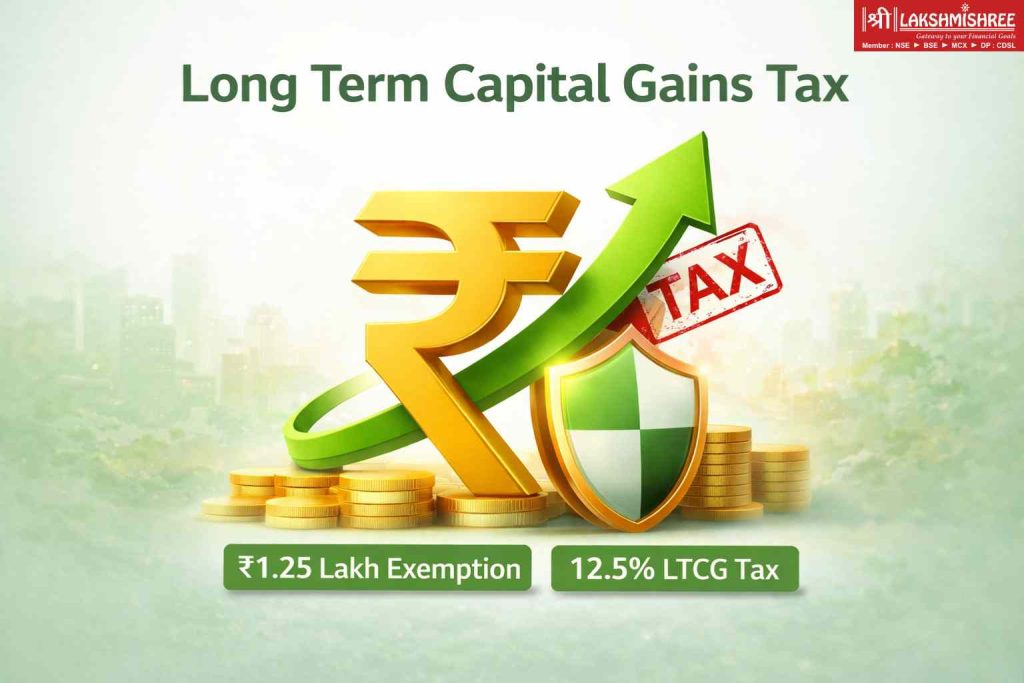
Understanding LTCG, Long Term Capital Gains Tax, is crucial for any investor. What exactly is LTCG? It's the tax applied to the profit gained from selling assets like stocks or real estate that have been held for a longer period, typically over a year. In 2026, knowing how LTCG can impact your investment returns and tax liabilities is more important than ever.
Whether you’re looking to sell investments or find ways to minimize your tax bill, this guide offers easy-to-understand insights and strategies that could let you save Tax legally
Long Term Capital Gains (LTCG) Tax is a tax on the profit you earn when you sell a capital asset, like stocks, mutual funds, or property, after holding it for a specified minimum period. In India, the LTCG tax rate and holding period depend on the asset type and were significantly revised in the Union Budget 2024.
Example: You bought shares of Reliance Industries for ₹1,00,000 in January 2023 and sold them for ₹1,60,000 in March 2026. Your capital gain is ₹60,000. Since you held for more than 1 year, this is a Long Term Capital Gain, and the LTCG tax applies to it.
The Union Budget 2024 revised LTCG tax rates significantly. Here are the current rates effective from July 23, 2024:
| Asset Type | Holding Period for LTCG | LTCG Tax Rate | Indexation Benefit |
|---|---|---|---|
| Listed Equity Shares | More than 12 months | 12.5% (above ₹1.25 lakh) | Not available |
| Equity Mutual Funds | More than 12 months | 12.5% (above ₹1.25 lakh) | Not available |
| Debt Mutual Funds (bought after Apr 1, 2023) | Taxed as per income slab | As per slab | Not available |
| Debt Mutual Funds (bought before Apr 1, 2023) | More than 36 months | 12.5% | Not available (removed in Budget 2024) |
| Real Estate / Property | More than 24 months | 12.5% | Not available (removed in Budget 2024) |
| Gold (Physical / Jewellery) | More than 24 months | 12.5% | Not available (removed in Budget 2024) |
| Gold ETF / Gold Fund | More than 24 months | 12.5% | Not available |
| Unlisted Shares | More than 24 months | 12.5% | Not available |
| NRE/NRO Accounts | Asset dependent | As per DTAA | — |
Data as of March 2026 per the Income Tax Act, 1961, as amended by the Finance Act 2024.
For listed equity shares and equity mutual funds, the first ₹1.25 lakh of LTCG per financial year is completely exempt from tax. Only gains above ₹1.25 lakh are taxed at 12.5%.
Example:
This ₹1.25 lakh limit was increased from ₹1 lakh to ₹1.25 lakh in Budget 2024, providing mild relief to retail equity investors.
Important: This exemption applies only to equity shares and equity mutual funds. It does not apply to debt funds, real estate, gold, or unlisted shares.
Budget 2024 made the most significant changes to LTCG tax in years. Here is exactly what changed:
Change 1: Rate Increased from 10% to 12.5% on Equity
The LTCG rate on listed equity shares and equity mutual funds increased from 10% to 12.5%. This is effective for gains made on or after July 23, 2024.
Change 2: Indexation Benefit Removed on Property and Gold.
Previously, property and gold sellers could use indexation, adjusting the purchase price for inflation, to reduce their taxable gain. Budget 2024 removed this benefit. This significantly increased the tax burden on property sellers.
Example of impact: If you bought a house for ₹50 lakh in 2014 and sold for ₹1.5 crore in 2026, your indexed cost (with inflation adjustment) would have been approximately ₹95 lakh, giving a taxable gain of ₹55 lakh. Without indexation, the gain is ₹1 crore i.e. almost double the taxable amount.
Change 3: Exemption Limit Raised from ₹1 Lakh to ₹1.25 Lakh
A small consolation for equity investors , the annual LTCG exemption was raised from ₹1,00,000 to ₹1,25,000. This saves ₹2,500 in tax per year for investors in the 12.5% bracket.
Short Term Capital Gains (STCG) and Long Term Capital Gains (LTCG) are taxed differently. Understanding the difference determines your tax strategy.
| Factor | LTCG | STCG |
|---|---|---|
| Holding Period (Equity) | More than 12 months | 12 months or less |
| Tax Rate (Equity) | 12.5% (above ₹1.25 lakh) | 20% (flat, from July 2024) |
| Holding Period (Property/Gold) | More than 24 months | 24 months or less |
| Tax Rate (Property/Gold) | 12.5% | As per income slab |
| Indexation | Not available (removed) | Not applicable |
| Set-off against losses | LTCG can set off LTCG losses | STCG can set off STCG or LTCG losses |
Key insight: STCG on equity was raised from 15% to 20% in Budget 2024. This makes long-term investing even more tax-efficient compared to short-term trading.
Step 1: Determine the sale price and date of the asset sold.
Step 2: Determine the purchase price and date of the asset bought.
Step 3: Calculate the holding period. If it exceeds the threshold (12 months for equity, 24 months for property/gold), it qualifies as LTCG.
Step 4: Calculate gross LTCG = Sale Price − Purchase Price − Transfer Costs (brokerage, STT, etc.)
Step 5: For equity/equity MF: Deduct ₹1.25 lakh exemption. The balance is taxable LTCG.
Step 6: Apply 12.5% on taxable LTCG.
Step 7: Add surcharge if applicable (if total income exceeds ₹50 lakh) and 4% health and education cess on the tax amount.
Worked Example:
For equity shares and equity mutual funds bought before January 31, 2018, a special grandfathering rule protects gains earned before LTCG tax was introduced in Budget 2018.
The Rule: The cost of acquisition is deemed to be the higher of:
This means gains earned on equity before January 31, 2018, are effectively tax-free. Only post-January 31, 2018, gains are subject to LTCG tax.
This rule still applies in 2026. If you hold shares since 2015, your cost basis is the January 31, 2018 price, not your original purchase price.
Since the first ₹1.25 lakh of equity LTCG is tax-free each financial year, book profits up to this limit every March and reinvest. Over 10 years, this strategy can save ₹15,000+ in taxes with zero investment change.
Example: You have an investment with a ₹2,00,000 profit. If you sell it all at once, you pay tax on ₹75,000 (after the ₹1.25L exemption). Instead, if you sell only enough to book ₹1,25,000 profit this March and reinvest it the next day, you pay ₹0 tax and your cost price for the future is now higher.
If you have made long-term losses on any equity investment, they can be used to offset your LTCG, reducing your taxable gain. Long-term losses can be carried forward for 8 years.
Example: Imagine you have a ₹3,00,000 profit from Sun Pharma but a ₹1,00,000 loss from a struggling small-cap stock. By selling both, your taxable gain drops to ₹2,00,000. After the standard ₹1.25L exemption, you only pay tax on ₹75,000 instead of ₹1,75,000.
ELSS funds have a 3-year lock-in. The gains on redemption after 3 years are LTCG, subject to the ₹1.25 lakh exemption. Unlike other 80C instruments, the investment itself saves tax (up to ₹1.5 lakh under Section 80C) AND redemption benefits from the LTCG exemption.
Example: You invest ₹1.5 Lakh in an ELSS fund. You immediately save ~₹45,000 in income tax (if in the 30% bracket). After 3 years, if that investment grows to ₹2.5 Lakh, the ₹1 Lakh gain is entirely tax-free because it falls under your annual LTCG limit.
Gifting listed shares to a spouse or family member does not attract gift tax in India. The recipient can then sell and use their own ₹1.25 lakh exemption. Two people = ₹2.5 lakh combined annual LTCG exemption on equity.
Example: You have ₹2.5 Lakh in total capital gains. If you book it all, you pay tax on ₹1.25 Lakh. However, if you gift half the shares to your spouse (who has no other income) and you both sell your respective shares, you both use your individual ₹1.25L exemptions. Result: Total Tax Paid = ₹0.
Note: Consult a tax advisor before executing this strategy. Clubbing provisions may apply depending on the relationship.
Each SIP instalment is a separate purchase with its own holding period. For equity SIPs, ensure each instalment has been held for at least 12 months before redemption to qualify for LTCG treatment (at 12.5%) rather than STCG treatment (at 20%).
Example: You started a monthly SIP in January 2025. If you sell the entire portfolio in February 2026, only the first two installments (Jan & Feb 2025) qualify for the lower 12.5% LTCG tax. The other 10 installments are less than a year old and will be taxed as STCG at a much higher 20% rate.
| Strategy | Primary Benefit | How-To Example | Potential Tax Saving |
| 1. Tax Harvesting | Uses annual ₹1.25L exemption. | Book ₹1.25L profit every March and reinvest immediately to reset your cost price. | ₹15,000+ per year |
| 2. Loss Offsetting | Neutralizes gains with losses. | Sell a loss-making stock to offset a ₹3L profit. Taxable gain drops to ₹2L. | ₹12,500 (on ₹1L loss) |
| 3. ELSS Investing | Dual tax deduction. | Invest ₹1.5L for 80C deduction; gains are tax-free up to the ₹1.25L limit. | ₹45,000 (upfront) |
| 4. Family Gifting | Doubles the tax-free limit. | Gift shares to a spouse. Two people selling means a ₹2.5L combined tax-free profit. | ₹15,625 |
| 5. SIP Planning | Avoids 20% STCG trap. | Hold each SIP for 12+ months to qualify for 12.5% LTCG instead of 20% STCG. | 7.5% of total gains |
Before investing in mutual funds, it is important to understand how taxation affects your returns. In 2026, LTCG rules vary across categories, depending on both holding period and asset type such as equity, debt, or gold. Similar-looking investments can lead to very different post-tax outcomes. The table below provides a clear, category-wise summary of these differences.
| Mutual Fund Category | Holding Period | Tax Rate | Notes |
|---|---|---|---|
| Equity Funds (65%+ equity) | 12+ months | 12.5% above ₹1.25L | Most common: Nifty index funds, large cap, flexi cap |
| ELSS Funds | 3 years (mandatory lock-in) | 12.5% above ₹1.25L | Also gives 80C benefit |
| Hybrid Equity Funds (65%+ equity) | 12+ months | 12.5% above ₹1.25L | Balanced advantage, aggressive hybrid |
| Debt Funds (bought before Apr 1, 2023) | 36+ months | 12.5% | No indexation from FY2024 |
| Debt Funds (bought after Apr 1, 2023) | Any holding period | As per income slab | Treated like FD interest |
| International Funds | 24+ months | 12.5% | Fund-of-fund structure; taxed as debt if equity < 65% |
| Gold Funds / ETFs | 24+ months | 12.5% | No indexation |
Data as of March 2026. Verify with a tax professional for your specific situation.

LTCG must be reported in your Income Tax Return. The applicable ITR form depends on your income sources:
For equity LTCG specifically: Report in Schedule CG (Capital Gains) → Long Term Capital Gains → Section 112A (for equity and equity MFs).
The broker's Statement of Capital Gains (available on Lakshmishree's platform) provides a ready calculation. Download it at the start of the new financial year and use it directly for ITR filing.
Non-Resident Indians (NRIs) are also subject to LTCG tax on Indian assets, with one key difference: TDS (Tax Deducted at Source) is applicable at the point of sale.
NRIs can claim a refund if TDS deducted exceeds their actual tax liability by filing an ITR in India.
Long Term Capital Gains Tax in India was restructured significantly in Budget 2024, and the rate increased from 10% to 12.5% on equity, indexation was removed on property and gold, and the exemption was raised from ₹1 lakh to ₹1.25 lakh. For most retail equity investors, the impact is manageable, especially those who invest systematically through SIPs and hold long-term.
The most effective tax-saving strategy remains simple: harvest your ₹1.25 lakh annual exemption every March, use long-term losses to offset gains, and invest through ELSS for the combined 80C + LTCG benefit.
Lakshmishree Investment and Securities is a SEBI-registered stockbroker (Reg. No. INZ000200835). This article is for educational purposes only and does not constitute tax or investment advice. Consult a CA or tax professional for personalised guidance.
The LTCG tax rate for listed equity shares and equity mutual funds is 12.5% on gains above ₹1.25 lakh per financial year. For real estate, gold, and debt funds (pre-April 2023), the rate is also 12.5% but without the exemption or indexation benefit.
Yes. Each SIP instalment is a separate purchase. If you redeem after holding each instalment for more than 12 months, the gains are LTCG taxed at 12.5%. If redeemed before 12 months, STCG at 20% applies.
Property sold after holding for more than 24 months attracts LTCG at 12.5%. Indexation benefit was removed in Budget 2024. So your entire capital gain (sale price minus original purchase price) is taxed at 12.5%.
Yes. Long-term capital losses can be carried forward for 8 assessment years and can only be set off against future LTCG, not against STCG or any other income.
₹1.25 lakh per financial year for equity shares and equity mutual funds. This was increased from ₹1 lakh in Budget 2024.
No. PPF and EPF withdrawals are fully tax-exempt. NPS withdrawals have their own tax treatment — 60% of the corpus withdrawn at maturity is tax-free; 40% used for annuity is taxable as income.
Physical gold, gold ETFs, and gold funds held for more than 24 months attract LTCG at 12.5% without indexation benefit (as of Budget 2024).