

Defence stocks in India are gaining attention as the country increases defence spending, expands indigenous production and strengthens its defence export capabilities.
For FY2026-27, the Ministry of Defence has received a record allocation of ₹7.85 lakh crore, with significant spending planned for capital acquisition and domestic procurement. India’s defence production also reached a record ₹1.78 lakh crore in FY2025-26, while defence exports rose to ₹38,424 crore.
With continued government support for Atmanirbhar Bharat, companies involved in aerospace, electronics, shipbuilding, missiles and other defence technologies could benefit from the sector’s long-term expansion.
If you are looking to invest in India’s growing defence sector, the following list highlights 10 leading defence stocks in India based on market capitalisation. These companies operate across aerospace, defence electronics, shipbuilding, missiles, precision engineering and other strategic areas, and may benefit from India’s focus on defence modernisation and indigenous manufacturing.
| Company | Market Capitalisation (in Cr.)* | 3Yr Growth (in %) |
| Hindustan Aeronautics Ltd | 3,25,000 | 142.76 |
| Bharat Electronics Ltd | 2,96,000 | 192.89 |
| Mazagon Dock Shipbuilders Ltd | 98,757.1 | 155.28 |
| Bharat Forge Ltd | 93,427.5 | 76.55 |
| Bharat Dynamics Ltd | 45,695.99 | 114.63 |
| Cochin Shipyard Ltd | 39,661.77 | 216.21 |
| Data Patterns (India) Ltd | 25,745 | 109.7 |
| Kaynes Technology India Ltd | 23,074.32 | 82 |
| MTAR Technologies Ltd | 23,128.22 | 173.76 |
| Astra Microwave Products Ltd | 16,378.01 | 342.39 |
*3-year growth represents the compounded annual growth rate (CAGR) of the stock price. Market capitalisation and 3-year growth data are based on the latest available figures and are subject to market fluctuations.
India’s defence sector continues to expand, supported by defence modernisation, rising domestic production and growing demand for aerospace, electronics, shipbuilding and precision-engineering capabilities. Here’s a list of notable defence stocks in India across these key segments.
Hindustan Aeronautics Ltd. (HAL) is a leading aerospace and defence company involved in the design, manufacturing, repair and overhaul of aircraft and helicopters. It also develops avionics, aero-engines and other aerospace systems for India’s defence and aviation requirements.
| 1Y growth (%)* | 3Y growth (%)* | 5Y growth (%)* |
| 9.19 | 142.76 | 606.1 |
Bharat Electronics Ltd. (BEL) is a leading defence electronics company that develops radars, communication systems, electronic warfare systems and avionics. Its portfolio also includes solutions for naval systems, electro-optics, surveillance and other strategic defence applications.
| 1Y growth (%)* | 3Y growth (%)* | 5Y growth (%)* |
| 9.03 | 192.89 | 517.39 |
Mazagon Dock Shipbuilders is a major Indian defence shipyard specialising in the construction of warships and submarines. Its key capabilities include building destroyers, frigates, conventional submarines and other naval vessels.
| 1Y growth (%)* | 3Y growth (%)* | 5Y growth (%)* |
| -8.33 | 155.28 | 1916.01 |
Bharat Forge is a diversified engineering company with a growing presence in defence and aerospace. Its defence portfolio includes artillery systems, protected vehicles, defence components and other systems, while its aerospace business focuses on precision-engineered components.
| 1Y growth (%)* | 3Y growth (%)* | 5Y growth (%)* |
| 62.2 | 76.55 | 152.1 |
Bharat Dynamics Ltd. (BDL) is a defence public sector company specialising in the manufacture of guided missile systems and allied defence equipment. Its portfolio includes missiles, underwater weapons, airborne products and other systems for the Indian Armed Forces.
| 1Y growth (%)* | 3Y growth (%)* | 5Y growth (%)* |
| -13.97 | 114.63 | 527.28 |
Cochin Shipyard is one of India’s major shipbuilding and ship-repair companies, with capabilities to construct and maintain large vessels. It undertakes shipbuilding and repair projects for the Indian Navy, Coast Guard and other domestic and international customers.
| 1Y growth (%)* | 3Y growth (%)* | 5Y growth (%)* |
| -8.65 | 216.21 | 719.26 |
Data Patterns (India) Ltd. is a defence and aerospace electronics company providing high-reliability electronic systems and solutions. Its capabilities cover areas such as radar, electronic warfare, avionics, communication and other mission-critical defence applications.
| 1Y growth (%)* | 3Y growth (%)* | 5Y growth (%)* |
| 81.38 | 109.7 | 509.87 |
Kaynes Technology is an integrated electronics manufacturing and technology company with capabilities across electronic system design and manufacturing. It has exposure to aerospace and defence electronics along with other high-technology and strategic sectors.
| 1Y growth (%)* | 3Y growth (%)* | 5Y growth (%)* |
| -48.93 | 82 | 382.59 |
MTAR Technologies specialises in high-precision engineering and manufacturing for aerospace, defence, nuclear and clean-energy applications. Its capabilities include the production of precision components, assemblies and complex systems for critical applications.
| 1Y growth (%)* | 3Y growth (%)* | 5Y growth (%)* |
| 430.7 | 173.76 | 448.67 |
Astra Microwave Products develops and manufactures RF and microwave systems and subsystems for defence, space and other strategic applications. Its capabilities include radar electronics, electronic warfare systems, telemetry, antennas and communication systems.
| 1Y growth (%)* | 3Y growth (%)* | 5Y growth (%)* |
| 71.74 | 342.39 | 900.58 |
*1-year growth, 3-year growth, 5-year growth represents the compounded annual growth rate (CAGR) of the stock price. CMP, Market capitalisation, P/E, ROCE and stock-price data are based on the latest available figures and are subject to market fluctuations.
Small-cap defence stocks in India represent companies operating in specialised areas such as defence electronics, aerospace manufacturing, unmanned systems and precision engineering. These companies can play an important role in India’s defence manufacturing ecosystem and may benefit from the country’s focus on indigenous production and defence modernisation.
| Company | Market Capitalisation* | 1Yr Growth* |
| Data Patterns (India) Ltd | 25745 | 81.38 |
| Paras Defence and Space Technologies Limited | 12,420.92 | 138.24 |
| Unimech Aerospace and Manufacturing Ltd | 7767.64 | 46.76 |
| Rossell Techsys Ltd | 4,458.74 | 66.54 |
| IdeaForge Technology Ltd | 3936.62 | 57.88 |
*1-year growth represents the compounded annual growth rate (CAGR) of the stock price. Market capitalisation and 1-year growth data are based on the latest available figures and are subject to market fluctuations.
Defence stocks in India are shares of companies involved in manufacturing and supplying products and services for the defence and aerospace sectors. These companies operate across areas such as fighter aircraft, helicopters, warships, submarines, missiles, defence electronics, radars, communication systems, precision components and unmanned technologies.
India’s defence sector is undergoing a significant shift towards domestic manufacturing and self-reliance under the Aatmanirbhar Bharat initiative. The Ministry of Defence received a record allocation of ₹7.85 lakh crore for FY2026-27, including ₹2.19 lakh crore under the capital head and ₹1.39 lakh crore earmarked for procurement from domestic defence industries.
The expansion of domestic manufacturing is also reflected in recent industry figures. Defence production reached a record ₹1.78 lakh crore in FY2025-26, while defence exports rose to ₹38,424 crore during the same year. The private sector accounted for 24% of defence production, highlighting its growing role in India’s defence industrial ecosystem.
For investors, defence stocks provide exposure to companies participating in this expanding ecosystem. However, these companies differ significantly in terms of business models, government dependence, order books, valuations and exposure to the defence sector. Therefore, investors should evaluate individual companies and their financial performance rather than treating all defence stocks as a single category.

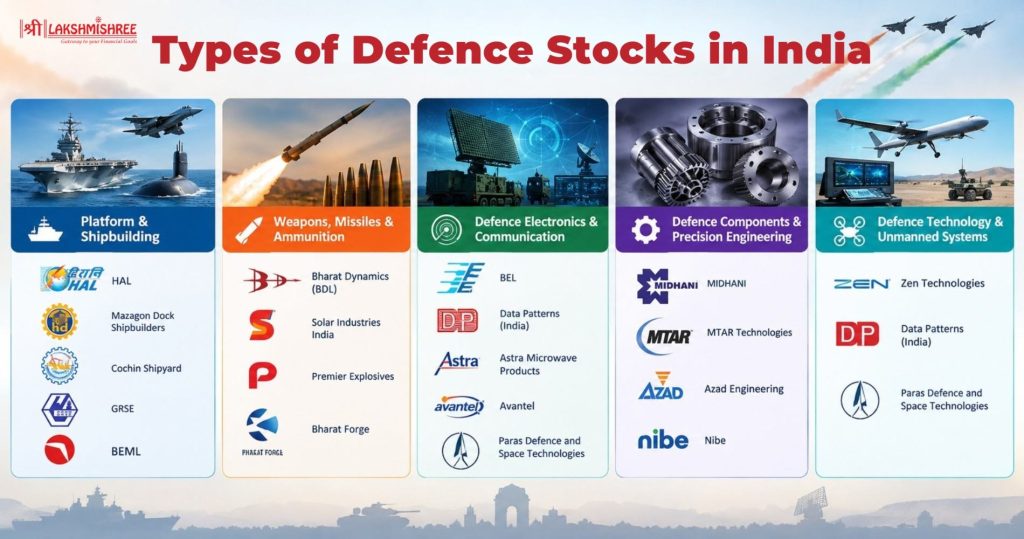
India’s defence industry includes companies working across manufacturing, shipbuilding, electronics, weapons, components and emerging defence technologies. Investors can broadly group defence stocks in India based on the type of products and services they provide.
These companies manufacture large defence platforms such as fighter aircraft, helicopters, submarines, warships and other naval vessels.
Companies in this segment manufacture or supply missiles, ammunition, explosives, propellants and other systems used by the armed forces.
These companies develop technologies used for radar, surveillance, electronic warfare, communication, avionics and other defence applications.
These businesses supply specialised components, materials and precision-engineered parts that are used in defence, aerospace and other strategic industries.
This emerging segment covers areas such as anti-drone systems, military simulators, unmanned technologies and other technology-driven defence solutions.
Defence stocks can sometimes be more resilient during economic slowdowns because defence spending is driven largely by national security requirements and government procurement rather than consumer demand. However, they are not completely counter-cyclical and can still be affected by broader market volatility and valuation corrections.
In India, continued government spending on defence modernisation can provide support to the sector during challenging economic conditions. For FY2026-27, the Ministry of Defence received a record allocation of ₹7.85 lakh crore, including ₹2.19 lakh crore under the capital head.
Related Reading: Motilal Oswal Defence ETF (MODefence) 2026: Full Review- Returns, Holdings & Buy Decision | Best Defence Mutual Funds in India 2026: Top Funds as India's Defence Budget Hits ₹6.2 Lakh Crore
Defence stocks in India have gained attention as the country increases defence spending, expands domestic production and strengthens its defence export capabilities. With continued focus on military modernisation, indigenous manufacturing and advanced defence technologies, the sector is expected to remain an important part of India’s industrial growth.
However, investors should evaluate individual defence companies based on factors such as order books, execution capabilities, financial performance, valuations and government dependence. A careful assessment of these factors can help investors make more informed decisions when considering defence stocks in India for their portfolios.
Defence stocks are shares of companies involved in manufacturing or supplying products and services for India’s defence and aerospace sectors, including aircraft, warships, missiles, defence electronics and precision components.
Some notable defence stocks in India include Hindustan Aeronautics, Bharat Electronics, Mazagon Dock Shipbuilders, Bharat Dynamics, Cochin Shipyard, Bharat Forge, Data Patterns, Kaynes Technology, MTAR Technologies and Astra Microwave Products.
Defence stocks can offer exposure to India’s growing defence manufacturing and modernisation efforts. However, investors should consider factors such as valuations, order books, execution, financial performance and government dependence before investing.
Defence stocks can sometimes be relatively resilient because defence spending is driven largely by national security requirements rather than consumer demand. However, they remain subject to broader market volatility and company-specific risks.Defence stocks can sometimes be relatively resilient because defence spending is driven largely by national security requirements rather than consumer demand. However, they remain subject to broader market volatility and company-specific risks.
Some established defence companies, particularly defence PSUs, may pay dividends. However, dividend payments vary by company and year, so investors should check the latest financial results and dividend announcements.
Disclaimer: This article is for educational purposes only and should not be considered financial advice. Always conduct your research and consider consulting with a financial advisor before making any investment decisions.