

NBFC stocks in India have gained attention as the country's demand for credit continues to grow. Non-Banking Financial Companies provide loans and financial services to individuals, businesses and MSMEs.
They serve several segments, including consumer finance, vehicle finance, gold loans and infrastructure funding. This makes the NBFC sector an important part of India's financial services industry. However, NBFC companies differ in their business models, financial performance and risk levels.
Understanding these factors can help investors make more informed decisions when evaluating NBFC shares in India.
NBFC stands for Non-Banking Financial Company. These companies provide financial services but operate differently from traditional banks.
NBFCs offer several types of credit. These include consumer loans, business loans, vehicle finance, gold loans and infrastructure finance.
Their revenue mainly comes from lending and related financial services. Interest income is an important part of their earnings.
The business model can vary widely between companies. Some focus on retail customers. Others specialise in commercial vehicles, gold loans or infrastructure financing.
NBFCs also support financial inclusion. They can provide credit to customers and businesses with different financing needs.
Buying an NBFC share means taking exposure to the company's financial performance and future growth. It also means taking exposure to risks linked to credit, funding and regulations.
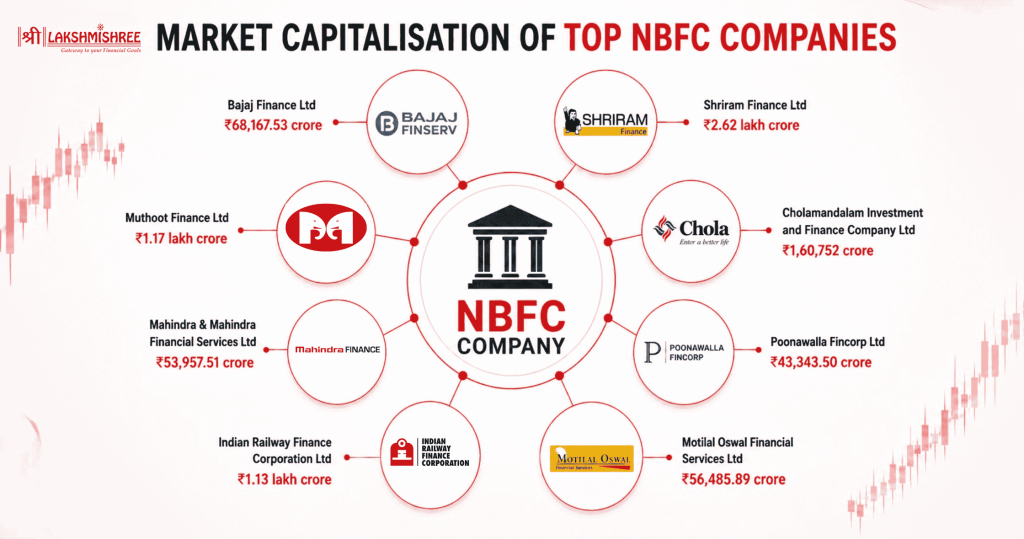
The following NBFC stock list includes eight established companies. Each company has a different business model and customer base.
| NBFC Company | 3-Year Growth* | Market Capitalisation* |
| Bajaj Finance Ltd | 56% | ₹68,167.53 crore |
| Shriram Finance Ltd | 212% | ₹2.62 lakh crore |
| Muthoot Finance Ltd | 43% | ₹1.17 lakh crore |
| Cholamandalam Investment and Finance Company Ltd | 73.5% | ₹1,60,752 crore |
| Mahindra & Mahindra Financial Services Ltd | 34.3% | ₹53,957.51 crore |
| Poonawalla Fincorp Ltd | 15% | ₹43,343.50 crore |
| Indian Railway Finance Corporation Ltd | 78.5% | ₹1.13 lakh crore |
| Motilal Oswal Financial Services Ltd | 328% | ₹56,485.89 crore |
Bajaj Finance is a diversified lending company. It serves retail, SME and commercial customers. Its portfolio covers multiple financial products.
Investors can monitor its loan growth and asset quality. Net interest margin and return ratios are also important.
Bajaj Finance's available market data shows a diversified lending portfolio across retail, SME and commercial customers.
| 1-Year Growth* | 3-Year Growth* | 5-Year Growth* |
| 21.27% | 56% | 70.81% |
Shriram Finance has a strong presence in vehicle finance. It also serves retail and business customers. Its lending portfolio is spread across multiple segments.
Investors can track AUM growth and asset quality. Credit costs and profitability are also important.
| 1-Year Growth* | 3-Year Growth* | 5-Year Growth* |
| 77.60% | 212% | 343% |
Muthoot Finance is mainly known for gold financing. It provides loans against gold. This makes its business model different from many diversified NBFCs.
Investors can monitor loan growth and asset quality. Margins and developments in gold lending are also relevant.
| 1-Year Growth* | 3-Year Growth* | 5-Year Growth* |
| 5.17% | 43% | 100% |
Cholamandalam Investment and Finance Company operates across several financing segments.
Its activities include vehicle finance and other forms of lending. The company has also expanded its financing portfolio over time.
Investors can track AUM growth and asset quality. Profitability and funding costs are also important.
| 1-Year Growth* | 3-Year Growth* | 5-Year Growth* |
| 23.53% | 73.5% | 287% |
Mahindra & Mahindra Financial Services has a strong focus on vehicle and rural finance. Its performance can be linked to vehicle demand and rural economic activity.
Investors can monitor loan growth and asset quality. Credit costs and profitability also require attention.
| 1-Year Growth* | 3-Year Growth* | 5-Year Growth* |
| 45.03% | 34.3% | 177% |
Poonawalla Fincorp focuses on consumer and business lending. It offers financing solutions across different customer segments.
| 1-Year Growth* | 3-Year Growth* | 5-Year Growth* |
| 5.83% | 15% | 163.6% |
Indian Railway Finance Corporation focuses on railway-related financing.
Its business model differs from retail-focused NBFCs.
The company supports financing within the railway infrastructure ecosystem.
Investors can monitor its asset growth and profitability. Borrowing costs are also important for this business model.
| 1-Year Growth* | 3-Year Growth* | 5-Year Growth* |
| -30.82% | 78.5% | 275% |
Motilal Oswal Financial Services has a diversified financial services business.
Its activities include capital markets, asset management and lending-related services.
Its performance can therefore be influenced by both financial markets and credit demand.
Investors can track segment performance and profitability. Market conditions are also an important factor.
| 1-Year Growth* | 3-Year Growth* | 5-Year Growth* |
| 0.37% | 328% | 380% |

NBFC stocks can provide exposure to India's expanding financial services sector. However, returns are not guaranteed.
Related Reading: Best Sugar Stocks in India to Invest in 2026 | 10 Best Railway Stocks in India 2026
| Risk | Potential Impact |
| Credit Risk | Defaults can increase NPAs and credit costs. |
| Liquidity Risk | Funding challenges can affect lending operations. |
| Interest Rate Risk | Higher funding costs can pressure margins. |
| Regulatory Risk | RBI regulations can affect business operations. |
| Asset Quality | Weak repayment can reduce profitability. |
| Economic Slowdowns | Lower economic activity can reduce credit demand. |
| Factor | NBFCs | Banks |
| Core activity | Lending and financial services | Banking and lending |
| Business model | Often specialised | Generally broader |
| Customer segments | Varies by NBFC | Retail, corporate and other segments |
| Key metrics | Loan growth, NPA, NIM, ROA and ROE | Loan growth, deposits, NIM, NPA, ROA and ROE |
| Key risks | Credit, liquidity, funding and regulatory risks | Credit, liquidity, interest-rate and regulatory risks |
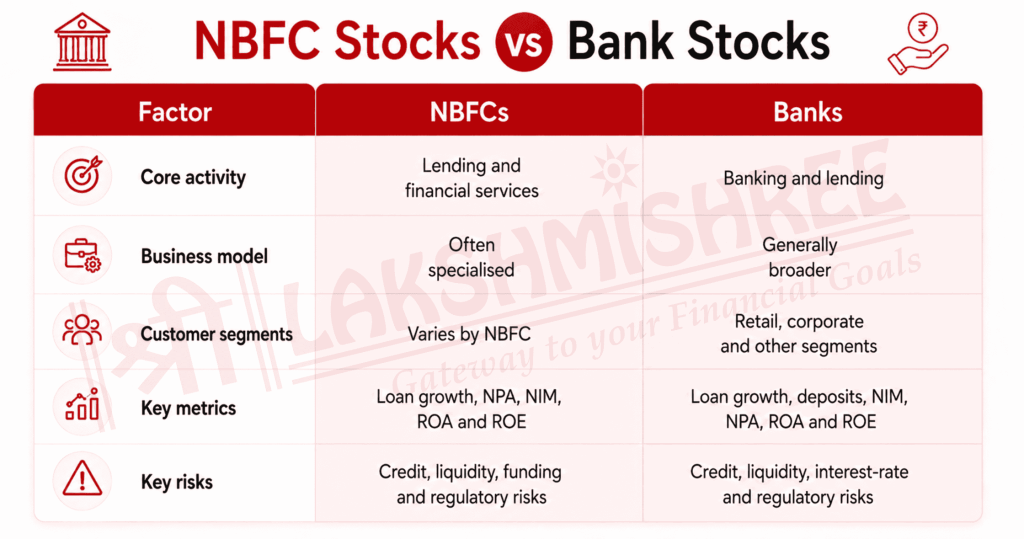
Investors should compare companies with similar business models. A retail-focused NBFC may not be directly comparable with an infrastructure-focused NBFC.
Related Reading: Top 10 Private Banks in India 2026 | Top 10 Government Banks in India list
NBFC stocks in India offer exposure to the country's growing financial services sector. The companies covered in this article operate across different segments. These include consumer finance, vehicle finance, gold lending, business finance and infrastructure financing.
However, sector growth alone does not make a stock suitable for every investor. Loan growth, asset quality, NPAs, margins, profitability, funding costs and valuation should all be considered.
Investors should conduct their own research and understand the risks before investing in NBFC shares in India.
*3yr Growth represents the approximate compounded annual growth rate (CAGR) of the share price over three years. Market capitalisation and share-price performance may change with market conditions.
NBFC stocks are shares of listed Non-Banking Financial Companies in India. These companies provide services such as lending and asset financing under the applicable regulatory framework.
Some notable listed NBFC companies include Bajaj Finance, Shriram Finance, Muthoot Finance, Cholamandalam Investment and Finance Company, Mahindra & Mahindra Financial Services, Poonawalla Fincorp, IRFC and Motilal Oswal Financial Services.
NBFC stocks can offer exposure to credit growth and the financial services sector. However, their suitability depends on company fundamentals, valuation, risk profile and an investor's financial goals.
Investors can examine loan-book growth, asset quality, gross and net NPA, credit costs, net interest margin, ROA, ROE, capital adequacy and valuation.
Yes. NBFCs are subject to the applicable regulatory framework of the Reserve Bank of India. The specific requirements can vary based on the type and activities of the NBFC.
Major risks include credit risk, liquidity risk, interest-rate risk, regulatory risk, asset-quality deterioration and economic slowdowns.
Disclaimer: This article is intended for educational purposes only. Please note that the data related to the mentioned companies may change over time. The securities referenced are provided as examples and should not be considered as recommendations.