
When looking at a company's financial performance, several metrics can help explain how well the business is performing. Understanding what is EBITDA can be particularly useful, as it shows a company's earnings before interest, taxes, depreciation and amortisation.
It helps businesses, investors and lenders assess operating performance and compare companies. It can also support comparisons between businesses with different financing or tax structures. However, it does not show the complete financial position of a company.
This guide explains its meaning, formula, calculation, importance and coverage ratio in simple terms.
EBITDA stands for Earnings Before Interest, Taxes, Depreciation and Amortisation. In simple terms, it shows how much a business earns from its operations before these four items are considered.
Interest expenses relate to borrowing. Taxes are payments made to the government. Depreciation reflects the gradual reduction in the value of physical assets. Amortisation applies a similar concept to certain intangible assets.
By excluding these items, it gives analysts a clearer view of operating performance. It is generally treated as a non-GAAP financial metric. Therefore, it should not be viewed as a replacement for net profit or cash flow.
It helps assess how profitable a company's core business operations are. It can also make comparisons easier between companies with different debt levels, tax situations or asset structures.
Investors and analysts may use this while studying business performance and valuation. Lenders can also consider it when assessing debt-servicing capacity. However, it works best when viewed alongside revenue, net profit, cash flow and other financial measures.
It is widely used as a financial metric in business and investment analysis. It focuses on earnings before financing costs, taxes and certain non-cash expenses. This can help analysts understand the underlying operating performance of a business.
Businesses, investors and lenders may use this financial metric to compare companies and study profitability. It can also form part of valuation analysis. Still, the metric alone cannot provide a complete picture of financial health.
Related Reading: DCF Valuation | P/B Ratio
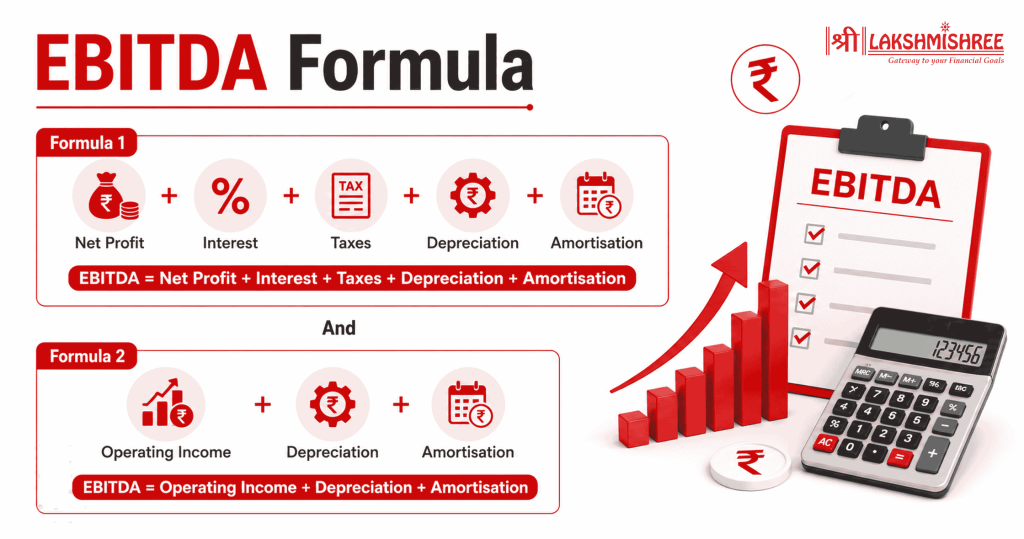
There are two commonly used approaches for calculating this financial metric:
EBITDA = Net Profit + Interest + Taxes + Depreciation + Amortisation
And
EBITDA = Operating Income + Depreciation + Amortisation
The first formula starts with net profit and adds back the expenses excluded from this operating earnings. The second starts with operating income and adds depreciation and amortisation.
For example, if a business has ₹5 lakh in net profit, ₹50,000 in interest, ₹1 lakh in taxes, ₹30,000 in depreciation and ₹20,000 in amortisation, these amounts can be added back to calculate the metric.
Suppose a retail company reports the following figures for a financial year:
| Financial component | Amount |
| Net Profit | ₹8,00,000 |
| Interest Expenses | ₹1,20,000 |
| Taxes | ₹2,00,000 |
| Depreciation | ₹80,000 |
| Amortisation | ₹40,000 |
To calculate this measure, add interest, taxes, depreciation and amortisation back to the net profit.
EBITDA = ₹8,00,000 + ₹1,20,000 + ₹2,00,000 + ₹80,000 + ₹40,000
EBITDA = ₹12,40,000
Therefore, the company's resulting amount is ₹12.4 lakh.
This means the company generated ₹12.4 lakh in earnings before interest, taxes, depreciation and amortisation. However, the figure should not be considered the same as cash available to the business, as the company may still have other cash expenses and financial obligations.
The EBITDA Coverage Ratio indicates a company's ability to meet its debt-related obligations using its earnings measure. It can be useful for lenders and investors assessing financial strength.
EBITDA Coverage Ratio = EBITDA ÷ Debt Obligations
For example, if the figure is ₹10 lakh and relevant debt obligations are ₹5 lakh, the ratio is 2×. Generally, a higher ratio indicates greater capacity to meet debt obligations. However, the definition of debt obligations can vary based on the methodology used.

EBITDA margin shows the metric as a percentage of a company's revenue. It helps assess how much operating earnings a business generates from its sales.
EBITDA Margin = (EBITDA ÷ Revenue) × 100
For example, if a company has revenue of ₹50 lakh and EBITDA of ₹5 lakh:
EBITDA Margin = (₹5 lakh ÷ ₹50 lakh) × 100 = 10%
A higher margin can indicate stronger operating profitability. However, the margin should ideally be compared with the company's past performance and businesses in the same industry.
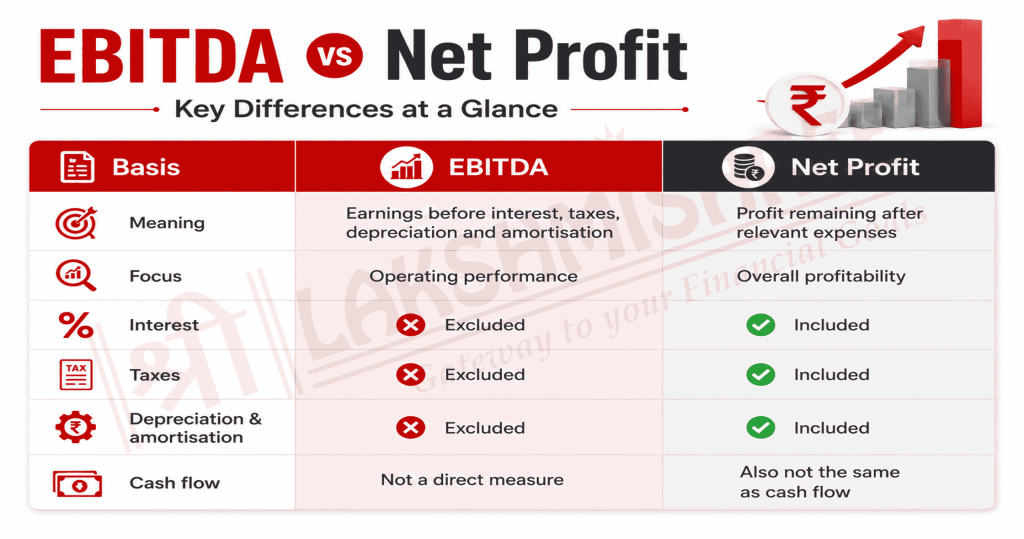
This financial measure and net profit measure different aspects of a company's financial performance.
| Basis | EBITDA | Net Profit |
| Meaning | Earnings before interest, taxes, depreciation and amortisation | Profit remaining after relevant expenses |
| Focus | Operating performance | Overall profitability |
| Interest | Excluded | Included |
| Taxes | Excluded | Included |
| Depreciation & amortisation | Excluded | Included |
| Cash flow | Not a direct measure | Also not the same as cash flow |
For example, a company may report strong operating earnings but lower net profit because of high interest costs, taxes or depreciation. Both metrics can therefore provide useful insights. The metric should not be treated as a replacement for net profit.
A clear understanding of what is EBITDA can help you make better sense of a company's operating performance and profitability. This operating metric focuses on earnings before interest, taxes, depreciation and amortisation, making it useful for comparing businesses and supporting financial analysis and valuation
The EBITDA margin can show operating profitability relative to revenue, while the EBITDA coverage ratio can provide insight into debt-servicing capacity.
However, this financial metric has certain limitations and should not be confused with net profit or cash flow. Considering the financial measure alongside other financial metrics gives a more complete picture of a company's financial position.
The metric stands for Earnings Before Interest, Taxes, Depreciation and Amortisation. It is used to assess a company's operating performance before these items are considered.
No. EBITDA and net profit are different measures. The former excludes interest, taxes, depreciation and amortisation, while later one accounts for these expenses.
No. Both measures are not the same. This metric does not account for several cash expenses, including capital expenditure and changes in working capital.
There is no single EBITDA figure that can be considered good for every company. It depends on factors such as the industry, business size, revenue and operating model. Comparing this metric with industry peers and the company's historical performance can provide better context.
This financial metric is generally considered a non-GAAP financial metric. Companies may use it to provide additional insight into operating performance, but it should be reviewed along with standard financial statements and other financial measures.
There is no universal EBITDA margin that is considered good. The appropriate level depends on the industry, business model and company size. Comparing the margin with industry peers and historical performance provides better context.
Not necessarily. A higher EBITDA can indicate stronger operating earnings, but it should be considered alongside revenue growth, margins, debt, cash flow, capital expenditure and net profit.
EBITDA excludes depreciation and amortisation, while EBIT accounts for them. Therefore, EBIT generally provides a closer view of operating profit after these expenses.
Yes. EBITDA can be negative when a company's operating expenses exceed its revenue. Negative EBITDA may indicate that the core business is currently not generating sufficient earnings to cover its operating costs.
Yes. Lenders may consider EBITDA when assessing a company's ability to service its debt. However, they may also examine cash flow, debt levels, interest coverage and other financial indicators before making a lending decision.
Disclaimer: This article is for educational and informational purposes only and does not constitute investment advice or a recommendation to buy or sell any specific security. Investing in stocks involves market risk. Past performance is not indicative of future results. Please conduct your own due diligence before making any investment decisions.