

If you're wondering what is SIF?, you are not alone. As investors look beyond investing in Mutual Funds through SIPs or Lump Sum, the demand for more flexible investment options has grown.
To address this need, the Securities and Exchange Board of India (SEBI) introduced Specialized Investment Funds (SIFs). These SEBI regulated investment products offer broader investment strategies while remaining more accessible than Portfolio Management Services (PMS).
This guide explains about SIFs, how they work, who should invest, and how to get started.
A Specialized Investment Fund (SIF) is an investment product regulated by SEBI that offers investors access to more flexible investment strategies than conventional mutual fund investing through SIP or lump sum. These funds are managed by Asset Management Companies (AMCs) and are designed for investors looking to explore a wider range of investment opportunities while remaining within a regulated framework.
SEBI introduced SIFs to address the needs of investors who wanted greater flexibility without opting for Portfolio Management Services (PMS). While Mutual Funds are suitable for most retail investors, they operate within defined investment limits. On the other hand, PMS offers customized portfolios but requires a significantly higher minimum investment.
SIFs fill this gap by offering professionally managed investment strategies with a lower entry requirement than PMS.
Understanding what is SIF and what it offers you is only the first step. The next question is whether it is the right investment option for you.
SIFs are designed for investors who are comfortable taking a moderate to high level of risk in exchange for potentially better diversification and more flexible investment strategies.
SIFs may be suitable for you, if you are:
SIFs may not be the best choice for you, if you are:
Choosing the right investment product depends on your financial goals and how much risk you can tolerate. Once you have determined that a SIF matches your financial goals, you must understand how these funds operate to know about the process and regulatory bodies involved in these.
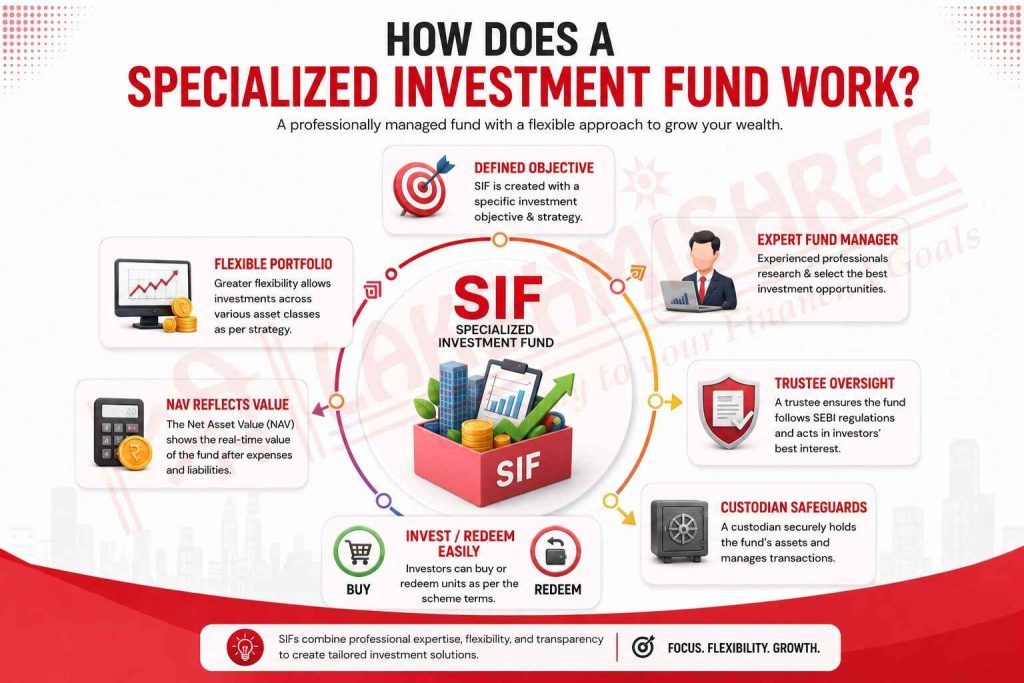
A Specialized Investment Fund (SIF) follows a structured investment process, with each stakeholder playing a specific role. Here's how it works:
One of the key advantages of a Specialized Investment Fund (SIF) is its ability to invest across a wide range of asset classes. Unlike conventional investment products that may follow stricter investment mandates, SIFs gives you greater flexibility to build your diversified portfolios based on your investment objectives and SEBI's guidelines. This allows your fund managers to identify opportunities across different market segments while managing risk effectively.
Some of the common investment avenues for Specialized Investment Funds include:
SIFs can invest in shares of listed companies across different sectors and market capitalizations. Equity investments aim to generate long term capital appreciation and allow investors to participate in the growth potential of businesses.
These include government securities, corporate bonds, treasury bills, and other fixed income instruments. Debt investments can help provide stability to the portfolio while generating relatively predictable returns, depending on market conditions.
SIFs can combine different asset classes such as equities, debt, gold, or other eligible investments within a single portfolio. This diversified approach helps spread risk while seeking balanced returns across varying market conditions.
Real Estate Investment Trusts (REITs) and Infrastructure Investment Trusts (InvITs) allow investors to gain exposure to income generating real estate and infrastructure assets without directly owning them. These investments can also add diversification to the portfolio.
Depending on the investment strategy and SEBI's regulations, SIFs may use derivatives for purposes such as hedging market risks, managing portfolio exposure, or implementing specific investment strategies. They are generally not used for speculative purposes alone.
SEBI may allow SIFs to invest in other eligible securities or investment instruments based on the applicable regulatory framework. The exact investment mix depends on the fund's objective and strategy.
The allocation across these asset classes varies from one Specialized Investment Fund to another. By investing across multiple investment avenues, SIFs aim to create diversified portfolios that align with your investment objectives and changing market conditions. This flexibility is one of the key reasons why many experienced investors consider SIFs as an alternative to conventional Mutual Fund investing options like SIP or lump sum investing.
Specialized Investment Funds are designed to offer you greater flexibility while maintaining the transparency and regulatory oversight associated with SEBI regulated investment products. However, like any investment, they come with both advantages and considerations.
Some of the key benefits of investing in a Specialized Investment Fund include:
Before investing in a Specialized Investment Fund, you must keep the following points in mind:
Although Specialized Investment Funds are often discussed alongside other investment products, they serve a different purpose. The following comparisons can help you understand where they fit within your investment journey.
A common misconception is that SIF, SIP, SWP, and Lump Sum are comparable investment products. In reality, a SIF is an investment product, while SIP, SWP, and Lump Sum are different ways of investing or withdrawing money.
| Feature | SIF | SIP | SWP | Lump Sum |
| Minimum Investment | ₹10 lakh (across SIF strategies of an AMC) | As decided by the AMC (often starts from a few hundred rupees) | Depends on the value of your existing investment | Depends on the amount you choose to invest |
| Investment Style | Professionally managed portfolio | Fixed amount invested at regular intervals | Fixed amount withdrawn at regular intervals | One time investment |
| Risk Exposure | Depends on the fund's investment strategy | Market risk averaged over time through periodic investing | Depends on the remaining invested corpus and market performance | Market risk based on the timing of the one time investment |
| Best Suited For | Experienced and affluent investors | First time and long term investors | Investors seeking regular cash flow from existing investments | Investors with surplus funds available for immediate investment |
| Portfolio Management | Managed by professional fund managers | Depends on the chosen Mutual Fund | Continues as per the chosen Mutual Fund | Depends on the chosen Mutual Fund |
| Flexibility | Can invest across multiple eligible asset classes | Limited to the selected Mutual Fund | Withdrawal amount and frequency can be customized | No periodic investment once the amount is invested |
Understanding these differences can help you choose the approach that best aligns with your financial goals. If you're specifically comparing different Mutual Fund investment methods, you can also read our guides on SIP vs Lump Sum and SIP vs SWP for a more detailed comparison.
Specialized Investment Funds are also compared with Portfolio Management Services (PMS) and Alternative Investment Funds (AIFs) because all three cater to investors seeking advanced investment solutions.
| Feature | SIF | PMS | AIF |
| Portfolio | Common portfolio managed for all investors in the scheme | Individually customized portfolio for each investor | Pooled portfolio managed for all investors in the fund |
| Minimum Investment | ₹10 lakh (across SIF strategies of an AMC) | ₹50 lakh (SEBI prescribed minimum) | ₹1 crore (SEBI prescribed minimum for most investors) |
| Suitable For | Affluent and experienced investors | High net worth individuals seeking personalized portfolio management | Sophisticated investors looking for alternative investment opportunities |
| Investment Flexibility | Greater flexibility than conventional Mutual Funds investing options like SIP or lump sum within SEBI's framework | Highly customized investment strategies based on investor preferences | Invests in alternative assets and specialized investment strategies |
| Portfolio Management | Managed by an Asset Management Company (AMC) following a common investment strategy | Dedicated portfolio manager manages investments based on an individual client's objectives | Managed by an AIF manager according to the fund's investment mandate |
| Regulatory Framework | Regulated under SEBI's Specialized Investment Fund framework | Regulated under the SEBI (Portfolio Managers) Regulations | Regulated under the SEBI (Alternative Investment Funds) Regulations |
| Best Suited For | Investors seeking a balance between flexibility and accessibility | Investors seeking personalized investment solutions | Investors comfortable with relatively higher risk and longer investment horizons |
Choosing the right Specialized Investment Fund involves more than just comparing past performance. Taking a few moments to evaluate the fund can help you make a more informed investment decision.
Ask yourself the following questions before investing:
Answering these questions can help you determine whether a SIF fits your investment plan and expectations.
Once you've selected a suitable fund, the next step is to understand the investment process.
Ready to invest in a Specialized Investment Fund (SIF)? Here's how you can get started with Lakshmishree.
Step 1: Complete your KYC and open your investment account if you haven't already.
Step 2: Assess your financial goals, investment horizon, and risk appetite to determine whether a SIF is suitable for you.
Step 3: Explore the available Specialized Investment Fund (SIF) offerings and compare their investment objectives and risk profile.
Step 4: Consult Lakshmishree's investment experts to understand the fund's features and minimum investment requirement of ₹10 lakh.
Step 5: Complete the required documentation and invest in the selected SIF through the prescribed investment process.
Step 6: Monitor your portfolio regularly and review your investments periodically to ensure they remain aligned with your financial goals.
The taxation of a SIF depends on its underlying asset allocation. SIFs follow a pass through taxation structure, meaning the fund itself is not taxed. Instead, you pay tax on their capital gains or income distributions.
The tax treatment of hybrid and debt oriented SIFs depends on the fund's equity allocation and the applicable provisions of the Income tax Act.
For a deeper understanding of capital gains taxation, holding periods, and the latest tax rules for different mutual fund categories, read our detailed guide on Tax on Mutual Funds.
By now, you should have a clear understanding of what is SIF, how it works, where it invests, its key features, taxation, and how it compares with other investment options. While a Specialized Investment Fund can offer greater portfolio flexibility and diversification, it is important to evaluate your financial goals, risk appetite, and investment horizon before investing.
If a SIF aligns with your investment objectives, Lakshmishree can help you explore suitable investment options and make informed financial decisions.
A Specialized Investment Fund (SIF) is a SEBI regulated investment product that offers greater flexibility than Mutual Fund investing options like SIP or lump sum through specialized investment strategies.
No. Unlike Mutual Funds, SIFs are not designed primarily for SIP based investing. Investment options may vary depending on the scheme offered by the Asset Management Company (AMC). Before investing, review the scheme details or consult your investment advisor.
You can invest in a Specialized Investment Fund through an eligible Asset Management Company (AMC) or an authorized distributor after completing your KYC formalities. Since SIFs have a minimum investment requirement of ₹10 lakh, you should also assess your financial goals and risk profile before investing.
Specialized Investment Funds can be offered by SEBI registered Asset Management Companies (AMCs) that meet SEBI's eligibility criteria. Investors can access these funds through the AMC directly or through authorized distributors and investment advisors.
The tax treatment of a SIF depends on its underlying asset allocation. Equity oriented SIFs are taxed similarly to equity mutual funds, while debt oriented and hybrid SIFs are taxed according to the applicable provisions of the Income tax Act. Investors should review the fund's tax implications before investing.
The minimum investment amount is ₹10 lakh across all SIF strategies offered by an Asset Management Company (AMC).