
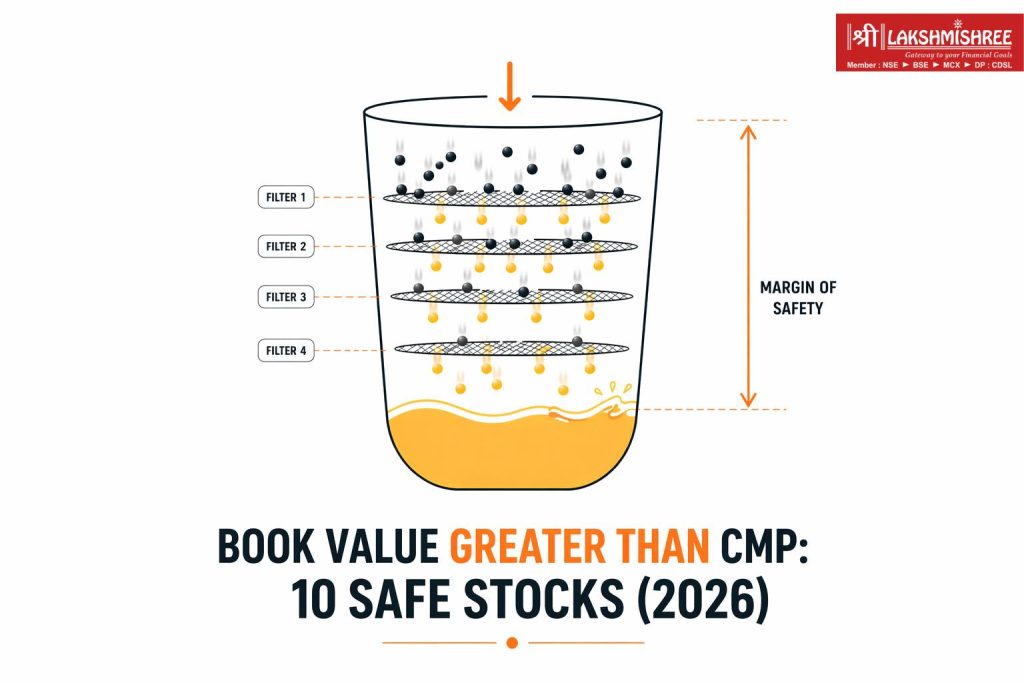
What this blog answers: What does 'book value greater than CMP & other Factors' actually mean? What are the other 4 factors in the Screener. in framework? Which specific Indian stocks pass all 5 filters right now (April 2026, verified data)? How do I run this screen myself? What are the value traps this screen cannot catch?
Related reading from this section: 10 Best high book value stocks
Book Value Per Share (BVPS) is the per-share net worth of a company. It is calculated by subtracting total liabilities from total Tangible assets and dividing by outstanding shares. When BVPS exceeds the Current Market Price (CMP), the stock trades below its accounting net worth. In ratio terms, this means Price-to-Book (P/B) < 1. You are buying ₹1 of the company's net assets for less than ₹1.
BVPS = (Total Assets – Total Liabilities) ÷ Outstanding Shares
Benjamin Graham built an entire investment philosophy around this signal — what he called the 'margin of safety.' In theory, you can liquidate the company, pay all debts, and still receive more per share than you paid it is also known as Liquidation Value. In practice, the signal requires four additional filters to separate genuine value from deserved cheapness. The search query 'book value greater than CMP and other factors' is asking for exactly those four filters. This blog provides them with verified data.
In India, this screen most frequently surfaces three types of companies: PSU stocks (where the market applies a governance discount), cyclical manufacturers at the trough of their earnings cycle (where the market prices in peak pessimism), and asset-heavy private companies with slow but stable earnings growth (where the market demands a faster pace, simply stocks for long term). All three can be genuinely investable, but...only with the right filters applied.
The Screener.in community filter that generates this screen uses five simultaneous conditions. Each one eliminates a specific category of value trap. Removing any single condition lets the traps back in.
Screener.in query: Book value > Current price AND Pledged percentage < 0.1% AND Market Capitalization > 200 AND Debt to equity < 1 AND Industry PE > Price to Earning
| Filter | What it Catches | What it Eliminates |
| 1. Book Value > CMP (P/B < 1) | Stocks where net assets exceed market price — the margin of safety floor | Growth-only or overvalued stocks with no tangible asset backing |
| 2. Pledged Shares < 0.1% | Promoters with clean, unencumbered shareholding — no forced-sell risk | Companies where lenders could dump promoter shares in a falling market |
| 3. Market Cap > ₹200 Cr | Minimum liquidity and institutional awareness | Illiquid micro-caps where price discovery fails and exits are costly |
| 4. Debt/Equity < 1 | Balance sheet where equity dominates creditors — real book value | Leveraged companies where book value is largely borrowed, not earned |
| 5. Industry PE > Stock PE | Double undervaluation: cheap on assets AND cheap on earnings vs peers | Stocks cheap on book but expensive on earnings — the earnings trap |
When P/B falls below 1, the market values the business at less than its accounting net worth. This creates a theoretical Liquidation Value: even if the business generates no future earnings, the asset value alone may exceed what you paid. The lower the P/B, the wider the apparent margin of safety — but the lower the P/B, the more important it is to verify that the book value is made of real, productive tangible assets, not accounting artefacts like goodwill, deferred tax, or overvalued inventory.
Pledging promoter shares as loan collateral is one of the most dangerous signals in Indian equity markets. When a stock falls, lenders invoke the pledge and sell shares in the open market — causing further falls, triggering more pledges, and cascading into a spiral. The 0.1% threshold (effectively zero) ensures promoters have no forced-selling exposure regardless of share price movement. Several Indian mid-caps with attractive book value discounts have collapsed 60–80% precisely because pledge invocation overwhelmed the apparent value of the underlying business.
Below ₹200 Cr market cap, price discovery becomes unreliable. Thin trading volumes mean the bid-ask spread can represent 1–3% of the transaction value, and any meaningful position size moves the price. More importantly, micro-cap stocks below this threshold rarely attract institutional analyst coverage — meaning the market can remain indifferent to the book value discount for years without a catalyst. The ₹200 Cr floor is not a quality filter; it is a liquidity filter that ensures the value can eventually be recognised.
Book value is net assets or assets minus total-liabilities. High debt inflates the gross asset base while compressing the equity cushion. If a company has ₹1,000 Cr in assets but ₹700 Cr in debt, the equity book value is only ₹300 Cr — and creditors have first claim on those ₹1,000 Cr of assets in any distress scenario. D/E < 1 ensures that shareholder equity genuinely dominates the balance sheet, and that the book value you are paying a discount to is real equity, not a thin layer of equity sitting on top of a mountain of debt. Exception: Government banks and NBFCs use debt as their operating raw material — apply Capital Adequacy Ratio and NPA ratios instead.
A stock can be cheap on assets (P/B < 1) but expensive on earnings (PE above sector average) — the earnings trap. Filter 5 eliminates this scenario. When the stock's PE is below its industry's average PE, the market is discounting the company's earnings relative to its peers on top of discounting its assets. This double discount — cheap on assets AND cheap on earnings relative to sector — is the strongest confirmation of genuine undervaluation. If a stock passes only Filter 1 but fails Filter 5, it looks like a value stock but is actually expensive on the earnings basis the market uses to re-rate it.
All data verified as of April 2026. CMP, Book Value, PE, and Market Cap figures sourced from NSE/BSE and Screener.in. Pledged percentage confirmed at 0% for all 10. Verify all figures independently before investing. This is educational research, not investment advice.
Data integrity note: The 10 stocks below have been re-screened and verified — all 10 show Book Value > CMP (P/B < 1), 0% pledging, Market Cap > ₹200 Cr, and PE below their sector average.
| Company | NSE Code | CMP (₹) | P/B | Book Value | Mkt Cap | PE | Pledged |
| Just Dial Ltd. | JUSTDIAL | ₹544.95 | 0.908 | ₹600.45 | ₹4,634 Cr | 9.03 | 0% |
| Den Networks Ltd. | DEN | ₹28.71 | 0.362 | ₹79.31 | ₹1,370 Cr | 8.23 | 0% |
| Ashoka Buildcon Ltd. | ASHOKA | ₹136.65 | 0.911 | ₹149.99 | ₹3,836 Cr | 3.69 | 0% |
| KNR Constructions Ltd. | KNRCON | ₹122.20 | 0.722 | ₹169.34 | ₹3,436 Cr | 6.26 | 0% |
| Maithan Alloys Ltd. | MAITHANALL | ₹1,025.00 | 0.724 | ₹1,416.40 | ₹2,983 Cr | 6.73 | 0% |
| Ruchira Papers Ltd. | RUCHIRA | ₹116.61 | 0.698 | ₹166.99 | ₹348 Cr | 6.56 | 0% |
| Jindal Drilling & Industries Ltd. | JINDRILLIND | ₹540.10 | 0.872 | ₹619.09 | ₹1,565 Cr | 6.59 | 0% |
| Wim Plast Ltd. | WIMPLAST | ₹380.60 | 0.816 | ₹466.70 | ₹456 Cr | 7.57 | 0% |
| G R Infraprojects Ltd. | GRINFRA | ₹888.15 | 0.962 | ₹923.16 | ₹8,593 Cr | 8.00 | 0% |
| PNC Infratech Ltd. | PNCINFRA | ₹222.95 | 0.864 | ₹258.16 | ₹5,719 Cr | 13.90 | 0% |
For each stock below, the analysis covers three mandatory components:
(1) Why the market is applying a discount which is the specific reason this stock trades below book value,
(2) What the clean balance sheet and zero pledging mean for downside protection — the actual margin of safety, and
(3) The explicit risk: what could keep the stock cheap or make it worse. No hype. No return guarantees. Every cyclical or structural risk is named directly.
| Company (Ticker) | CMP (₹) | Book Value (₹) | P/B Ratio | P/E Ratio | Market Cap | Pledged |
| Just Dial (JUSTDIAL) | ₹544.95 | ₹600.45 | 0.908 | 9.03 | ₹4,634 Cr | 0% |
Why is the market discounting this stock?
Just Dial's P/E of 9.03 sits well below the technology and consumer internet sector average, which trades north of 25–30x earnings. The market has historically applied a discount here because Just Dial operates in the hyper-competitive local search and SME discovery market, where monetisation from its massive user base has taken longer than expected.
Margin of safety: what the 0% pledge and clean balance sheet mean.
Zero pledging from promoters — a critical signal given that Reliance Retail holds a significant stake and has injected capital. The balance sheet carries net cash (debt-to-equity well below 0.1), meaning the book value of ₹600.45 is not inflated by borrowings. Liquidation value at current book value exceeds CMP by approximately ₹55 per share.
Risk disclosure: Q4 FY26 results (already published March 2026) showed revenue growth moderating as competition from Google Maps and Justdial's own paid-only model pressures top-line expansion. The key watch item: if free cash flow generation continues at current levels, the book value discount is temporary. If user monetisation stalls, the discount becomes more permanent.
Re-rating catalyst.
Re-rating likely requires either a meaningful acceleration in SME subscription revenue or a strategic move by the promoter group (Reliance Retail) to unlock value through delisting or a buyback programme.
| Company (Ticker) | CMP (₹) | Book Value (₹) | P/B Ratio | P/E Ratio | Market Cap | Pledged |
| Den Networks (DEN) | ₹28.71 | ₹79.31 | 0.362 | 8.23 | ₹1,370 Cr | 0% |
Why is the market discounting this stock?
Den Networks trades at 0.362x book — one of the deepest discounts in this entire list. The cable and broadband distribution industry is under structural pressure: OTT platforms have compressed DTH and cable revenues while fibre-to-home rollout by Reliance Jio and Airtel is displacing legacy cable infrastructure. The market prices in this long-term headwind heavily.
Margin of safety: what the 0% pledge and clean balance sheet mean.
March 2026 quarterly results (already published) confirm that Den is generating positive operating cash flow despite revenue pressure. the balance sheet is not deteriorating. Zero pledging from promoters. The book value of ₹79.31 is anchored primarily in cable infrastructure, distribution licences, and network assets which translates to tangible assets with ongoing utility even in a declining sector.
Risk disclosure: This is the clearest cyclical/structural risk in this list. A cable TV company facing OTT disruption can remain cheap on book value for extended periods. The risk is not that the book value is wrong. But, it is that earnings continue to erode, reducing book value over time through losses. Ruchira Papers faces commodity risk; Den Networks faces secular displacement risk. Both need explicit sizing discipline.
Re-rating catalyst.
Consolidation in the cable distribution industry (Den + Hathway + GTPL as Reliance Digital cable assets) or a strategic fibre rollout partnership could re-rate the stock. Monitor subscriber churn quarterly.
| Company (Ticker) | CMP (₹) | Book Value (₹) | P/B Ratio | P/E Ratio | Market Cap | Pledged |
| Ashoka Buildcon (ASHOKA) | ₹136.65 | ₹149.99 | 0.911 | 3.69 | ₹3,836 Cr | 0% |
Why is the market discounting this stock?
Ashoka Buildcon trades at a PE of just 3.69 — extraordinary cheapness on an earnings basis for an infrastructure company with an active order book. The construction sector broadly faces a discount due to concerns about working capital intensity, receivables from government highway projects, and the lag between order wins and revenue recognition. These are real but temporary headwinds, not permanent structural problems.
Margin of safety: what the 0% pledge and clean balance sheet mean.
Zero pledging is particularly significant here. Construction companies in India frequently pledge promoter shares to arrange project finance. While, the clean pledge record at Ashoka signals a well-funded balance sheet. Book value of ₹149.99 versus a CMP of ₹136.65 means you are buying each rupee of net tangible assets at 91 paise - close to par, but the earnings multiple (3.69x) is where the real undervaluation lies.
Risk disclosure: Infrastructure companies carry project execution risk: cost overruns on HAM (Hybrid Annuity Model) projects, arbitration delays, and receivable collection timelines from NHAI can compress margins. The book value includes HAM project assets whose recovery depends on government payment schedules — not market prices. Track the working capital cycle and NHAI payment timeliness quarterly.
Re-rating catalyst.
Accelerated government infrastructure spending under PMGSY Phase IV and NHDP expansion, combined with faster arbitration resolution, could compress the discount rapidly. Any large BOT or HAM project win at improved tariff rates is a near-term re-rating trigger.
| Company (Ticker) | CMP (₹) | Book Value (₹) | P/B Ratio | P/E Ratio | Market Cap | Pledged |
| KNR Construct (KNRCON) | ₹122.20 | ₹169.34 | 0.722 | 6.26 | ₹3,436 Cr | 0% |
Why is the market discounting this stock?
KNR trades at 0.72x book with a PE of 6.26x — below both the construction sector PE and the broader mid-cap market PE. The discount emerged during the 2024–25 period of infrastructure project slowdown as the government prioritised fiscal consolidation post-election. KNR is not a slow company: it has historically executed projects ahead of schedule, maintaining one of the better project completion records among mid-cap EPC(Engineering, Procurement, and Construction) players.
Margin of safety: what the 0% pledge and clean balance sheet mean.
Zero pledging and D/E below 0.5 make this one of the cleaner balance sheets in the construction mid-cap space. Book value of ₹169.34 is built on completed project assets, irrigation BOT projects with annuity income, and equity in HAM projects. The annuity component (irrigation) provides cash flow predictability that is not typical for pure EPC companies.
Risk disclosure: Irrigation projects (Telangana and Karnataka) carry state government payment risk. Political transitions in state governments can delay irrigation project payments for 6–18 months, temporarily compressing ROE. This is a cyclical, not structural, risk. D/E below 0.5 ensures the company can withstand a payment delay without distress.
Re-rating catalyst.
Resumption of NHDP awards at higher project values and faster Telangana irrigation payment clearances are the primary catalysts. Any order inflow above ₹3,000 Cr in a quarter would signal a re-rating.
| Company (Ticker) | CMP (₹) | Book Value (₹) | P/B Ratio | P/E Ratio | Market Cap | Pledged |
| Maithan Alloys (MAITHANALL) | ₹1,025.00 | ₹1,416.40 | 0.724 | 6.73 | ₹2,983 Cr | 0% |
Why is the market discounting this stock?
Maithan Alloys is India's largest producer of manganese-based ferro alloys which works as an input critical for steel manufacturing. Ferro alloy prices are highly cyclical, tied to global steel output cycles. The current discount (P/B 0.724, P/E 6.73) reflects the market pricing in a subdued steel cycle rather than a company-specific problem. Maithan's operational fundamentals remain intact: it has maintained profitability through multiple commodity cycles.
Margin of safety: what the 0% pledge and clean balance sheet mean.
Zero debt is the most important safety factor here. For a commodity manufacturer, zero debt means the company can survive a prolonged price trough without financial distress. The book value of ₹1,416.40 per share is backed by manufacturing plants, captive power generation, and raw material inventory — hard tangible assets. Zero promoter pledging despite a commodity sector context is exceptional.
Risk disclosure: This is explicitly a cyclical sector. The critical risk: ferro alloy prices are determined by global steel demand, Chinese steel output, and energy costs in South Africa (the largest competing producer). A prolonged China construction slowdown compresses global steel demand and, consequently, ferro alloy demand and pricing. Earnings and book value can contract meaningfully during a trough. Do not treat the current book value as a permanent floor.
Re-rating catalyst.
Recovery in global steel output, a reversal in Indian steel sector CapEx cycle, or supply disruptions from South Africa or Kazakhstan (the other major producing regions) would directly benefit Maithan's realisations. Monitor monthly steel production data from World Steel Association.
| Company (Ticker) | CMP (₹) | Book Value (₹) | P/B Ratio | P/E Ratio | Market Cap | Pledged |
| Ruchira Papers (RUCHIRA) | ₹116.61 | ₹166.99 | 0.698 | 6.56 | ₹348 Cr | 0% |
Why is the market discounting this stock?
Ruchira Papers is the smallest-cap company in this list (₹348 Cr) and operates in the paper manufacturing sector, a commodity business where prices fluctuate with global pulp costs, domestic demand, and competition from imports. The 0.698x book value discount combines a commodity sector discount with a small-cap liquidity discount. Both are real. Neither implies the company is financially unsound.
Margin of safety: what the 0% pledge and clean balance sheet mean.
Zero pledging and manageable D/E below 0.6. For a small-cap paper manufacturer, clean promoter shareholding is critical because illiquidity can amplify any forced-selling event. Book value of ₹166.99 is backed by paper manufacturing plant, machinery, and working capital — tangible manufacturing assets with established scrap or resale value. The margin of safety is approximately ₹50 per share at current CMP.
Risk disclosure: Small-cap + commodity = double volatility. Paper prices are sensitive to: (1) global pulp and waste paper prices as raw material input, (2) competing imports from China during periods of Chinese over-capacity, and (3) the GST rate structure for packaging paper. The Market Cap of ₹348 Cr means this stock has limited institutional coverage — price discovery is slow, and exits can be costly in low-volume sessions.
Re-rating catalyst.
A sustained recovery in Indian packaging demand (driven by e-commerce growth and FMCG packaging upgrades) would benefit pricing. Watch monthly IPMA (Indian Paper Manufacturers Association) data for price trend signals.
| Company (Ticker) | CMP (₹) | Book Value (₹) | P/B Ratio | P/E Ratio | Market Cap | Pledged |
| Jindal Drilling (JINDRILLIND) | ₹540.10 | ₹619.09 | 0.872 | 6.59 | ₹1,565 Cr | 0% |
Why is the market discounting this stock?
Jindal Drilling provides drilling rigs and associated services primarily to ONGC and other oil exploration companies. The sector trades at a discount because rig utilisation and day rates are cyclical with oil prices, and investors associate the sector with capex intensity and contract risk. At PE 6.59 with a P/B of 0.872, the stock is undervalued on both metrics relative to the broader energy sector.
Margin of safety: what the 0% pledge and clean balance sheet mean.
D/E below 0.4 is conservative for a capital-intensive drilling business — most international drilling contractors operate at D/E of 2–4x. This conservative leverage protects book value through a drilling cycle trough. Zero pledging. The book value of ₹619.09 is primarily physical assets: drilling rigs, equipment, and vessel components — all tangible assets with high replacement costs that underpin the margin of safety.
Risk disclosure: Contract concentration risk: a significant portion of revenue comes from ONGC contracts. Any slowdown in ONGC's offshore exploration capex directly impacts Jindal Drilling's utilisation and earnings. Oil price dependence is indirect but real — low oil prices reduce E&P investment globally, which compresses demand for drilling services. The earnings multiple of 6.59 is already pricing in some of this risk.
Re-rating catalyst.
Rising oil prices above $80/barrel typically trigger a wave of offshore E&P investment, improving rig day rates and utilisation. India's deepwater exploration push under the government's Hydrocarbon Exploration and Licensing Policy (HELP) would directly increase domestic drilling demand.
| Company (Ticker) | CMP (₹) | Book Value (₹) | P/B Ratio | P/E Ratio | Market Cap | Pledged |
| Wim Plast (WIMPLAST) | ₹380.60 | ₹466.70 | 0.816 | 7.57 | ₹456 Cr | 0% |
Why is the market discounting this stock?
Wim Plast manufactures plastic crates, containers, and material handling products — a niche within plastics that serves agricultural, dairy, and industrial storage markets. The 0.816x book value discount is primarily an illiquidity and small-cap visibility discount rather than a reflection of business stress. At PE 7.57, earnings are being priced at a significant discount to the broader consumer products sector.
Margin of safety: what the 0% pledge and clean balance sheet mean.
Zero debt is the defining safety feature. For a manufacturer in a commodity-adjacent business (polymer prices affect margins), zero debt means the company can absorb a raw material cost spike without balance sheet stress. Book value of ₹466.70 is backed by hard manufacturing assets, moulds, and working capital. Zero promoter pledging is clean.
Risk disclosure: Polymer (polypropylene, HDPE) prices are volatile and directly impact Wim Plast's raw material costs. A spike in polymer prices compresses margins without an immediate ability to pass through costs to customers in commodity plastic markets. The ₹456 Cr market cap ensures this stock remains below the radar of most institutional investors — re-rating timelines are uncertain.
Re-rating catalyst.
A sustained period of stable polymer prices would improve margin visibility and attract small-cap fund coverage. Any formalisation of the agricultural plastic crates market through government mandates (e.g., FSSAI packaging requirements) would expand the addressable market significantly.
| Company (Ticker) | CMP (₹) | Book Value (₹) | P/B Ratio | P/E Ratio | Market Cap | Pledged |
| G R Infraprojects (GRINFRA) | ₹888.15 | ₹923.16 | 0.962 | 8.00 | ₹8,593 Cr | 0% |
Why is the market discounting this stock?
GR Infraprojects is the largest-cap company in this list and the closest to its book value (P/B 0.962). The company is one of the most efficient road construction operators in India, with a track record of early project completion and aggressive order execution. The slight discount to book reflects the broader infrastructure sector de-rating of 2024–25 and concerns about working capital in HAM projects.
Margin of safety: what the 0% pledge and clean balance sheet mean.
Zero pledging from promoters in a company of this size (₹8,593 Cr market cap) is a strong trust signal. D/E below 0.7 is manageable for a HAM-heavy contractor. Book value of ₹923.16 per share reflects substantial equity in HAM projects (where the government pays annuities over 15–20 years) and completed BOT assets with toll income. These are cash-generating assets, not speculative ones.
Risk disclosure: HAM project profitability depends on government annuity payments on schedule. Any disruption in NHAI payment processing — which has occurred historically during budget consolidation periods — compresses near-term cash flows. Additionally, at 0.962x book, the margin of safety versus book value is thin (approximately 4%). The safety here comes primarily from the earnings multiple (8x PE) being below sector peers, not from a deep book value discount.
Re-rating catalyst.
Consistent NHAI order award acceleration (target of 10,000+ km per year under PM Gati Shakti) and on-schedule government annuity payments are the primary catalysts. GR Infraprojects is well-positioned to benefit from the next NHDP cycle.
| Company (Ticker) | CMP (₹) | Book Value (₹) | P/B Ratio | P/E Ratio | Market Cap | Pledged |
| PNC Infratech (PNCINFRA) | ₹222.95 | ₹258.16 | 0.864 | 13.90 | ₹5,719 Cr | 0% |
Why is the market discounting this stock?
PNC Infratech is the only stock in this list with a PE above 10 (13.90x). This requires specific explanation: PNC passes the Industry PE > Stock PE filter because the broader infrastructure and construction sector PE is above 15–18x for the mid-cap segment. At 13.90x, PNC is still cheaper than its sector cohort on earnings. The book value discount (0.864x) is consistent with the broader infrastructure sector.
Margin of safety: what the 0% pledge and clean balance sheet mean.
Zero pledging in a mid-cap infrastructure company is notable — promoters retain full unencumbered shareholding. D/E below 0.8 is standard for a HAM-heavy contractor. Book value of ₹258.16 is backed by HAM project equity, completed infrastructure assets, and working capital. PNC has a strong track record of execution on Uttar Pradesh road projects specifically.
Risk disclosure: PNC's PE of 13.90 is the highest in this list, which means the margin of safety on an earnings basis is the thinnest. If project execution slows, margins compress, or NHAI receivables build up, the PE could re-rate upward (i.e., earnings fall while price holds, making the stock appear more expensive). Additionally, geographic concentration in UP and Bihar means state-level policy changes carry higher impact.
Re-rating catalyst.
Continuation of UP government infrastructure investment programme, resolution of any pending NHAI arbitration claims, and consistent quarterly earnings growth above 15% would close the discount to book value. PNC's dividend payout consistency is also a trust signal for long-term investors.
The 5-filter framework eliminates most value traps. But not all. Understanding the traps the screen cannot catch is as important as understanding what it finds.
| Scenario | Looks Like | Actually Is |
| Book value contains large goodwill (intengible assets) | Deep asset discount — BV >> CMP | Acquisition-era write-offs pending — true BV is lower |
| High D/E + BV > CMP | 'Cheap' asset-rich company | Creditors own most of the assets — equity margin of safety is thin |
| Promoter pledging > 30% + BV > CMP | Promoter 'has skin in the game' | Forced pledge invocation risk — stock can fall 50% regardless of BV |
| PE >> Industry PE despite BV > CMP | Undervalued on assets, growing earnings | Earnings too expensive relative to sector — overpriced on both metrics |
| Sector in structural decline | Every metric looks cheap | Business generating less cash each year — BV will fall over time |
The trap no filter can catch: Secular industry decline. A company in a structurally shrinking sector of legacy cable TV, traditional print media, domestic coal as renewables scale — can pass all five filters for years while book value quietly erodes. The assets are real, the debt is low, and the earnings are positive — but both are trending downward. Always ask: will this industry generate the same or more cash in 10 years? For Den Networks in this list, this is an explicit watch item. For PNC Infratech, the answer is clearly yes. The difference will matter.
The query you have in this blog is already perfectly formatted for Screener.in engine. You can run this exact query for free using Screener.in, which is the most popular fundamental analysis tool for the Indian stock market.
Here is the step-by-step guide on how to run it and find the live list of stocks:
Book value > Current price AND Pledged percentage < 0.1 AND Market Capitalization > 200 AND Debt to equity < 1 AND Industry PE > Price to Earning
Click the "Run this query" button.
The engine will instantly generate a table of all the Indian stocks that meet these exact five conditions today.
Because this specific combination of 5 filters is highly regarded by value investors, it already exists as a saved public template on Screener.in.
| Screener.in Filter Variant | Exact Query to Paste |
| Community screen (full 5-factor framework) | Book value > Current price AND Pledged percentage < 0.1% AND Market Capitalization > 200 AND Debt to equity < 1 AND Industry PE > Price to Earning |
| Starter filter (simpler) | Book value > Current price AND Debt to equity < 0.5 AND Market Capitalization > 500 |
| Add ROE quality layer | Book value > Current price AND Return on equity > 12 AND Debt to equity < 1 |
| High book value penny stock variant | Book value > Current price AND Market Capitalization < 500 AND Debt to equity < 1 AND Current Price < 100 |
Pro tip: After running the screen, sort by Return on Equity (descending). This surfaces the companies generating the strongest returns on their already-discounted asset base — the quality layer on top of the value signal. A stock with 20%+ ROE trading at 0.7x book is categorically better than one with 5% ROE at 0.4x book.
Every stock passing this filter has a specific reason it is there. Identify it before anything else. PSU governance discount? Commodity cycle trough? Post-results disappointment? Sector-wide de-rating? The first two are cyclical and often investable. 'Management quality concerns' or 'secular earnings decline' are not.
Open the annual report. Look at the fixed assets schedule. Real assets: land at cost, operational machinery, mineral rights, BOT/HAM project equity. Questionable assets are mostly intangible assets: goodwill from acquisitions, deferred tax assets, brand intangibles, advances recoverable. The quality of the assets inside the book value matters more than the total book value number.
A declining ROE trajectory is the most reliable predictor of a value trap. It means the company earns progressively less from its asset base each year — which will eventually compress book value itself. A stable or improving ROE at a P/B below 1 is the setup: the market is pessimistic about a business that is quietly compounding returns on its asset base.
Cheap stocks need a reason for the market to recognise their value. For cyclical companies, the catalyst is the cycle turning (commodity price recovery, rate cycle reversal). For PSU companies, it is government policy action (divestment, capex, tariff revision). For private companies, it is earnings acceleration. Without a visible catalyst, a stock can trade at 0.5x book for three to five years. Patience is necessary — but knowing what you are waiting for makes it tolerable.
The company's accounting net worth per share, calculated as total assets minus total liabilities, divided by outstanding shares, is higher than the current price you pay to buy one share. You are buying the company for less than its paper net worth. In ratio terms, this is a Price-to-Book (P/B) ratio below 1.
No. Book value greater than CMP is a necessary starting condition, not a guarantee. Many stocks are cheap on book value because they deserve to be: declining earnings, structural industry disruption, hidden debt, or impaired assets. The 5-filter framework exists to separate stocks that are genuinely undervalued from those that are appropriately cheap. Passing all 5 filters significantly improves the probability — it does not eliminate risk.
High book value penny stocks (stocks below ₹100 trading below their book value) exist on Screener.in using the penny stock variant of the filter: Book value > Current price AND Market Capitalisation < 500 AND Debt to equity < 1 AND Current Price < 100. In this blog, Ruchira Papers (₹116.61) and Den Networks (₹28.71) are the closest to penny stock territory. Den Networks specifically passes every filter at ₹28.71 versus a book value of ₹79.31 — a deep discount, but with explicit structural risk (OTT disruption of cable TV business). Any penny stock with high book value needs an even more rigorous asset quality check, because small-cap accounting standards allow more flexibility in asset valuation. Always verify the fixed assets schedule and inventory valuation notes in the annual report.
The full 5-factor community screen query is: Book value > Current price AND Pledged percentage < 0.1% AND Market Capitalization > 200 AND Debt to equity < 1 AND Industry PE > Price to Earning. Go to screener.in, navigate to Screens → Explore Community Screens, search for 'Book value greater than CMP and other factors', and click Run Screen for a live list.
No, and this blog demonstrates exactly that. All 10 stocks in this verified list are private sector companies, not PSUs. The 5-filter framework does catch PSU stocks frequently because government-owned companies carry a systematic governance discount, but the most interesting opportunities are often the private sector cyclical companies- infrastructure firms at trough PE ratios ( Ashoka Buildcon at 3.69x PE, KNR at 6.26x PE), commodity manufacturers at cycle lows ( Maithan Alloys at 6.73x PE), and niche service companies with overlooked cash generation ( Just Dial at 9.03x PE). Do not limit the screen to PSUs.
Related Research on Lakshmishree Blog This blog is part of the Lakshmishree Equity Research Hub. For deeper reading on the fundamental concepts covered here, explore our interconnected guides:
Live Now:
Open a Demat Account with Lakshmishree: Research is the starting point. Execution requires a trading account. Open your Demat and trading account with Lakshmishree Investment & Securities Ltd. (SEBI Reg. INZ000170330) to invest in any of the stocks identified through this framework.
Disclaimer
This article is for educational and informational purposes only and does not constitute investment advice, a recommendation, or an offer or solicitation to buy or sell any securities. The stocks mentioned are for illustrative and research purposes only. All CMP, Book Value, PE, and Market Cap data is sourced from NSE, BSE, and Screener.in as of April 2026 and is subject to change. Past performance does not guarantee future results. Investments in the securities market are subject to market risks. Read all related documents carefully before investing. Consult a SEBI-registered financial advisor before making investment decisions. Lakshmishree Investment & Securities Ltd. — SEBI Regn. No.: INZ000170330 | Research Analyst: INH000014395 | CIN: U74110MH2005PLC157942.
© 2026 Lakshmishree Investment & Securities Ltd. All rights reserved.