
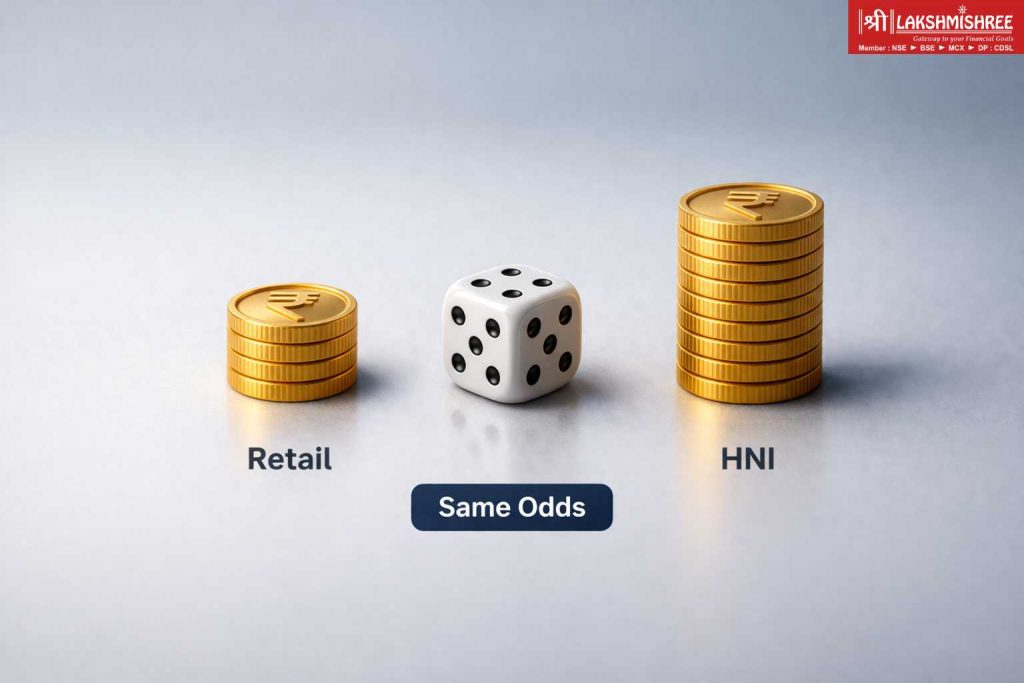
You applied for an IPO. Your broker app shows three categories: RII, NII, and QIB. You know the retail category. But when your IPO applications constantly yield zero shares allotted due to massive oversubscriptions, you start looking for alternatives or questions like:
What is NII?
Who is an HNI Full Form?
Can regular investors apply as HNIs?
Are the allotment odds actually better?
The Dilemma: Is it mathematically smarter to max out 13 lots in Retail, or step up to 1 lot in Small HNI (sHNI)? And why does the allotment work differently for them?
This is exactly what brings thousands of Indian investors to search for HNI full form and HNI meaning every day. This guide covers everything: what HNI means in different contexts, how HNI allotment works in IPOs, whether applying as an HNI is actually better, and how to qualify.
HNI full form is High Net Worth Individual. In the context of Indian IPOs and the stock market, an HNI is any individual investor applying for shares worth more than ₹2 lakh in a single IPO application. In the Indian financial system, this term is used in two related but slightly different contexts:
Understanding the difference between the two prevents confusion.
In an IPO, HNIs are technically referred to as Non-Institutional Investors (NII) by SEBI. The NII category is reserved for Indian resident individuals, HUFs (Hindu Undivided Families), NRIs, companies, trusts, and scientific institutions who apply for IPO shares above ₹2 lakh. The terms HNI and NII are used interchangeably in IPO discussions, meaning that both terms mean the same person.
In banking and wealth management, an HNI is a person with investable assets above ₹5 crore (approximately $600,000). This is the global definition used by private banking divisions of HDFC, ICICI, and Kotak to classify premium clients who get dedicated relationship managers and access to pre-IPO opportunities.
For most IPO investors reading this, the relevant definition is the first one: HNI means anyone applying for more than ₹2 lakh in a single IPO.
Every public issue in India divides its available shares across three distinct categories. Your application amount dictates which bucket you fall into.
1. Retail Individual Investors (RII)
2. Qualified Institutional Buyers (QIB)
3. Non-Institutional Investors (NII / HNI)
A few years ago, SEBI realized it was unfair for a retail investor bumping their bid to ₹2.5 lakh to compete against a billionaire bidding ₹50 crores. To level the playing field and protect smaller investors, SEBI split the HNI category into two distinct sub-categories based on the bid amount:
1. Small HNI (sHNI): The Middleweight Category
2. Big HNI (bHNI): The Heavyweight Category
3. Corporate NIIs: If you see this term on your broker's app, don't let it confuse you. This isn't a separate money bracket; it simply defines who is applying. It includes private companies, trusts, and HUFs (Hindu Undivided Families) bidding within the HNI space.
The biggest misconception about the HNI category is that you need to be wealthy to use it. You don't. Qualification is purely about your application size, not your total net worth. You never have to prove your income, assets, or bank balance.
If you bid for even one rupee more than ₹2 lakh in a single IPO, the system automatically upgrades your application to the HNI category.
Established investors who want a larger allocation than the retail category allows. In popular IPOs, the retail category can be subscribed 40–80 times, meaning each retail applicant's odds of getting a full lot are very low. Some investors apply in the HNI category with a large application specifically to improve their expected allocation.
Business owners and professionals who have significant investable capital and regularly participate in IPOs as part of portfolio building.
NRIs who wish to apply beyond the retail limit by applying in the HNI/NII category for IPOs of Indian companies through the NRI allotted quota.
This is the part most investors misunderstand, and understanding it changes your IPO strategy completely.
Retail Allotment (RII): Lottery-based for a minimum lot. If oversubscribed, SEBI mandates that as many distinct applicants as possible get at least one lot. This is done via a computerized lucky draw. Consequently, applying for 5 retail lots gives you exactly the same chance of getting 1 lot as applying for just 1 lot. In a hot IPO, you will never get more than 1 lot in the retail category.
HNI Allotment (NII): Now also largely Lottery-based. Since April 2022, SEBI has moved the HNI category away from pure proportional allotment to a "draw of lots" system to ensure wider share distribution.
| Bidding Strategy | What Most Investors Expect (The Myth) | What Actually Happens (The Reality) |
| Retail (RII): Bidding ₹1.9 Lakh (13 Lots) instead of ₹15k (1 Lot) | Higher probability of winning, or winning multiple lots. | Zero Advantage. You have the exact same lottery odds as someone bidding for 1 lot. If you win, you only get 1 lot. |
| Small HNI (sHNI): Bidding ₹9 Lakh instead of ₹2.1 Lakh | Getting a proportionally larger allotment (e.g., winning ₹4 Lakh worth of shares). | Zero Advantage. Both bids enter the exact same lottery. Both have the same odds of winning one base ₹2 Lakh lot. |
| Big HNI (bHNI): Bidding ₹5 Crore instead of ₹15 Lakh | Guaranteed allotment or a massive, multi-lakh share allocation. | No Advantage in Hot IPOs. Both enter the same lottery for a base ₹2 Lakh lot. Proportional math only applies if the category isn't heavily oversubscribed (which rarely happens). |
What this means in practice for a hot IPO:
In a typically oversubscribed IPO (e.g., 100x or more), the proportionate math no longer applies. You cannot guarantee an allotment simply by applying for ₹4 crore. Instead, the NII category has become a high-stakes lottery. A Big HNI applicant putting in ₹15 Lakh has the same statistical chance of getting a ₹2 Lakh allotment as someone putting in ₹5 Crore, because the oversubscription is usually so high that only the minimum HNI lot lottery is triggered.
Choosing the right category depends entirely on your available capital and whether you are playing solo or using family accounts. Here is the definitive strategy based on current IPO mechanics:
1. Apply in Retail (Under ₹2 Lakh) When:
2. Apply as Small HNI / sHNI (₹2 Lakh to ₹10 Lakh) When:
(Note: Never apply in both Retail and HNI from the same PAN card, as your application will be instantly rejected).
The truth is, there is no "one size fits all" strategy. An IPO with a massive retail frenzy might require an sHNI bid to win, while another might be easily won in the Retail category.
At Lakshmishree, our research team takes the guesswork out of this decision. We regularly publish deep-dive IPO analyses - including real-time subscription tracking and exact recommendations on which category offers the highest probability of allotment for each specific issue.
With 31 years of market experience and over 60,000 investors served, we have navigated every type of bull and bear market scenario. Whether you are applying for 1 lot or ₹10 Lakhs, we can guide you on the mathematically smartest approach.
With 31+ years of institutional memory and 1,200+ IPOs navigated, we replace retail guesswork with mathematical allotment probability.
| Feature | Retail (RII) | Small HNI (sHNI) | Big HNI (bHNI) |
| Bid Amount | Up to ₹2 Lakh | ₹2 Lakh – ₹10 Lakh | Above ₹10 Lakh |
| Allotment Logic | Lottery (₹15k prize) | Lottery (₹2L prize) | Lottery + Pro-rata |
| Cut-off Price? | Allowed | NOT Allowed | NOT Allowed |
| Withdrawal? | Allowed anytime | No (Modify up only) | No (Modify up only) |
| Payment Mode | UPI / ASBA | UPI (up to ₹5L) | Net Banking ASBA |
| Interest Earned | Yes | Yes | Yes |
For the purposes of IPO applications, UHNI and VHNI applicants use the same NII/HNI category as all investors applying above ₹2 lakh. The IPO categories do not distinguish between active wealth creators and institutional-scale legacy holders.
It is a common misconception that UHNIs get a VIP category in IPOs. Legally, anyone bidding above ₹2 lakh falls into the NII (Non-Institutional Investor) category. However, the true intent satisfaction for a wealthy investor lies in the 1/3rd vs. 2/3rd split:
For a VHNI or UHNI, the mathematical advantage is not just having more money, rather it is the ability to bid in the bHNI tier, where the sheer size of the quota often results in better allotment odds compared to the frenzied Small HNI segment. While SEBI does not recognize UHNI as a label, the market rewards the Big HNI bidder with a significantly larger pool of shares.
Beyond IPOs, crossing the HNI threshold is the key that unlocks institutional-grade investment structures. While mutual funds are excellent for building wealth, HNI-specific vehicles like PMS and AIFs are designed to manage and protect it using strategies legally barred from the retail public.
Portfolio Management Services (PMS): SEBI mandates a minimum investment of ₹50 lakh for PMS. PMS is designed for HNI investors who want active, personalised portfolio management beyond what mutual funds offer. Returns are direct, no pooling with other investors and portfolio managers make discretionary decisions within an agreed mandate.
Alternative Investment Funds (AIFs): AIFs require minimum investment of ₹1 crore. Category III AIFs (including hedge funds and long-short strategies) are exclusively available to HNI and institutional investors. These structures allow access to strategies not permitted in regular mutual funds.
Lakshmishree's wealth management division works with HNI investors seeking structured access to PMS, AIFs, and direct equity portfolios. If your investable corpus has crossed ₹50 lakh and you want to explore options beyond regular mutual funds and direct equity, our HNI investment desk is available to discuss the right structure for your portfolio.
SEBI mandates a minimum investment of ₹50 lakh for PMS. This is the first step out of the "retail pool" and into professional, discretionary management.
AIFs require a minimum "entry ticket" of ₹1 crore. For the VHNI and UHNI tiers, Category III AIFs (Hedge Funds) are the ultimate tool for market volatility.
At Lakshmishree (SEBI Reg. INZ000170330), our wealth management division doesn't just "sell" products; we act as a Research Filter. With 31+ years of institutional memory, we help you navigate the transition from being a "Mutual Fund Investor" to a "Strategic Capital Allocator."
If your investable corpus has crossed ₹50 lakh, your portfolio requires a structure that reflects your tax bracket and legacy goals. Our HNI investment desks in Mumbai, Varanasi, and Surat are available to audit your current holdings and identify where a PMS or AIF could add the "missing link" of protection and performance.
Move beyond the retail ceiling. Leverage 31+ years of institutional memory to audit your portfolio for PMS, AIF, and Direct Equity Alpha.
Applying as an HNI requires more than just a larger check; it requires a specific banking workflow to ensure your application is not rejected on technical grounds.
Every IPO has a minimum lot size. While Retail investors apply for 1–13 lots (keeping the total under ₹2 lakh), HNI status is triggered the moment your application value exceeds ₹2,00,000.
Contrary to popular belief, your funds do earn interest during the IPO process. Under ASBA (Application Supported by Blocked Amount), your bank "blocks" the funds in your savings account. They are not debited until the allotment is finalized. This means you continue to earn your standard savings account interest on the entire amount until the moment of debit—a significant advantage for large HNI applications.
On the Lakshmishree platform, the application form features a category dropdown.
Critical Note: You must manually select NII (Non-Institutional Investor) or HNI. If you apply for ₹3 lakh but leave the category as "Retail," your application will likely be rejected for exceeding the retail limit.
Pro-Tip: Do NOT select Cut-off Price. HNIs are legally barred from using it. You must manually enter the Upper Price Band (the ceiling) to ensure your bid remains valid when the issue is oversubscribed.
In 2026, the Indian market operates on a T+3 listing cycle.
Day 0: Issue Closes.
Day 1: Allotment Finalized.
Day 2: Refund initiation and Credit of shares.
Day 3: Listing on Exchanges.
The old 6-day wait is gone. At Lakshmishree, your allotment status and Listing Day Strategy are updated in real-time on your dashboard to help you decide whether to hold for long-term gains or book listing-day profits.
The best category for your application changes depending on how many people are applying for the IPO. Use this simple guide to decide your move:
| If the IPO is... | Your Best Category | The Simple Logic |
| Not very popular (Low Demand) | Big HNI (Above ₹10 Lakh) | Best chance to get all the shares you asked for. |
| Moderately popular (Medium Demand) | Small HNI (₹2L - ₹10L) | Better winning odds than the crowded Retail group. |
| Extremely popular (High Demand) | Retail (Using Family Accounts) | Using 3-4 family accounts is smarter than 1 big bid. |
HNI full form is High Net Worth Individual in IPOs, it means any investor applying for more than ₹2 lakh. The allotment mechanism is different from retail: it is now primarily lottery-based for the minimum HNI lot (similar to retail, but for a higher value) rather than purely proportional as i8t was before sebi removed it. This ensures that in heavily oversubscribed issues, a larger number of investors get a meaningful base allotment, though it remains a draw of lots when demand exceeds supply.
For most Indian retail investors building wealth, the retail IPO category remains the most efficient use of capital in oversubscribed issues. The HNI category becomes relevant when you have significant capital to deploy, when an issue is expected to have moderate subscription, or when your long-term conviction justifies locking up large amounts for a potential ₹2 Lakh base allotment.
Lakshmishree provides IPO analysis before every major issue covering subscription trends, grey market premium, recommended category, and post-listing expectations. With over 31 years of experience guiding 60,000+ investors through every market cycle, our research is built on data, not speculation.
HNI full form in banking is High Net Worth Individual. It refers to clients with investable assets typically above ₹5 crore. Banks use this classification to provide premium services like dedicated relationship managers, lower loan interest rates, and exclusive access to Private Equity or AIF products.
The minimum amount to qualify as an HNI in an Indian IPO is ₹2,00,001. Any bid above ₹2 lakh automatically moves your application from the Retail to the Non-Institutional Investor (NII) category. No income proof is required; the classification is purely based on your bid value.
It depends on the subscription math. For less popular issues (under 5x subscription), HNI applicants can get full allotment. However, in "hot" oversubscribed IPOs, both use a lottery system. The Lakshmishree research team analyzes real-time data to recommend the category with the highest mathematical winning probability.
UHNI full form is Ultra High Net Worth Individual. In India, a UHNI is typically defined as someone with investable assets exceeding ₹25 crore. This group receives institutional-level wealth management, including family office structures, estate planning, and global investment portfolios managed by specialized private banking desks.
Yes, NRIs can apply as HNIs under the NII category. However, they must use NRE or NRO account-based ASBA through their bank's net banking portal. Unlike retail investors, NRIs applying in the HNI category cannot use UPI and must ensure they bid within the specific NRI sub-quota
The difference lies in the bid amount. Small HNI (sHNI) applies for ₹2 lakh to ₹10 lakh and gets 1/3rd of the NII quota. Big HNI (bHNI) applies for above ₹10 lakh and gets 2/3rd of the quota. bHNIs often see better allotment odds in large institutional issues.
Lakshmishree Investment and Securities is a SEBI-registered stockbroker (Reg. No. INZ000200835). This content is for educational purposes only and does not constitute investment advice.