Published: March 6, 2026 | Last Updated: March 6, 2026 | Reading Time: 18 minutes
Executive Summary · Thematic Exposure
Quick Answer: What is MODefence ETF?
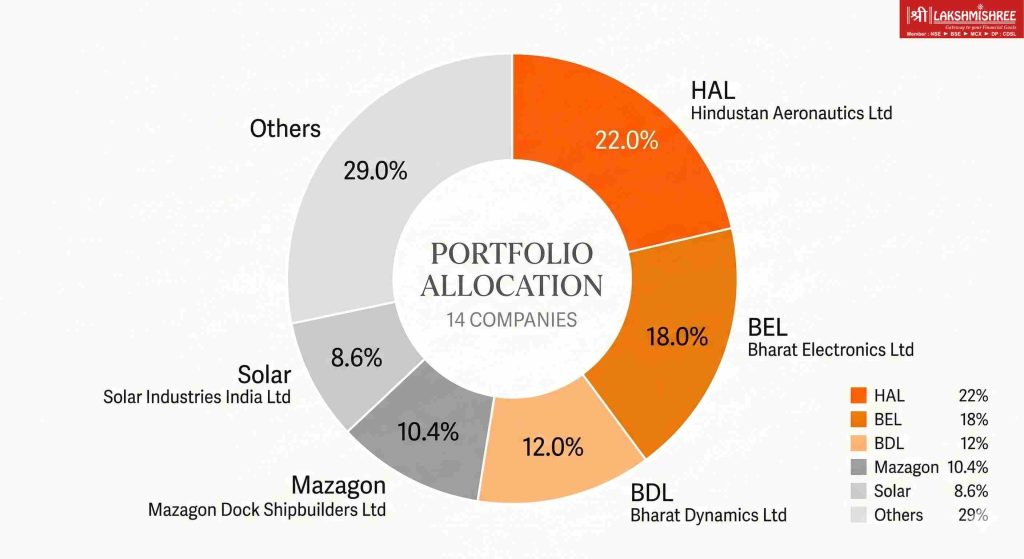
MODefence ETF (NSE: MODEFENCE) is India's first pure-play defense vehicle. At approximately ₹93.60 per unit, it provides immediate diversified exposure to 14 strategic companies, anchored by HAL (22%), BEL (18%), and BDL (12%).
AUM: ₹1,400 CREXPENSE: 0.58%CONCENTRATION: 84%
Refer to the comprehensive analysis below for growth drivers and institutional buying strategy.
Table Of Contents
Defence ETF: The Investment You are "Re"searching
The average investor whosoever is reading this blog, probably is here,
BEL shares: Go from ₹800 to ₹2,200 (You opened a demat account or thought about it), but never took the next step).
Bharat Dynamics: surged 451%. If you're reading this, you likely watched these moves happen: some from the sidelines, paralyzed by research, others regretting exits made too early.
Someone from your circle: Probably Posted a screenshot of a ₹ XXX profit.
Now you’re searching defence ETF probably late at night because you’re a little hesitant of picking the wrong stock, struck by the fear of being too late, all while searching for any sign and indication for someone with experience to just tell: "Buy this defence stock. buy on this day.
Wait! Actually...there's more to it! "
Research Note · Lakshmishree Methodology
What Makes This Analysis Different
Generic financial content focuses on the What. Our methodology focuses on the You. By the end of this briefing, you will possess total tactical clarity on:
The "Fear" Check: Distinguishing between rational caution and market noise.
The Allocation: Engineering your exposure based on your specific risk profile.
The Triggers: Removing emotional bias with pre-defined buy/sell signals.
The Execution: Implementing the strategy within a 15-minute timeframe.
Designed for informed capital allocation decisions.
"Time in the market beats timing the market"
Investing expert Kenneth Fisher
Before The Numbers
Before we analyze the data, let’s address the core concerns that often lead to investor paralysis. At Lakshmishree, we believe clarity is the first step toward decisive action.
Concern #1: Has the investor missed the rally?
The Institutional Reality: The last five years were defined by Discovery: i.e. the market identifying that Indian Defence is a fundamental structural powerhouse and it has deep value.
The next five years are defined by Delivery. With HAL’s order book exceeding ₹1.2 Lakh Crore and massive indigenous procurement targets for FY27, the hype phase has transitioned (with good reasons) into an execution phase.
You haven't missed the opportunity; you are just entering at the point of proven performance.
Concern #2: What if the investor selects the wrong asset?
The Institutional Reality: Individual stock picking in a high-growth sector requires institutional-grade research and 40+ hours of weekly analysis (avg). You don’t need to be a defense analyst to profit from the sector. A Defence ETFprovides diversified exposure to all 14 major players simultaneously. When HAL secures a contract or BEL upgrades a radar system, your portfolio captures that upside. So, You are making essential distance from gambling on a single player; you are investing in the entire national defense infrastructure.
For example- one player from cricket team may not score a century but the entire team's probability of scoring a century together is more than a single player.
Concern #3: Is staying in cash the safest option?
The Institutional Reality: In a 2026 economy where inflation remains a persistent pressure, waiting on the sidelines is not a neutral act. Earning 3% in a savings account while the stock market grows at 9 percent per year. If we aren't growing at 9 percent per year, we are falling behind, according to the numbers. “safest,” in the most generic sense, would be 9 percent growth year over year.
Earning 3% in a savings account while even the real-world inflation sits significantly higher (consider 4%-6% inflation on an avg) is a scientific loss of purchasing power. At Lakshmishree, we know that calculated participation over passive erosion wins in this market.
Lakshmishree Internal · Investment Philosophy
The Unspoken Truth About Research
At Lakshmishree Investment, we observe a consistent market reality: investors who spend 6+ months in the "research phase" often underperform those who make informed, decisive moves.
Why? Extended research fuels analysis paralysis, not conviction. In the 2026 execution economy, more data often leads to more contradictions rather than clarity.
The objective of a successful investor isn't to attain perfect information—it is to achieve sufficient clarity to act, and the institutional discipline to remain invested through market noise.
Action Over Analysis →
What a Defence ETF Actually Is
You want defence stocks, but you’re afraid to pick a dud. So, a basket was created containing all of them. You buy one unit of that basket (the ETF) for roughly ₹100 (precisely 93.60 with more than 2% return on March 6 alone at 11:04 am, at the time of writing).
What You're Actually Buying: MODefence ETF Structure
When you buy 100 units of MODEFENCE at ₹110 each (₹11,000 investment), you're NOT buying a prediction about defence stocks. You're buying fractional ownership of 14 companies simultaneously, in these exact proportions
MODEFENCE ETF · Key Portfolio Holdings 2026
#
Holding
Segment
Weight (%)
Allocation (₹11K)
01
Hindustan Aeronautics (HAL)
Air Platforms
22.0%
2,420.00
02
Bharat Electronics (BEL)
Defense Electronics
18.0%
1,980.00
03
Bharat Dynamics (BDL)
Missile Systems
12.0%
1,320.00
04
Mazagon Dock Shipbuilders
Naval Systems
10.4%
1,144.00
05
Solar Industries India
Explosives
8.6%
946.00
—
9 Additional Holdings
Misc. Defense
29.0%
3,190.00
Source: Motilal Oswal Asset Management · Data as of March 2026 · Allocation based on ₹11,000 illustrative investment.
Translation:
Your ₹11,000 immediately becomes ₹2,420 in HAL, ₹1,980 in BEL, ₹1,320 in BDL, and so on across 14 companies. If HAL wins a ₹40,000 crore fighter jet contract tomorrow, 22% of your investment benefits. If BEL secures radar orders, 18% benefits. If three holdings disappoint but six outperform, you capture the weighted average outcome.
This is automatic portfolio construction. No rebalancing needed-the index adjusts quarterly based on market cap changes. No individual stock risk. If one company's CEO resigns or a project delays, you hold 13 others. No decision fatigue that you're not choosing between HAL and BEL; you own both.
The Numbers: What will you have in 5 years?
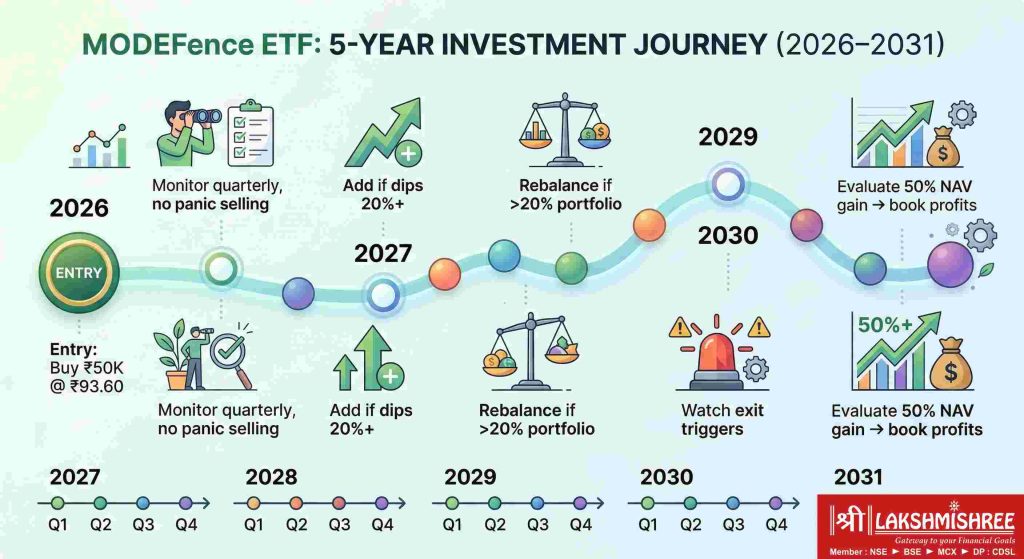
If you put in ₹50,000 today, here is where you could stand in 5 years based on different market conditions:
Scenario
Estimated CAGR
Potential Value in 5 Years
Conservative
12%
₹88,117 (+76% gain)
Moderate
18%
₹1,14,415 (+128% gain)
Optimistic
24%
₹1,46,500 (+193% gain)
The Growth Thesis: Why Defence Could Deliver (Or Disappoint)
Every investment case needs bull AND bear analysis. Here's both:
Bull Case: Structural Tailwinds (55% Probability)
Government Budget Trajectory: India's defence budget grew from ₹5.25 lakh crore (FY23) to ₹6.81 lakh crore (FY26)—compound annual growth of 9%. This isn't party-specific; it's bipartisan consensus driven by border security needs. FY26 capital procurement allocation: ₹1.62 lakh crore, up from ₹1.38 lakh crore (FY25). Within that, domestic procurement mandate increases from 58% to 75% by FY27. Even if overall budget growth slows to 6-7%, domestic companies capture expanding share of a growing pie.
Order Book Visibility: HAL holds ₹1.2 lakh crore in orders—3.8X annual revenue. BEL: ₹68,000 crore (4.2X revenue). These aren't projections; they're contracted orders with phased delivery over 5-8 years. The investment question isn't WHETHER revenue materializes but WHEN and at what margin. Historical precedent shows 20-30% execution delays are common, but even delayed revenue conversion represents 15-20% CAGR from current levels.
Export Momentum: India's defence exports: ₹21,000 crore (FY24), up from ₹1,500 crore (FY17)-14X growth in 7 years. Government target: ₹50,000 crore by FY30. This isn't fantasy: BrahMos missiles to the Philippines, Dornier aircraft to the Maldives, artillery to Southeast Asia. Export revenue provides diversification beyond domestic budget cycles and validates product quality to global standards.
Strategic Context · Global Geopolitics
Structural Reality vs. Temporary Factors
The Russia-Ukraine conflict exposed critical import dependency risks. Historically, India sourced 60-70% of its equipment from Russia. As global supply chains face structural fractures, indigenization has moved from an option to a necessity.
MARKET PULSE: MARCH 2026 UPDATE
Fueled by heightened U.S.-Iran tensions and record global military expenditure of $2.63 trillion, Indian defense equities have reached historic peaks.
Government Dependency: 85-95% of defence company revenue comes from government orders. If fiscal pressures force budget reallocation, perhaps economic slowdown, competing social spending, or political shifts, sector revenue contracts immediately. Defence budgets are "sticky" but not immune. The 2008 financial crisis saw some countries cut military spending 10-15%. While India's current geopolitical environment makes severe cuts unlikely, this single-customer concentration is genuine structural risk.
Execution Uncertainty: Order books guarantee contracts, not delivery timelines or profitability. Defence PSUs historically face: supply chain delays, technology integration challenges, quality control issues. HAL's Light Combat Aircraft experienced multi-year delays. If order execution extends 40-50% beyond planned timelines (not unprecedented), intermediate returns disappoint even though ultimate revenue arrives. This is earnings timing risk—the hardest kind to manage.
Valuation Compression Risk: Defence stocks currently trade at P/E ratios of 25-40, compared to historical ranges of 8-15. This re-rating reflects improved prospects and strategic importance. But it also means current valuations embed optimistic assumptions. If earnings growth disappoints, perhaps margins compress or order flow slows, leading stocks to de-rate toward historical multiples. A move from 35 P/E to 20 P/E represents 43% downside EVEN IF earnings don't decline. That's valuation math, not speculation.
Sector Concentration: 84.84% allocation to aerospace and defence means ZERO diversification. If defence underperforms broader markets for sector-specific reasons unrelated to company execution, perhaps policy changes, budget priorities shift, or geopolitical de-escalation—your entire investment absorbs that underperformance. Compare to Nifty 50 ETF spreading risk across IT, finance, consumer goods, energy. Concentration creates opportunity AND vulnerability.
Sector Intelligence · Growth Projections
Growth Driver
Current Status (2026)
2031 Projection
Defence Budget
₹6.81L Cr9.0% Annual Growth
₹9.5-10L Cr7-9% CAGR Range
Domestic Procurement
58% Share₹3.95L Cr Order Book
75% Mandate₹7L Cr+ Domestic CapEx
Export Momentum
₹21,000 Cr14X Expansion since FY17
₹50,000 Cr138% Upside Forecast
HAL Order Backlog
₹1.2L Cr3.8X Revenue Coverage
5-7 Yr Delivery15-20% CAGR Target
Source: Union Budget FY26 · Ministry of Defence · Institutional Reports (HAL, BEL, BDL)
The Decision Matrix: ETF vs. Direct Stock Picks
Here's the honest trade-off analysis most articles won't give you:
Execution Strategy · Active Management
If You Have Research Bandwidth → Direct Stocks Win
For investors with high conviction and deep monitoring capabilities, direct equity remains the ultimate vehicle for alpha generation in the defense sector.
HISTORICAL ALPHA CASE
Investors who identified HAL (626% return) or BDL (451%) in 2021 vastly outperformed thematic ETF averages.
The Institutional Requirements:
Time: 3-5 hours of dedicated monthly sector research.
Risk Tolerance: Ability to withstand 35-50% single-stock volatility.
Capital Base: Portfolio of ₹5L+ for effective position sizing.
Technical Skill: Evaluating order book execution & management quality.
Appropriate for high-conviction, long-term capital allocation.
Passive Allocation · Thematic Exposure
For Low-Maintenance Exposure → ETF Wins
Investors seeking high-conviction sector exposure without the operational burden of active monitoring find the ETF path to be the most efficient capital vehicle.
THE "AVERAGE-UP" PROTOCOL
Capture HAL's momentum (22%) and BEL's dominance (18%) while single-stock downside—like a Mazagon volatility—is capped by the portfolio's structural weight.
The Strategic Suitability Check:
Capital Base: Efficient for sector allocations between ₹50K – ₹5L.
Operational Preference: Automated rebalancing and broad diversification.
Time Constraint: No requirement for quarterly monitoring or earnings calls.
Risk Profile: Preference for sector-wide stability over individual "Moonshots."
Optimized for passive, structural growth capture.
The Decisive Question: Would you rather (A) potentially outperform ETF by 3-5% annually IF your stock picks succeed, or (B) eliminate the risk of underperforming it by 50%+ if your picks fail? For investors without strong stock selection conviction, (B) is mathematically
Risk Assessment: The Uncomfortable Realities
At Lakshmishree Investment and Securities, we've observed that most investors focus extensively on upside scenarios while underweighting downside risks. Balanced analysis requires equal attention to what could go wrong:
Risk Control · Portfolio Sizing
Appropriate Capital Allocation (Critical)
Regardless of the structural growth thesis, institutional discipline requires strict exposure limits to mitigate the volatility inherent in thematic sectors.
ALLOCATION PROTOCOL
We recommend capping total sector exposure at 10–15% of your total equity corpus.
Illustration: For a ₹10 Lakh portfolio, total allocation should not exceed ₹1.5 Lakh.
The Horizon Mandate:
Maintain a minimum holding duration of 5–10 years to capture the complete industrial execution cycle.
Liquidity Warning: If capital is required within 24 months, this sector is inappropriate regardless of potential upside.
Implementation: How to Actually Buy (15-Minute Process)
If you've determined Defence ETF aligns with objectives, implementation is straightforward. Here's the exact process:
Trade Desk · Implementation Protocol
How to Buy: Step-by-Step
01
Access Demat Environment
Est. 2 Min
Authenticate via the Shree Varahi app. For new accounts, the onboarding protocol requires approximately 5 minutes (₹0 AMC).
02
Asset Identification
Est. 1 Min
Execute search for MODEFENCE. Verify against ISIN: INF0FTB01015. Current reference price is approximately ₹93.60/unit.
03
Position Architecture
Est. 5 Min
Target an allocation of 10–15% of total equity. Example: A ₹5L portfolio warrants a ₹60K position (~641 units). Deploy capital in tranches to optimize entry price.
04
Order Execution
Est. 2 Min
Optimal Window: 10:30 AM – 2:30 PM (Peak Liquidity). Utilize Market Orders for immediate fill or Limit Orders for price-specific execution.
For structural wealth building, automate your exposure with a ₹10,000 monthly mandate. This mitigates timing risk and ensures disciplined sector entry.
Portfolio Governance · Monitoring Protocol
Strategic Management & Rebalancing
QUARTERLY REVIEW CALENDAR
APR 01
JUL 01
OCT 01
JAN 01
The Three Critical Inquiries:
Is the Defense Budget trajectory maintaining its structural growth?
Has sector exposure exceeded 20% of total equity? (Trigger rebalance).
Are order book deliveries being executed within scheduled timelines?
Tactical Warning: Suppress the urge for daily price monitoring. It serves only to fuel emotional noise. Defence is an industrial 5-year play; ignore interim market volatility.
Designed for institutional-grade portfolio maintenance.
Exit Triggers: When to Sell (Pre-Defined Rules)
The hardest part isn't buying—it's knowing when to sell. Set these triggers NOW, before emotions cloud judgment:
Trade Discipline · Exit & Profit Protocols
Exit Trigger
Strategic Context
Mandated Action
Budget Cut >10%
Structural shift in Government fiscal priority.
Liquidate 50%; reassess thesis.
NAV +50% Gain
Price target achievement (e.g., ₹93 → ₹140).
Book 30–40% profit; trail rest.
Allocation >20%
Exposure exceeds institutional safety limits.
Rebalance to 10–15% target.
Geopolitical Shift
Resolution of border tensions; priority shift.
Reduce to 5% or full exit.
Liquidity Need
Personal capital requirements within 24 months.
Liquidate 100% position.
Source: Lakshmishree Risk Management Framework · Adherence is vital for capital preservation.
Making Your Decision: The Final Framework
You've now examined MODefence ETF's structure, growth drivers, risk factors, and implementation mechanics. The decision isn't whether defence is "good" or "bad" in absolute terms—that framing oversimplifies. The question is whether this specific investment aligns with YOUR financial objectives, risk tolerance, and portfolio construction.
Investment Thesis · Suitability Assessment
Defence ETF Suits You IF:
You identify the defence sector as a multi-year structural trend rather than a short-term speculative trade.
You maintain a 5–10 year holding horizon to allow the industrial execution thesis to materialize.
You seek broad sector growth without the operational burden of selecting and monitoring individual equities.
You are comfortable with a tactical allocation of 10–15% of your total portfolio corpus.
You possess the institutional discipline to withstand 15–20% market corrections without initiating panic-liquidations.
Designed for investors aligning capital with India’s industrial delivery cycle.
Mandatory Disclaimer · Risk Exclusion
Defence ETF Does NOT Suit You IF:
You require full capital liquidity within a 24-month window.
Your psychological profile is ill-suited to withstand 20–30% peak-to-trough drawdowns.
You already maintain significant direct exposure to individual defense equities (HAL, BEL, BDL, etc.).
You are seeking guaranteed capital protection with zero exposure to market-linked volatility.
You have not yet established firm exit protocols based on tactical or fundamental triggers.
Capital at risk. Designed for long-duration industrial equity cycles only.
If you've determined Defence ETF aligns, the implementation path is clear (15-minute process above). If you've determined it doesn't, then perhaps due to risk factors, portfolio constraints, or timeline considerations—that's equally valid. Successful investing requires saying "no" to opportunities that don't fit as much as saying "yes" to those that do.
The Growth Thesis: Why Defence Could Deliver (Or Disappoint)
Why NOW? (Discovery vs. Delivery)
The people who made 600% returns caught the "Discovery Phase" (2021-2025). That was when the market "realized" these stocks were undervalued. That phase is over.
We are now entering the "Delivery Phase" (2026-2031).
HAL has an order book of ₹1.2L Crore.
The Government target is 75% local procurement by 2027.
Export targets are jumping from ₹21k Cr to ₹50k Cr.
The Bakery Analogy: Phase 1 was a bakery getting "discovered" (Hype). Phase 2 is the bakery actually delivering 10,000 loaves of bread every day (Actual Profit).
Right Time for Act 2.
Direct Engagement Protocol
Ready to Proceed? Talk to Our Research Team
At Lakshmishree, we have engineered growth for 60,000+ investors over 31 years. Whether you deploy capital via ETFs or direct equity, we provide the tactical clarity required to act.
Disclaimer: This analysis is provided by Lakshmishree Investment and Securities for educational purposes. Defence ETF investments carry sector-specific risks including government budget dependency, execution delays, geopolitical factors, and market volatility. Past performance (HAL +626%, BEL +209%, BDL +451%) represents historical outcomes and does not guarantee future results. Investment projections represent scenarios based on assumptions that may not materialize. All investment decisions should be made based on individual financial circumstances, risk tolerance, and investment objectives. Consult with SEBI-registered investment advisor before making investment decisions. Read all scheme-related documents carefully before investing.
What is the current NAV and Expense Ratio of MODefence ETF?
NAV: As of March 6, 2026, the NAV (price) is approximately ₹93.60. Expense Ratio: It stands at 0.41% - 0.58% (varies slightly between portal data and actual fund disclosures). This is significantly lower than most active thematic mutual funds. AUM: The fund manages approximately ₹1,400 crore, reflecting strong investor interest in the defence theme.
Can I invest in this ETF through a Systematic Investment Plan (SIP)?
Yes. Most major brokers (including Lakshmishree) allow you to set up an ETF SIP. You can automate your purchase (e.g., buying 50 units every month) to benefit from Rupee Cost Averaging, which is highly recommended for a volatile sector like defence.
How many stocks are in the MODefence ETF?
The ETF currently holds a concentrated basket of 14 to 18 companies (depending on the quarterly rebalancing of the Nifty India Defence Index). The top 3 holdings: HAL, BEL, and BDL: typically make up over 50% of the total weight.
Does this ETF pay dividends?
Indirectly. While the ETF units themselves don't usually "payout" cash to your bank account, the dividends paid by the underlying companies (like HAL or BEL) are reinvested into the fund (Total Return Index), which is reflected in an increased NAV.
Is it better to buy the MODefence ETF or individual stocks like HAL?
Choose the ETF if: You want peace of mind. It removes "selection risk" (the risk of picking the one company that underperforms while the sector flies).
Choose Direct Stocks if: You are an active researcher. If you believe Mazagon Dock will outperform HAL by 20%, you can't express that view in an ETF because the weights are fixed by the index.
What are the main risks of the MODefence ETF?
Concentration Risk: Over 80% of the fund is in one sector. If the government slashes the defence budget or shifts focus to social schemes, the entire ETF will drop. Policy Risk: These companies have one major customer: The Government of India. Any change in procurement policy directly impacts your investment.
How is the MODefence ETF taxed?
Short Term (STCG): 20% if sold before 1 year.
Long Term (LTCG): 12.5% on gains exceeding ₹1.25 lakh if held for more than 1 year.
Divyansh Shah is a seasoned Risk Analyst with a deep-rooted understanding of financial markets and risk management strategies. With a keen eye for detail and a passion for data-driven insights, Divyansh has honed his skills in identifying and mitigating potential risks within complex financial environments.