
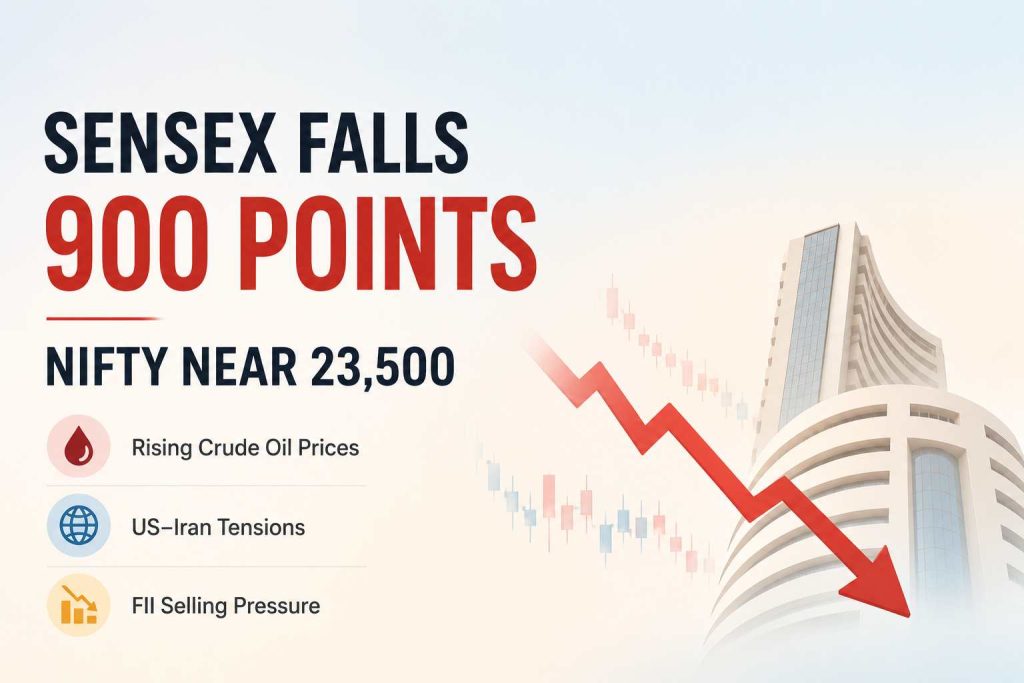
Indian equity markets extended their losing streak for a fourth straight session on Tuesday, with benchmark indices witnessing sharp declines amid rising crude oil prices, persistent foreign investor selling, and renewed concerns over the fragile US–Iran ceasefire situation.
By afternoon trade, the Sensex had dropped more than 900 points to near 75,092, while the Nifty slipped toward the 23,500 mark, reflecting continued weakness in broader market sentiment. The decline remained broad-based, with nearly all major sectoral indices trading in negative territory.
The market reaction was driven primarily by renewed geopolitical uncertainty.
Investor confidence weakened after US President Donald Trump described the Iran ceasefire as being on “massive life support,” raising fears that tensions in West Asia could escalate again and disrupt global crude oil supply chains. The uncertainty pushed Brent crude above $105 per barrel, intensifying concerns around inflation, India’s import bill, and pressure on corporate profitability.
For Indian markets, elevated crude prices continue to remain a critical risk factor.
As one of the world’s largest oil importers, India remains highly sensitive to sustained increases in energy prices. Rising oil costs not only pressure inflation and currency stability but also weaken the broader macroeconomic outlook.
The rupee reflected this pressure immediately.
India’s currency weakened further to a record low near 95.63 against the US dollar as rising crude prices and foreign capital outflows continued to weigh on sentiment. Persistent depreciation in the rupee has added another layer of concern for investors already navigating a volatile global environment.
Foreign institutional investors continued their aggressive selling activity, offloading more than ₹8,400 crore worth of equities in the previous session. The sustained FII outflows have emerged as one of the biggest drags on domestic markets this year, particularly as global investors rotate capital toward markets benefiting from stronger earnings momentum and AI-led growth themes.
Technology stocks amplified the decline.
The Nifty IT index plunged more than 3%, emerging as the biggest sectoral loser during the session. Heavyweight stocks including TCS, Infosys, HCLTech, and Wipro declined sharply ahead of key US inflation data, which investors believe could influence future Federal Reserve policy direction.
Despite the broader weakness, selective sectors showed resilience.
Oil-linked stocks such as ONGC and Oil India rallied strongly after brokerage firm CLSA highlighted government royalty cuts on crude and gas production as a significant positive for the companies. PSU banks and select metal stocks also managed to outperform in an otherwise weak market environment.
Volatility indicators continued to rise.
India VIX, often referred to as the market’s fear gauge, moved higher again, reflecting increasing uncertainty and expectations of sharper near-term swings in equity markets. Investors are also closely watching India’s inflation data release later in the day for further signals on the economic impact of elevated crude prices.
For now, market sentiment remains fragile.
The combination of rising oil prices, weakening currency, sustained foreign selling, and geopolitical instability has created a difficult environment for risk assets.
And until clarity emerges on those fronts, volatility is likely to remain firmly in control of the market narrative.

Kaashika is a social media strategist and financial content creator at Lakshmishree. She specialises in simplifying complex IPO and stock market concepts into clear, easy-to-understand content. Having created over 500+ pieces of financial content across reels, blogs, website posts and digital creatives, Kaashika helps audiences connect with the world of finance in a more accessible and engaging way.