
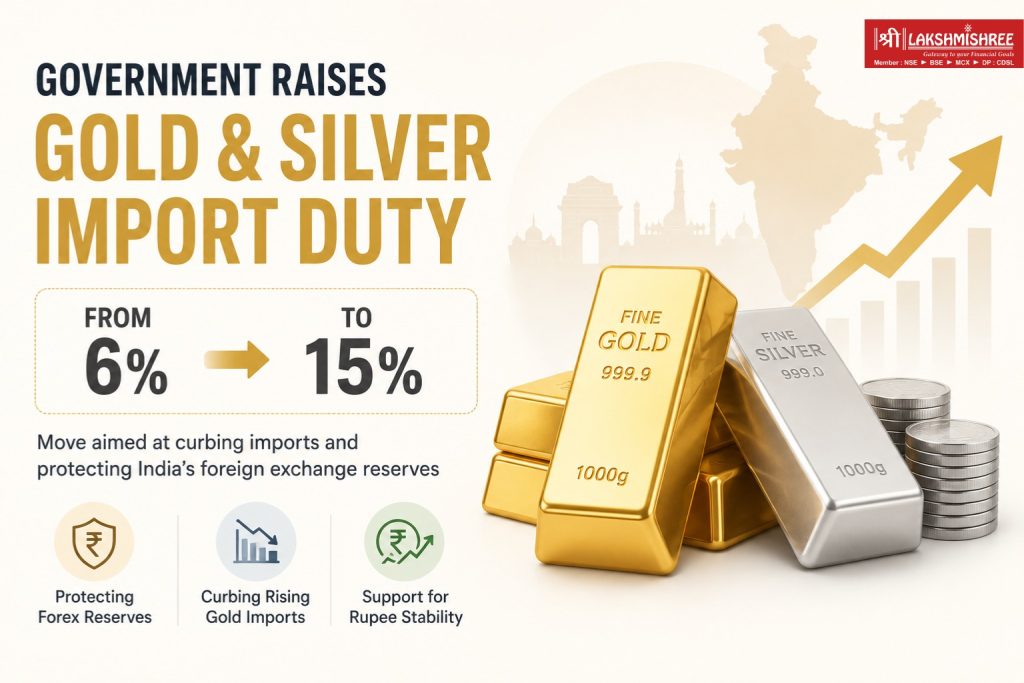
The government on Wednesday sharply increased import duties on gold and silver to 15% from 6%, signaling a decisive policy move aimed at reducing precious metal imports and protecting India’s foreign exchange reserves amid rising global uncertainty.
The decision comes at a sensitive moment for the Indian economy.
With geopolitical tensions in the Middle East continuing to disrupt energy markets and pressure global trade routes, policymakers are becoming increasingly concerned about India’s external stability. Rising crude oil prices, a weakening rupee, and widening import costs have already placed pressure on the country’s trade balance. Gold imports, now surging alongside these challenges, have emerged as another major concern.
The tariff hike reflects the government’s attempt to slow that pressure before it intensifies further.
India remains the world’s second-largest consumer of gold, and demand for bullion—particularly for weddings, investment, and savings—has remained consistently strong despite economic volatility. According to data cited by the Global Trade Research Initiative (GTRI), India’s gold bar imports rose sharply from $36.5 billion in 2022 to nearly $58.9 billion in 2025, with imports from the UAE accounting for a growing share.
That surge has alarmed policymakers.
Higher gold imports increase dollar outflows from the economy, putting direct pressure on India’s foreign exchange reserves and weakening the rupee further. In periods of global instability, when oil prices are also rising, such import-heavy demand can significantly widen the current account deficit.
The government’s latest move, therefore, is not just about gold.
It is about conserving dollars.
It is about protecting external balances.
And it is about preventing additional stress on an already fragile macroeconomic environment.
The tariff increase also follows Prime Minister Narendra Modi’s recent public appeal urging citizens to postpone non-essential gold purchases—including wedding-related buying—for one year in the national interest. The Prime Minister argued that conserving foreign exchange reserves had become critical at a time when instability in West Asia continues to disrupt energy flows through the Strait of Hormuz and impact global markets.
Union Minister Ashwini Vaishnaw echoed the same concerns during the CII Annual Business Summit 2026, urging citizens to reduce import-linked spending and support broader economic stability.
Meanwhile, policy experts are also turning attention toward India’s trade agreements.
The Global Trade Research Initiative has urged the government to reassess tariff concessions granted under the India-UAE free trade agreement, arguing that lower import duties through Dubai have significantly accelerated gold inflows into the country over recent years.
Economists believe the higher duties could reduce domestic demand for imported bullion in the near term, helping narrow the trade deficit and offering some support to the rupee, which has been among Asia’s weakest-performing currencies in recent months.
However, the move may also have side effects.
Higher import duties historically tend to increase smuggling risks and can impact jewellery demand, especially ahead of India’s festive and wedding seasons. The jewellery industry is also likely to face higher input costs and softer consumer demand if gold prices remain elevated.
Still, the broader message from the government is becoming increasingly clear—
In a period marked by rising oil prices, geopolitical uncertainty, and pressure on foreign exchange reserves, controlling non-essential imports is now being treated not merely as an economic decision, but as a strategic necessity.

Kaashika is a social media strategist and financial content creator at Lakshmishree. She specialises in simplifying complex IPO and stock market concepts into clear, easy-to-understand content. Having created over 500+ pieces of financial content across reels, blogs, website posts and digital creatives, Kaashika helps audiences connect with the world of finance in a more accessible and engaging way.