
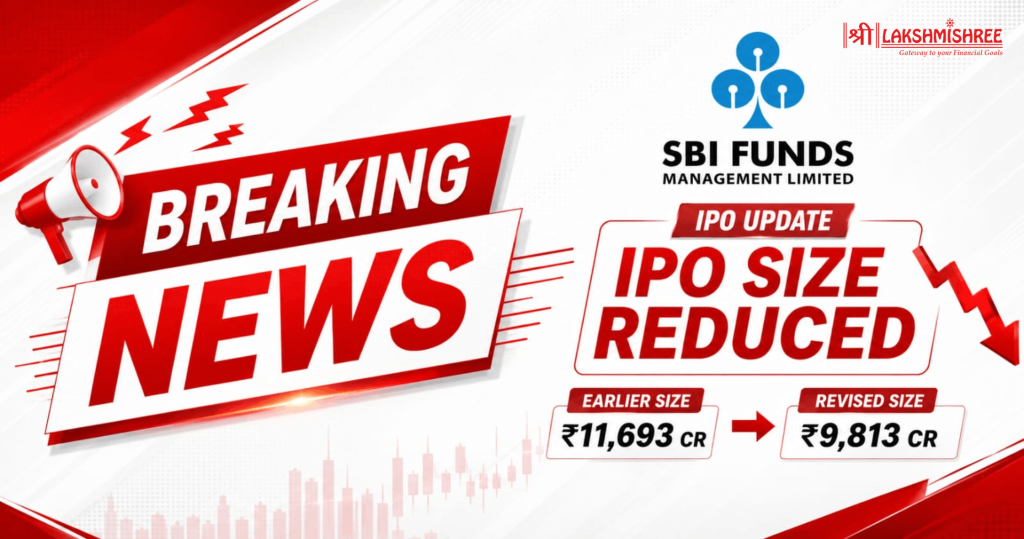
SBI Funds Management, India’s largest asset management company, has revised its upcoming IPO by reducing the issue size from approximately ₹11,692.91 crore to around ₹9,812 crore. While this caught the attention of investors, the change is primarily due to a successful pre-IPO placement and not because of weak demand or any regulatory concern.
SBI Funds Management IPO: Key Highlights
| Particular | Details |
| IPO Type | 100% Offer for Sale (OFS) |
| Initial Issue Size | ₹11,692.91 crore |
| Revised Issue Size | ₹9,812.90 crore |
| Total Shares Offered | 17.09 crore equity shares |
| Stake Offered | 8.39% of paid-up equity share capital |
| Fresh Issue | Nil |
| Main Reason for Reduction | Successful Pre-IPO Placement |
Why Was the IPO Size Reduced?
The company completed a pre-IPO placement with institutional investors, raising nearly ₹1,880 crore before the public issue. As these shares were allotted in advance, the number of shares available in the IPO was reduced, bringing down the overall issue size.
Importantly, the IPO remains a 100% Offer for Sale (OFS). This means no new shares are being issued, and SBI Funds Management will not receive any fresh capital. Instead, the proceeds will go to the existing shareholders selling part of their stake.
What Does This Mean for Investors?
The revised IPO now offers 17.09 crore equity shares, representing 8.39% of the company’s paid-up equity share capital. Despite the smaller issue size, the company’s valuation and fundamentals remain unchanged.
A lower public float may improve demand-supply dynamics, especially if investor interest remains strong. Additionally, successful participation by institutional investors before the IPO reflects confidence in the company’s long-term growth prospects.
Final Takeaway
The reduction in SBI Funds Management’s IPO size should be viewed as a strategic outcome of a successful pre-IPO placement rather than a negative signal. Investors should focus on the company’s business fundamentals, valuation, and long-term growth potential instead of the revised issue size alone.

Kaashika is a social media strategist and financial content creator at Lakshmishree. She specialises in simplifying complex IPO and stock market concepts into clear, easy-to-understand content. Having created over 500+ pieces of financial content across reels, blogs, website posts and digital creatives, Kaashika helps audiences connect with the world of finance in a more accessible and engaging way.