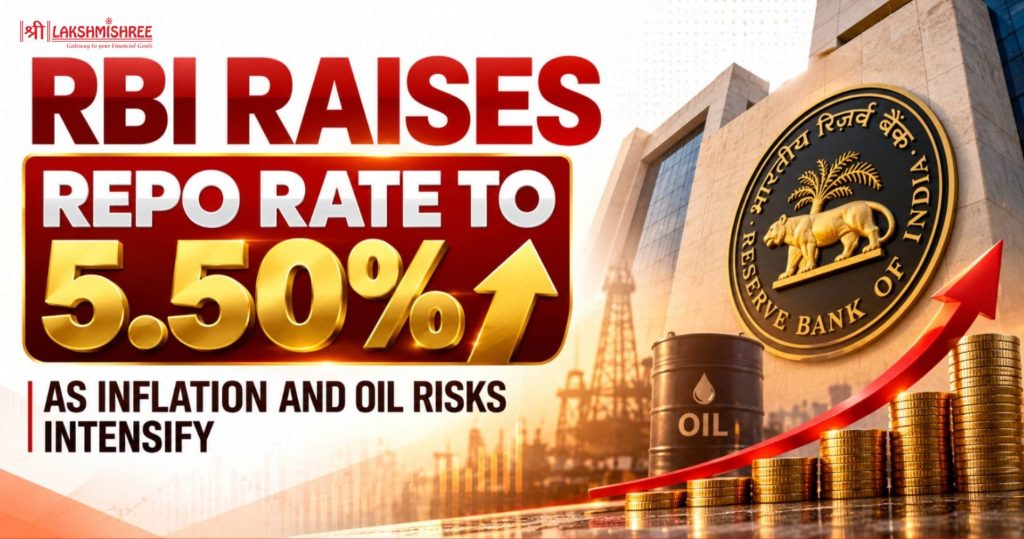
The RBI Repo Rate Hike has brought a fresh shift in India’s interest-rate cycle, with the Reserve Bank of India raising the benchmark repo rate by 25 basis points from 5.25% to 5.50%. The decision comes amid renewed inflationary pressures, higher crude oil prices and heightened uncertainty caused by tensions in West Asia.
The rate increase marks a significant move by the central bank after a prolonged period of policy easing and subsequent rate stability. The decision is expected to have implications for borrowers, depositors, businesses and financial markets.
RBI Repo Rate Hike by 25 Basis Points
The Monetary Policy Committee (MPC), headed by RBI Governor Sanjay Malhotra, decided to increase the repo rate by 25 basis points. With the latest move, the rate has moved from 5.25% to 5.50%.
The repo rate is the interest rate at which the RBI lends short-term funds to commercial banks. Changes in this rate can influence the borrowing and lending rates offered by banks and other financial institutions.
The latest increase is particularly significant because it comes after a period during which the central bank had focused on supporting economic activity through lower interest rates. The RBI is now placing greater emphasis on containing inflationary risks.
Inflation Emerges as a Key Concern
Inflation has become one of the key factors influencing the RBI’s policy decision. While retail inflation remains within the central bank’s tolerance range, the recent upward movement in prices has raised concerns about the possibility of sustained inflationary pressure.
The RBI has a medium-term inflation target of 4%, with a tolerance band of 2% to 6%. Any persistent increase in inflation can complicate the central bank’s task of maintaining price stability while supporting economic growth.
The latest rate hike signals that the RBI is prepared to act pre-emptively if inflationary risks intensify.
Rising Crude Oil Prices Add to Pressure
Another major concern for policymakers is the sharp rise in international crude oil prices. Escalating tensions in West Asia have increased uncertainty around global energy supplies and pushed oil prices higher.
India imports a substantial portion of its crude oil requirements. Therefore, a sustained rise in global oil prices can increase the country’s import bill and put pressure on the rupee.
Higher crude prices can also feed into domestic inflation by increasing transportation, logistics and production costs. This creates an additional challenge for the RBI as it attempts to prevent temporary price pressures from becoming more persistent.
West Asia Crisis Complicates the Inflation Outlook
The ongoing geopolitical tensions in West Asia have added another layer of uncertainty to the economic outlook.
A prolonged crisis in the region could affect crude oil supplies and international shipping routes. Any significant disruption could keep energy prices elevated for an extended period.
For India, this could translate into higher input costs and increased pressure on inflation. The RBI is therefore closely monitoring global developments along with domestic economic indicators.
What Does the Rate Hike Mean for Borrowers?
The immediate concern for borrowers is the possible impact on loan interest rates and monthly repayments.
Home loans, auto loans, personal loans and other floating-rate borrowings could become more expensive if banks pass on the increase in their lending rates. However, the impact will depend on the benchmark linked to the loan and the bank’s individual rate-reset mechanism.
For existing borrowers, a higher interest rate could either increase the EMI or extend the repayment period, depending on the lender’s policy.
New borrowers may also face higher borrowing costs if banks revise their lending rates following the RBI’s decision.
FD Investors Could Benefit
The rate hike may also have implications for fixed deposits. When interest rates rise, banks may increase deposit rates to attract more funds from customers.
However, the increase in FD rates is not necessarily equal to the RBI’s 25-basis-point hike. Banks determine deposit rates based on their funding requirements, liquidity position and competitive environment.
For savers, therefore, the new rate cycle could create opportunities to lock in better returns, particularly if banks revise their deposit rates upwards.
Impact on Stock Market and Businesses
Higher interest rates can also influence equity markets. Companies that rely heavily on borrowing may face increased financing costs, which can affect profitability.
Interest-rate-sensitive sectors such as real estate, automobiles and some consumer businesses could see an impact if borrowing costs remain elevated.
At the same time, the banking and financial sector could see mixed effects. Higher lending rates can support interest income, but expensive credit may eventually affect loan demand and credit growth.
What Happens Next?
The key question now is whether the 25-basis-point hike marks a one-time adjustment or the beginning of a prolonged tightening cycle.
The RBI’s future decisions are likely to depend on inflation, crude oil prices, currency movements, global interest rates and domestic economic growth.
For borrowers, the latest decision is a reminder to review their loan interest rates and repayment terms. Depositors, meanwhile, may watch for better FD rates as banks respond to changing funding conditions.
For investors, the focus will now shift to the RBI’s future policy guidance and incoming inflation and economic-growth data.
The latest move underlines the central bank’s priority of keeping inflationary risks under control while maintaining economic stability. With global oil markets and geopolitical tensions adding uncertainty, the direction of interest rates in the coming months will remain closely watched by households, businesses and financial markets.
For more updates on the stock market, RBI decisions, IPOs and the economy, visit the Lakshmishree investment and Securities News section.

Kaashika is a social media strategist and financial content creator at Lakshmishree. She specialises in simplifying complex IPO and stock market concepts into clear, easy-to-understand content. Having created over 500+ pieces of financial content across reels, blogs, website posts and digital creatives, Kaashika helps audiences connect with the world of finance in a more accessible and engaging way.