
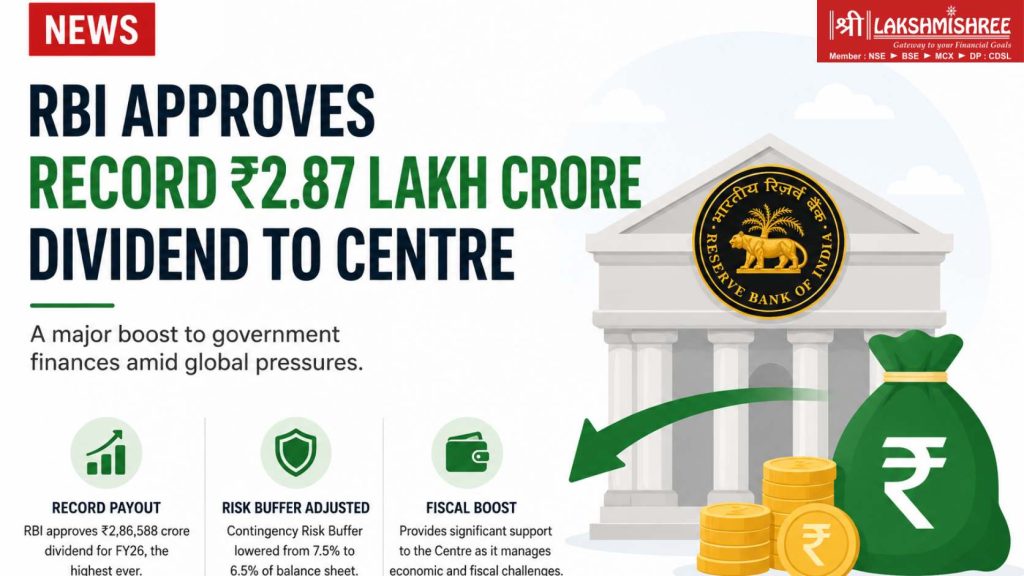
The Reserve Bank of India (RBI) has approved a record surplus transfer of ₹2.87 lakh crore to the Central Government for FY26, marking the largest dividend payout in the central bank’s history and providing significant support to government finances at a time of growing global uncertainty.
The approved transfer amounts to ₹2,86,588 crore, exceeding last year’s record payout of ₹2.69 lakh crore and arriving as India faces pressure from elevated crude oil prices, geopolitical disruptions, and concerns around fiscal management.
The dividend comes from RBI’s surplus income generated through investment earnings, valuation gains on reserve assets, foreign exchange holdings, and other central banking operations.
What Led to the Record Transfer?
The size of the payout reflects a strong year for RBI’s financial position.
During FY26:
- RBI’s gross income rose 26.42%
- Net income before provisions increased to ₹3.96 lakh crore
- The central bank’s balance sheet expanded 20.61% to ₹91.97 lakh crore
Analysts believe stronger earnings, liquidity operations, and favourable reserve valuations contributed to the increase.
A major policy decision also played a role.
RBI reduced its Contingency Risk Buffer (CRB)—capital maintained to absorb financial shocks—from 7.5% of the balance sheet to 6.5%, allowing a larger portion of surplus to be transferred to the government.
Why This Matters for the Government
The timing of the transfer is important.
India’s fiscal position is facing pressure from:
- higher energy costs,
- subsidy risks,
- global market volatility,
- and uncertainty linked to Middle East tensions.
In the Union Budget, the Centre had estimated approximately ₹3.16 lakh crore in dividends and surplus receipts from RBI and financial institutions for FY27. RBI’s transfer alone now covers most of that expectation.
This gives the government additional flexibility to manage expenditure without immediately increasing borrowing.
Economists Still Remain Cautious
Despite the record payout, economists say fiscal risks have not disappeared.
Several forecasts suggest India could still miss its FY27 fiscal deficit target of 4.3% of GDP if oil prices remain elevated and subsidy spending rises. Estimates from analysts indicate the deficit could move closer to 4.5–5% of GDP under adverse conditions.
Bond markets are already reflecting this uncertainty, with government yields moving higher amid concerns over inflation and energy costs.
The Bigger Picture
The RBI dividend provides breathing room—but not a complete solution.
It strengthens the government’s financial position, supports fiscal management, and creates a temporary buffer against external shocks.
But whether this record transfer becomes a long-term advantage or simply buys time will depend on factors outside RBI’s control—
oil prices, global growth, and how long geopolitical uncertainty continues.

Kaashika is a social media strategist and financial content creator at Lakshmishree. She specialises in simplifying complex IPO and stock market concepts into clear, easy-to-understand content. Having created over 500+ pieces of financial content across reels, blogs, website posts and digital creatives, Kaashika helps audiences connect with the world of finance in a more accessible and engaging way.