
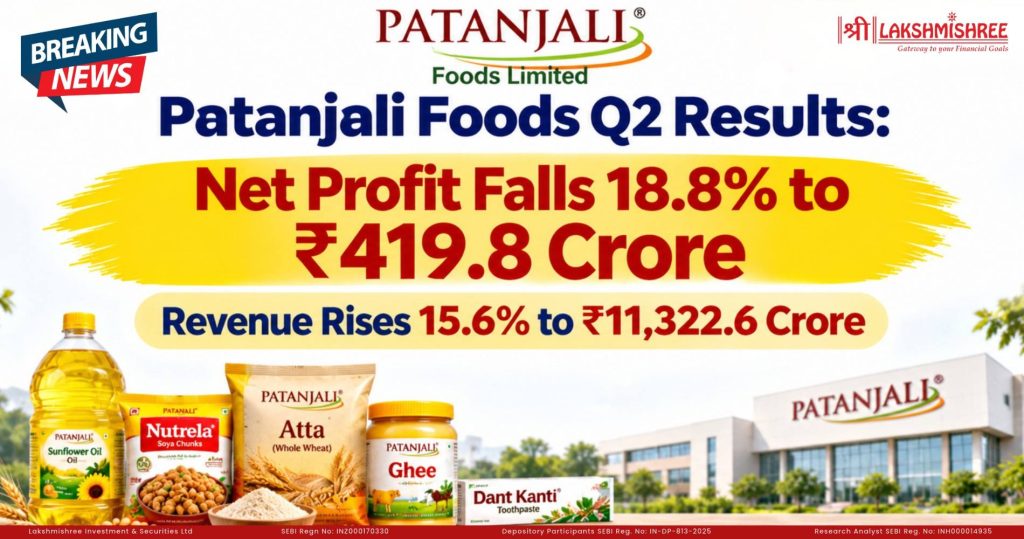
Patanjali Foods Limited reported a mixed financial performance for the second quarter ended September 30, 2026, with consolidated net profit declining 18.76% year-on-year (YoY) to ₹419.77 crore, compared with ₹516.70 crore in the corresponding quarter last year.
Despite the decline in profitability, consolidated revenue from operations increased 15.55% YoY to ₹11,322.58 crore in Q2 FY27, against ₹9,798.84 crore in Q2 FY26.
The company’s total income increased 15.8% to ₹11,406.50 crore from ₹9,850.07 crore. However, total expenses increased at a faster pace, rising 17.68% to ₹10,997.51 crore.
The performance presented a contrasting picture across business segments. The edible oils business recorded strong revenue growth, while profitability in the FMCG segment came under pressure.
Patanjali Foods Q2 Results : Key Financial Highlights
- Consolidated revenue from operations: ₹11,322.58 crore, up 15.55% YoY.
- Consolidated net profit: ₹419.77 crore, down 18.76% YoY.
- Consolidated total income: ₹11,406.50 crore, up 15.8% YoY.
- Profit before tax: ₹408.98 crore, down 19.03% YoY.
- Total expenses: ₹10,997.51 crore, up 17.68% YoY.
- Edible oils segment revenue: ₹8,532.25 crore, up 22.39% YoY.
- FMCG segment revenue: ₹2,923.48 crore.
- Operating EBITDA excluding exceptional items: ₹425.63 crore.
- Operating EBITDA margin: 3.76%.
Revenue Growth Fails to Translate into Higher Profit
Patanjali Foods recorded healthy revenue growth during the September quarter, but its profitability declined.
Consolidated revenue from operations increased 15.55% to ₹11,322.58 crore. However, total expenses rose 17.68% to ₹10,997.51 crore, outpacing revenue growth.
Consequently, profit before tax declined 19.03% to ₹408.98 crore from ₹505.09 crore in Q2 FY26.
Net profit also declined 18.76% to ₹419.77 crore, compared with ₹516.70 crore in the year-ago quarter.
The difference between revenue and profit growth highlights the pressure on the company’s earnings despite higher business volumes and sales.
FMCG Segment Faces Profitability Pressure
The FMCG business was one of the key areas of concern during the quarter.
The segment recorded revenue of ₹2,923.48 crore, compared with ₹2,914.24 crore in Q2 FY26, indicating relatively flat year-on-year growth.
However, segment profit before finance costs and tax declined to ₹207.90 crore from ₹341.63 crore, a fall of approximately 39.1%.
The segment reported an EBITDA of ₹221.33 crore, with an EBITDA margin of 7.57%.
Despite the profitability pressure, some product categories continued to record healthy growth.
The biscuits division reported its highest-ever quarterly revenue of ₹638.31 crore, registering 27.69% YoY growth. Its EBITDA margin improved to 11.91% from 9.79% in the corresponding quarter last year.
The textured soya products business also recorded 16.40% revenue growth during the quarter.
Within Home and Personal Care, revenue increased 11.06% to ₹713.88 crore, supported by growth across skin care, home care and hair care categories.
Edible Oils Business Records Strong Growth
The edible oils segment remained an important contributor to the company’s revenue growth.
The segment recorded its highest-ever quarterly revenue of ₹8,532.25 crore, increasing 22.39% year-on-year from ₹6,971.64 crore.
Segment profit before finance costs and tax increased to ₹223.39 crore from ₹207.76 crore, registering growth of approximately 7.5%.
The segment reported EBITDA of ₹256.22 crore, with an EBITDA margin of 3%.
The company’s oil palm plantation business generated revenue of ₹742.29 crore during the quarter.
As of September 2026, Patanjali Foods had 1,27,265 hectares under oil palm cultivation, with approximately 34% of the area in the prime yielding phase.
The expansion of its plantation network and edible oil operations remains an important part of the company’s business strategy.
First-Half Performance Records Revenue Growth
For the six months ended September 30, 2026, Patanjali Foods reported strong growth in revenue and an improvement in net profit.
Key H1 performance figures include:
- Revenue from operations: ₹22,660.03 crore, up 22.06% YoY.
- Total income: ₹22,748.39 crore, compared with ₹18,629.08 crore.
- Net profit: ₹755.50 crore, compared with ₹697.06 crore.
- Operating EBITDA excluding exceptional items: ₹969.03 crore.
- Operating EBITDA margin: 4.28%.
While the first-half net profit increased approximately 8.4%, the September quarter witnessed a decline in profitability.
This indicates that the company’s earnings performance weakened in Q2 compared with the broader first-half trend.
Management Expects Growth Momentum to Continue
Commenting on the quarterly performance, Sanjeev Asthana, Chief Executive Officer of Patanjali Foods, said the quarter reflected the resilience of the company’s integrated business model across branded edible oils, oil palm plantations and its growing FMCG portfolio.
Management highlighted that the timing of festive demand affected quarterly performance. Navratri began in October this year compared with September last year, while Pitru Paksha during September deferred some festive-led purchases.
The company expects growth momentum to continue with the recent festive season and the upcoming wedding season.
Its priorities include strengthening brands, expanding the edible oils and FMCG portfolio, growing the oil palm plantation business and improving operational efficiencies.
What Does Patanjali Foods Do?
Patanjali Foods Limited is one of India’s major FMCG and edible oil companies, with operations across edible oils, food products, personal care and wind power generation.
The company operates through several well-known consumer brands, including Patanjali, Ruchi Gold, Nutrela, Mahakosh, Sunrich and Dant Kanti.
Its business operations are divided into three key segments:
- Edible Oils: Crude and refined edible oils, vanaspati, bakery fats and seed extraction products.
- FMCG: Food products, ghee, biscuits, noodles, nutraceuticals, personal care and home care products.
- Wind Power Generation: Electricity generation through wind turbines.
The company’s performance is influenced by edible oil prices, raw material costs, consumer demand, product mix, distribution expansion and competition in the FMCG market.
Conclusion
Patanjali Foods’ Q2 performance presented a mixed picture. Consolidated revenue from operations increased 15.55% year-on-year to ₹11,322.58 crore, but net profit declined 18.76% to ₹419.77 crore.
The edible oils business recorded its highest-ever quarterly revenue, while the FMCG segment faced a significant decline in segment profitability despite relatively stable revenue.
The biscuits division and Home and Personal Care category continued to record growth, providing some support to the broader FMCG portfolio.
Going forward, investors and market participants will monitor the recovery in FMCG profitability, edible oil margins, raw material prices, festive-season demand and the company’s ability to convert revenue growth into stronger earnings.
Source: Patanjali Foods Limited’s unaudited standalone and consolidated financial results and Q2/H1 press release for the quarter and half-year ended September 30, 2026, announced on November 14, 2026.
Disclaimer: Investments in the securities market are subject to market risks. Read all related documents carefully before investing.
Do you have a news tip for Lakshmishree reporters? Please email us at [email protected]

News Desk