
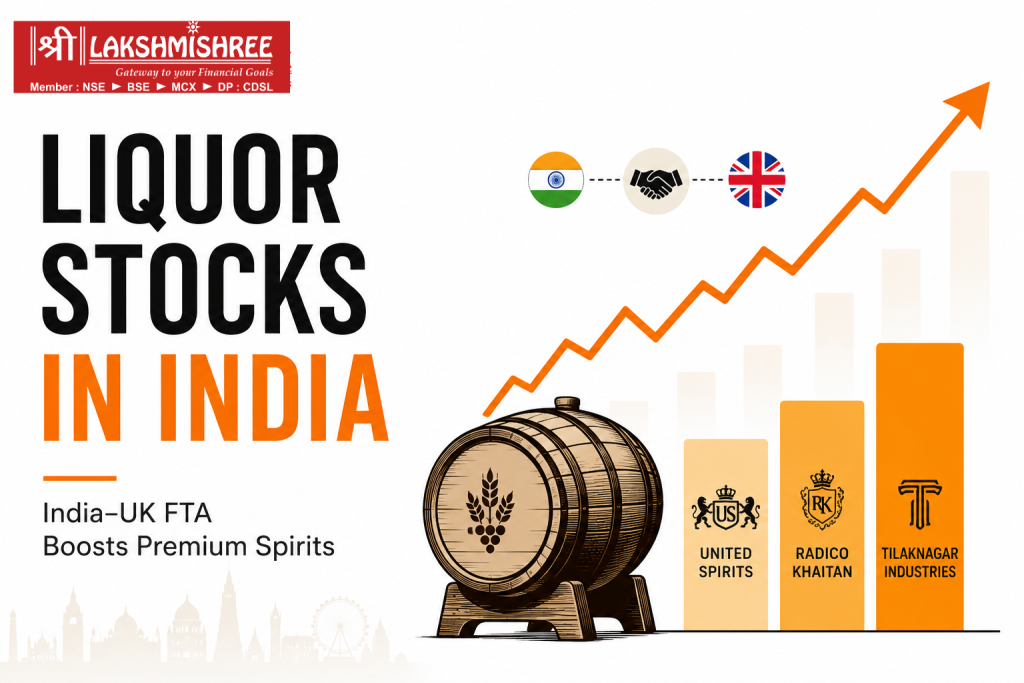
Shares of leading alcoholic beverage companies traded higher on Wednesday after the implementation of the India-UK Free Trade Agreement (FTA) sparked optimism about the future of India’s premium spirits market, aka Liquor Stocks.
Among the major gainers, United Spirits rose nearly 3%, Tilaknagar Industries climbed more than 3%, while Associated Alcohols & Breweries, Piccadily Agro and Radico Khaitan also traded firmly in the green.
While the immediate trigger was the trade agreement between India and the United Kingdom, the market’s reaction reflects something much bigger: investors are betting that lower tariffs on Scotch whisky could accelerate premiumisation in India’s fast-growing alcohol industry.
Why Are Liquor Stocks Rising Today?
The answer lies in one word: premiumisation.
Under the India-UK FTA, tariffs on Scotch whisky imports from the United Kingdom are expected to decline over time. Industry bodies believe this will strengthen bilateral trade, expand consumer access to premium international brands and create opportunities across India’s spirits value chain.
For years, high import duties kept premium imported spirits expensive in India. Lower tariffs could make Scotch whisky more accessible to a larger segment of consumers, potentially increasing demand across the premium alcohol category.
Investors appear to believe that this shift could benefit companies with strong premium portfolios and established distribution networks.
Why The FTA Matters Beyond Imported Whisky
At first glance, lower tariffs on Scotch whisky may seem like a challenge for domestic liquor companies.
The market, however, is viewing the development differently.
Industry experts argue that greater access to premium imported brands could encourage consumers to move up the value chain rather than simply switch products.
In other words, consumers who begin exploring premium Scotch may also become more willing to spend on premium Indian whisky, vodka, tequila and other high-margin offerings.
That trend is already visible in India’s alcohol market, where premium and prestige brands have consistently grown faster than mass-market products.
The FTA could potentially accelerate that transition.
JPMorgan Turns Bullish On United Spirits
Investor sentiment received an additional boost after JPMorgan maintained its “Overweight” rating on United Spirits and set a target price of ₹1,510.
The brokerage believes the company’s growth outlook for FY27 remains constructive, supported by multiple growth drivers.
According to JPMorgan, key positives include:
- Double-digit growth expectations for premium and above (P&A) brands
- Product renovation initiatives such as the McDowell’s refresh
- Expansion in vodka and tequila categories
- Potential upside from the India-UK FTA
- Improving execution amid rising competition
The brokerage also expects the second half of the financial year to be stronger as the impact of regulatory changes in Maharashtra gets absorbed.
While higher packaging and logistics costs may continue to pressure margins in the near term, JPMorgan believes gradual margin expansion remains achievable.
Why United Spirits Could Be One Of The Biggest Beneficiaries
Among listed alcohol companies, United Spirits appears particularly well-positioned to benefit from premiumisation trends.
The company owns several leading premium brands and also enjoys direct exposure to global spirits giant Diageo’s portfolio.
Lower import duties could improve opportunities in premium categories while supporting broader consumer interest in high-end spirits.
The company has also increased its focus on brand-building, innovation and consumer segmentation.
Management has reportedly refined its strategy around multiple consumer cohorts, each targeting a different growth opportunity within the alcohol market.
This is one reason analysts remain optimistic despite rising competition from domestic players.
What Industry Bodies Are Saying
The International Spirits and Wines Association of India (ISWAI) welcomed the implementation of the trade pact, describing it as a positive development for the entire spirits ecosystem.
According to the association, lower tariffs on Scotch whisky imports, including bulk Scotch used for blending and bottling in India, could create value across the supply chain while expanding consumer choice.
The industry expects benefits to flow through:
- Importers
- Bottling companies
- Distributors
- Premium alcohol brands
- Retail channels
However, not everyone sees the agreement in exactly the same way.
The Concern Raised By Domestic Producers
The Confederation of Indian Alcoholic Beverage Companies (CIABC) has urged state governments to reconsider concessions currently available to bottled-in-origin (BIO) brands.
The industry body argues that if import duties decline while existing benefits remain unchanged, imported liquor could eventually become cheaper than products manufactured domestically.
This raises concerns about competitive balance within the industry.
Domestic producers believe that tax and regulatory policies should evolve alongside the FTA to ensure a level playing field.
The debate highlights an important reality: while the agreement creates opportunities, it may also intensify competition within India’s alcohol sector.
The Bigger Story Investors Should Understand
The market is not simply celebrating lower tariffs on Scotch whisky.
Investors are responding to the possibility that the India-UK FTA could accelerate one of the most important trends in the alcoholic beverages industry: premiumisation.
The chain reaction looks like this:
Lower Import Tariffs → Greater Access to Premium Spirits → Rising Consumer Aspirations → Higher Premium Alcohol Sales → Better Margins → Stronger Earnings Growth
That is the bigger reason liquor stocks moved higher.
Companies such as United Spirits, Radico Khaitan and Tilaknagar Industries are increasingly being valued not just as alcohol manufacturers, but as beneficiaries of India’s growing appetite for premium products.
What Investors Should Watch Next
The long-term impact of the India-UK FTA will depend on how quickly tariff reductions are implemented and how consumer behaviour evolves over the coming years.
Investors should closely monitor:
- Future tariff reduction schedules
- Premium spirits sales growth
- Margin trends among leading liquor companies
- Changes in state-level alcohol policies
- Competitive responses from domestic and international brands
For now, the market appears optimistic.
The rally in liquor stocks suggests investors believe the India-UK FTA could become a meaningful growth catalyst for India’s premium alcohol industry, creating opportunities for both global spirits companies and domestic manufacturers alike.

Kaashika is a social media strategist and financial content creator at Lakshmishree. She specialises in simplifying complex IPO and stock market concepts into clear, easy-to-understand content. Having created over 500+ pieces of financial content across reels, blogs, website posts and digital creatives, Kaashika helps audiences connect with the world of finance in a more accessible and engaging way.