
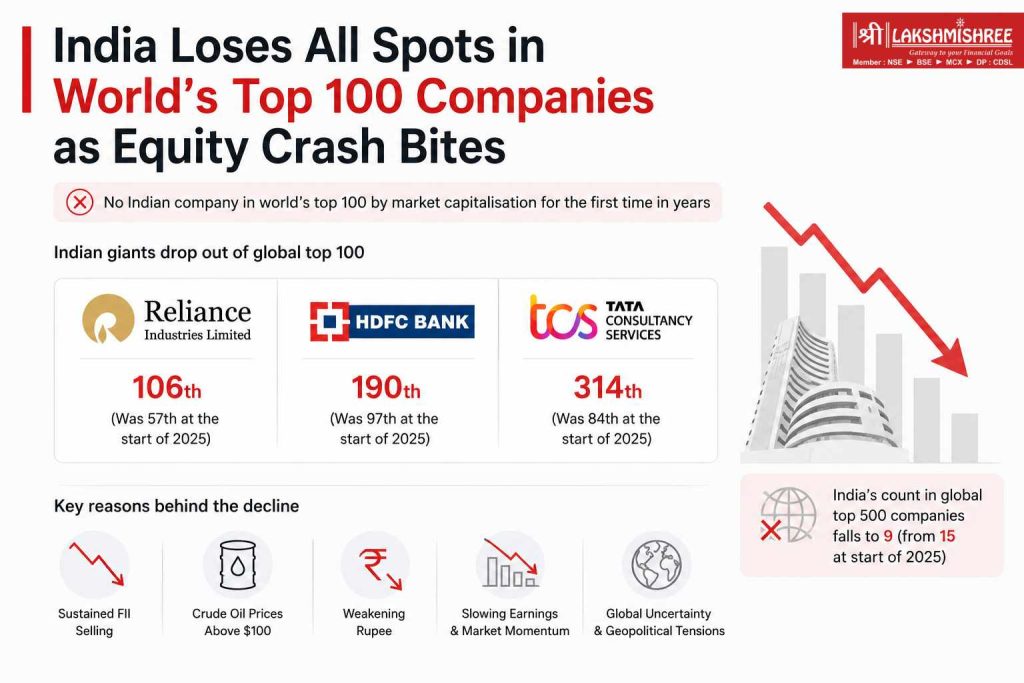
India loses all spots in world’s top 100 companies as the ongoing stock market correction erases Reliance, HDFC Bank, and TCS from the global market-cap elite., highlighting the scale of the ongoing correction in Indian equities and the growing pressure on the country’s largest listed firms.
Reliance Industries, HDFC Bank, and Tata Consultancy Services (TCS)—all of which were part of the global top 100 at the start of 2025—have now fallen out of the list amid sustained market weakness, foreign investor selling, and rising macroeconomic risks.
Indian Companies Fall in Global Market Cap Rankings
The decline in rankings has been sharp across sectors.
Reliance Industries, India’s most valuable company, has slipped to around 106th globally from 57th at the beginning of 2025. HDFC Bank, once ranked among the world’s top 100 firms, has now fallen to nearly 190th globally.
The correction has been even steeper in the technology sector.
TCS, India’s largest IT exporter, dropped to around 314th globally after being ranked 84th at the start of 2025. Infosys also witnessed a major decline, falling to nearly 590th globally as weakness in technology stocks and slowing global demand continued to pressure valuations.
Bharti Airtel, ICICI Bank, State Bank of India, and ITC also slipped significantly in global rankings amid the broader market correction.
The fact that India loses all spots in world’s top 100 companies reflects the depth of the recent equity market correction and weakening investor confidence.
Why India Loses All Spots in World’s Top 100 Companies
The erosion in market capitalisation reflects a combination of domestic and global pressures that have intensified over the past year.
The selloff initially began in mid-2024 as foreign institutional investors started reducing exposure to Indian equities amid elevated valuations, slowing earnings growth, and concerns around global trade tensions.
However, the correction accelerated sharply in recent months after the US–Iran–Israel conflict pushed crude oil prices above $100 per barrel.
For India, which imports a majority of its energy requirements, higher crude prices create immediate risks:
- rising inflation,
- pressure on the rupee,
- widening fiscal deficits,
- and weaker corporate profitability.
These concerns have significantly weakened investor confidence in Indian markets.
Foreign Investors Continue to Exit Indian Markets
Persistent foreign investor selling has emerged as one of the biggest pressures on Indian equities in 2026.
Global investors have increasingly shifted capital toward markets linked to artificial intelligence, semiconductor manufacturing, and high-growth technology ecosystems such as the United States, Taiwan, and South Korea.
Analysts say India’s relatively limited exposure to AI-led growth sectors has reduced its attractiveness in the current global investment cycle.
At the same time, the rupee’s sharp depreciation and rising bond yields globally have further accelerated capital outflows from emerging markets, including India.
Global Brokerages Cut Outlook on Indian Markets
Several major global financial institutions have downgraded their outlook on Indian equities in recent months.
Brokerages including UBS, Morgan Stanley, Nomura, JPMorgan, HSBC, Goldman Sachs, and Citi have all flagged concerns around:
- high market valuations,
- oil-driven inflation risks,
- weakening earnings momentum,
- and pressure on domestic consumption.
Many analysts have warned that crude oil prices remaining above $100 per barrel could continue to squeeze corporate margins and weaken India’s macroeconomic outlook.
India’s $100 Billion Market Cap Club Shrinks
The broader impact of the correction is now visible across India’s corporate landscape.
India currently has only three listed companies with a market capitalisation above $100 billion:
- Reliance Industries,
- HDFC Bank,
- and Bharti Airtel.
Earlier in the year, the country had nearly double that number.
The number of Indian firms in the global top 500 by market capitalisation has also declined sharply, reflecting the broader underperformance of domestic equities compared to global technology-driven markets.
Technology Giants Continue to Dominate Globally
While Indian firms struggle with slowing growth and macroeconomic pressure, global markets continue to be dominated by US technology giants.
Nvidia currently remains the world’s most valuable company, followed by Alphabet, Apple, Microsoft, and Amazon, as investor capital continues flowing aggressively into AI and technology-driven sectors.
What This Means for Indian Markets
The removal of all Indian companies from the global top 100 list is more than a symbolic shift.
It reflects:
- weakening investor confidence,
- slowing earnings momentum,
- pressure from rising oil prices,
- and changing global capital flows.
For Indian markets, the challenge is no longer just about valuations.
It is now about competitiveness in a world increasingly driven by:
- artificial intelligence,
- advanced technology,
- and global capital concentration around innovation-led sectors.

Kaashika is a social media strategist and financial content creator at Lakshmishree. She specialises in simplifying complex IPO and stock market concepts into clear, easy-to-understand content. Having created over 500+ pieces of financial content across reels, blogs, website posts and digital creatives, Kaashika helps audiences connect with the world of finance in a more accessible and engaging way.