
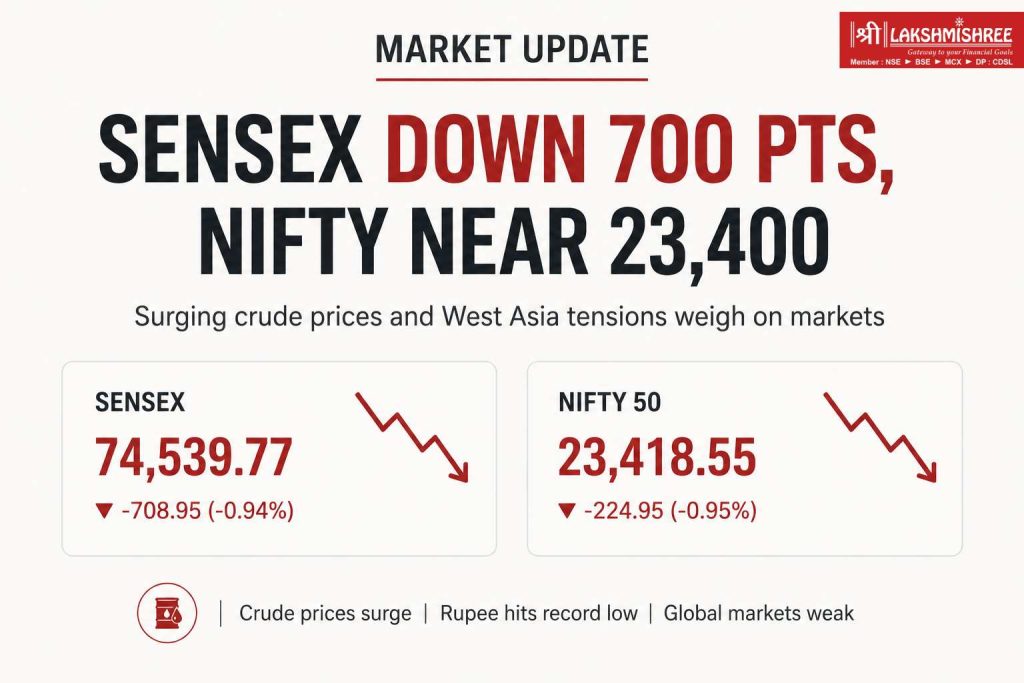
Indian equity markets traded sharply lower on Monday, with the Sensex falling more than 700 points and the Nifty slipping near the 23,400 mark amid surging crude oil prices, rupee weakness, and escalating geopolitical tensions in West Asia.
At around mid-morning trade, the Sensex declined nearly 709 points to 74,540, while the Nifty dropped close to 225 points to trade near 23,419. The selloff reflected broad-based weakness across sectors as investors reacted to rising global uncertainty and mounting macroeconomic pressures.
Why Is the Market Falling Today?
The primary trigger behind the decline was the sharp rise in crude oil prices.
Brent crude climbed above $111 per barrel after fresh tensions emerged in the Middle East, particularly following reports of a drone attack targeting the Barakah nuclear facility in the United Arab Emirates. Investors fear the conflict could further disrupt oil supply routes around the Strait of Hormuz, a critical corridor for global energy shipments.
For India, which imports a majority of its crude oil requirements, rising energy prices create immediate pressure on inflation, corporate profitability, and the broader economy.
Rupee Hits Fresh Record Low
The Indian rupee weakened further against the US dollar, slipping to a fresh record low near 96.25 during the session. Forex traders attributed the decline to rising crude oil prices, a stronger dollar, and persistent geopolitical uncertainty impacting emerging market currencies.
A weaker rupee increases import costs for India and adds pressure on inflation at a time when oil prices are already elevated.
Global Markets Remain Weak
Global cues also remained unsupportive.
Asian markets traded lower, while US markets had ended sharply weaker in the previous session. Futures for major US indices including the Nasdaq and S&P 500 also pointed toward continued weakness, reflecting deteriorating global risk appetite.
Analysts said investor sentiment has turned increasingly cautious as geopolitical tensions continue to intensify without clear signs of de-escalation.
Broader Markets Under Pressure
Selling pressure extended beyond benchmark indices.
Midcap and smallcap stocks witnessed sharper declines, with the Nifty Smallcap100 and Midcap100 indices falling more than 2% and 1.6%, respectively. Most sectoral indices traded in negative territory, with only Nifty IT managing to hold marginal gains.
Among individual stocks, Tata Steel dropped sharply after reporting weaker-than-expected quarterly earnings, while HDFC Bank and Power Grid also remained under pressure. In contrast, Gland Pharma surged after reporting strong profit growth for the March quarter.
India VIX Signals Rising Fear
The India VIX, often referred to as the market’s fear gauge, rose more than 6% to near 20 levels, indicating heightened uncertainty and expectations of increased market volatility in the near term.
Market experts believe equities may remain under pressure as long as crude oil prices stay elevated and geopolitical tensions continue to escalate.
Technical Outlook for Nifty
Technical analysts said the 23,489 zone could act as an important near-term support level for the Nifty. However, failure to reclaim the 23,600 level may expose the market to further downside pressure toward lower support regions.
For now, markets are reacting to a convergence of risks—
Rising oil prices.
Weakening currency.
Geopolitical instability.
And fading global risk appetite.

Kaashika is a social media strategist and financial content creator at Lakshmishree. She specialises in simplifying complex IPO and stock market concepts into clear, easy-to-understand content. Having created over 500+ pieces of financial content across reels, blogs, website posts and digital creatives, Kaashika helps audiences connect with the world of finance in a more accessible and engaging way.