The war in West Asia is rapidly evolving from an energy crisis into a trade crisis and India stands directly in its path.
For weeks, global attention has focused on the surge in oil prices as conflict between the United States, Israel and Iran intensifies across the Gulf. But the deeper economic risk lies not only in the price of crude. It lies in the disruption of the shipping routes that quietly sustain billions of dollars of trade every month.
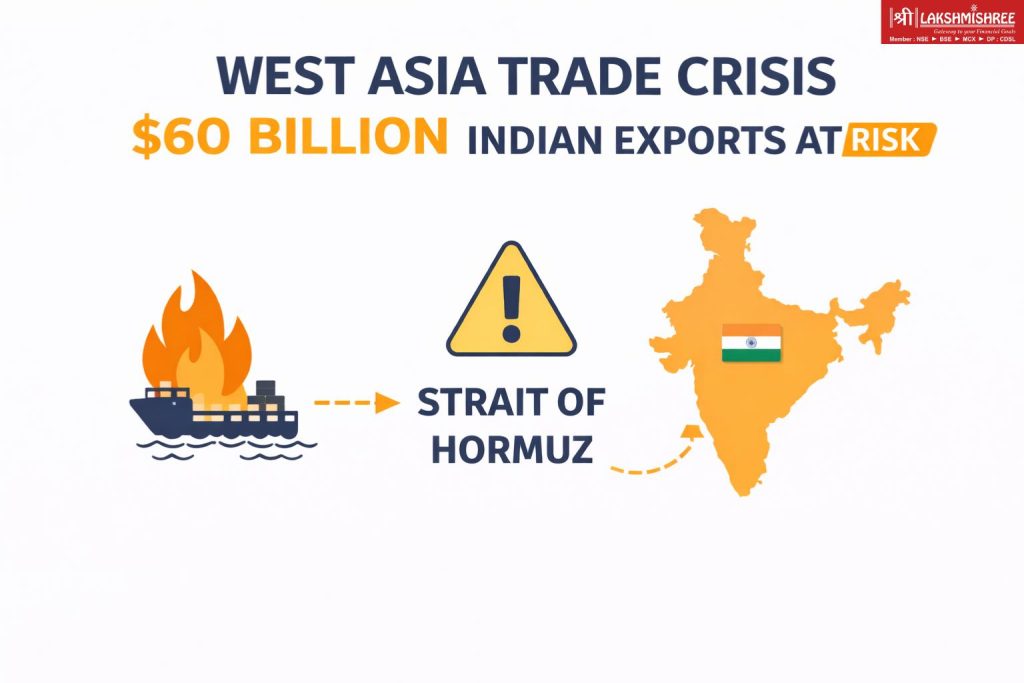
At the centre of this crisis is the Strait of Hormuz, one of the world’s most strategic maritime chokepoints. Nearly one-fifth of global oil supplies pass through this narrow corridor. Less often discussed, however, is the fact that a significant portion of India’s trade with West Asia also depends on this route. That dependence is now being tested.
Industry estimates suggest that as much as $4 billion worth of Indian exports could be disrupted in a single month if the current logistical bottlenecks continue. Shipping delays, emergency freight surcharges, rising insurance costs and shrinking air cargo capacity are already slowing cargo movement across the region.
For India, the stakes are particularly high because West Asia has become one of its most important trade partners. Annual trade between India and the region now stands at roughly $180 billion, including about $60–65 billion in Indian exports. Everything from engineering goods and automobiles to pharmaceuticals, textiles, food products and chemicals flows regularly into Gulf markets. This relationship is not accidental. Gulf economies rely heavily on imported goods to sustain domestic consumption, while a large Indian diaspora across the region has reinforced long-standing demand for Indian products. But geography, which once enabled this trade, is now turning into a vulnerability.
The Strait of Hormuz is not merely an oil route. It is the logistical artery through which a substantial share of India’s exports to the Gulf moves. As the conflict escalates following the killing of Iran’s Supreme Leader Ali Khamenei in U.S.–Israeli strikes and the elevation of his son Mojtaba Khamenei to power, the corridor has become increasingly unstable.
Shipping companies now face missile threats, attacks on commercial vessels and escalating insurance risks. Freight lines have begun imposing emergency surcharges, in some cases reaching $4,000 per container, while air freight rates have surged as airlines cut services into the region.
The immediate consequence is delay. The longer-term consequence could be a structural slowdown in India’s export pipeline.
Some sectors are more exposed than others. Basmati rice exports, for instance, depend overwhelmingly on Gulf markets, which absorb more than 80 percent of shipments. The gems and jewellery sector sends about 30 percent of its exports to the region, much of it through Dubai’s global trading hub. Even the automobile industry, which has expanded its export footprint in recent years, ships roughly a quarter of its overseas vehicles to West Asia. For exporters operating on thin margins, logistics costs and delays quickly translate into financial stress.
Perishable goods face the most immediate danger. Containers carrying fruits, vegetables and meat must remain plugged into power supplies at ports while awaiting ships, pushing up refrigeration costs and eroding profitability.
Meanwhile, exporters must also confront another challenge that rarely makes headlines: liquidity. Longer shipping routes, particularly if vessels are forced to detour around the Cape of Good Hope rather than use the Red Sea and Suez Canal can extend delivery times by 10 to 20 days. That delay slows payments from overseas buyers and stretches the cash conversion cycle for exporters.
In other words, the problem is not only lost shipments. It is also slower money.
Some exporters are already searching for alternatives. Basmati rice shipments may be redirected toward African markets, while engineering goods exporters are exploring demand in Europe and Southeast Asia. Chemical producers may pivot toward Latin America.
Yet replacing the Gulf market will not be easy. Dubai, for example, functions not merely as a consumer destination but as a global trading hub connecting India to multiple regions. Replicating that role elsewhere would take years, not months.
Trade agreements have strengthened India’s position in the region. The India–UAE Comprehensive Economic Partnership Agreement (CEPA) has removed tariffs on nearly all Indian exports to the Emirates, while negotiations with the Gulf Cooperation Council promise further integration.
But trade agreements cannot shield commerce from missiles or maritime risk.
For now, most shipments have been delayed rather than cancelled. Exporters hope that a quick diplomatic resolution could allow cargo flows to resume and backlogs to clear.
Yet the larger lesson is already visible.
The Gulf War has reminded India that energy security and trade security are often two sides of the same coin. When a narrow stretch of water becomes unstable, the effects travel far beyond oil markets, reaching factories, exporters, ports and eventually the broader economy.
The Strait of Hormuz has long been described as one of the world’s most critical oil chokepoints.
This crisis is proving that it may also be one of India’s most important trade lifelines.

Kaashika is a social media strategist and financial content creator at Lakshmishree. She specialises in simplifying complex IPO and stock market concepts into clear, easy-to-understand content. Having created over 500+ pieces of financial content across reels, blogs, website posts and digital creatives, Kaashika helps audiences connect with the world of finance in a more accessible and engaging way.