Overview : A Sudden Escalation With Global Implications
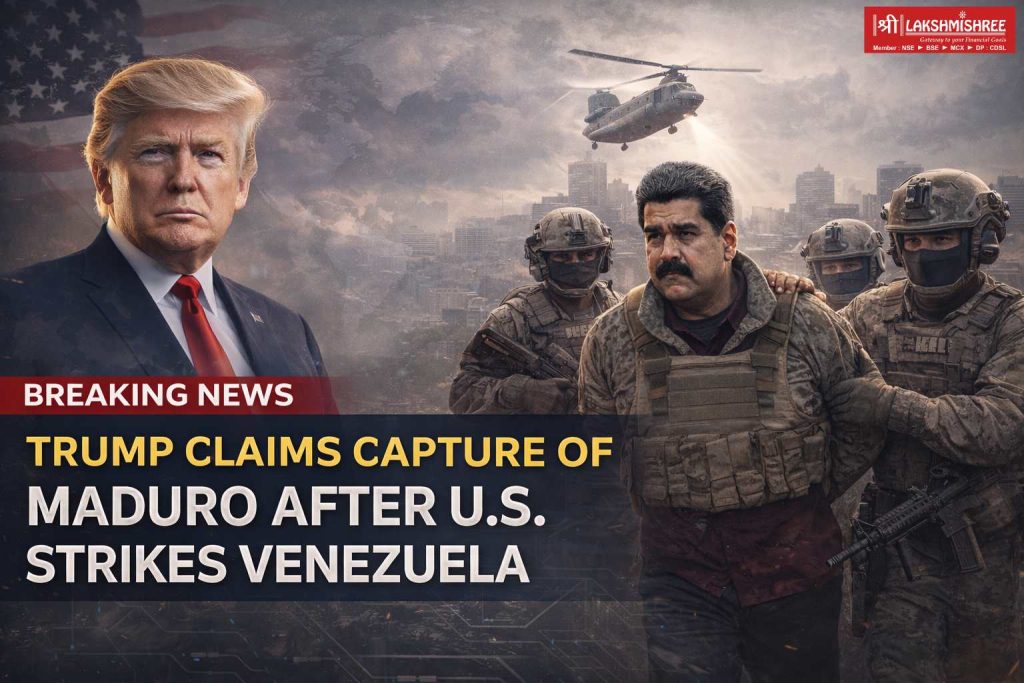
Global markets were jolted on January 3, 2026, after US-Venezuela conflict surfaced abruptly. US President Donald Trump claimed that American forces had carried out a “large-scale strike” in Venezuela and captured President Nicolás Maduro, along with his wife, flying them out of the country.
The announcement, made via Trump’s Truth Social account, marked the sharpest escalation in US-Venezuela tensions in decades, immediately raising questions around oil supply stability, geopolitical risk premiums, emerging-market exposure, and international law.
While the US administration and select American media outlets cited unnamed officials confirming the operation, Venezuela has neither confirmed nor denied Maduro’s capture, instead declaring a national emergency and accusing Washington of military aggression.
What Trump Said about US-Venezuela and What Is Officially Known
In his statement, Trump said:
“The United States of America has successfully carried out a large-scale strike against Venezuela and its leader, President Nicolas Maduro, who has been, along with his wife, captured and flown out of the Country.”
Trump later confirmed he would address the media from Mar-a-Lago, calling the operation a “brilliant mission” in private remarks reported by US media.
However:
- The US Congress was reportedly not notified in advance
- The Pentagon has not released operational details
- The CIA and Department of Defense have not clarified jurisdiction
- No visual or independent proof of Maduro’s custody has been provided
This ambiguity has become a central risk factor for markets and diplomacy alike.
Ground Situation: Explosions, Strikes, and Military Build-Up
Multiple explosions were reported in Caracas around 2:00 am local time, with AFP journalists confirming loud blasts and aircraft-like sounds. Venezuelan officials said strikes hit:
- Fuerte Tiuna (main military complex)
- La Carlota airbase
- La Guaira port
- Radar and coastal facilities
- Higuerote airport (unconfirmed visuals)
The US has built a substantial naval and aerial presence in the Caribbean, including:
- Aircraft carrier USS Gerald R. Ford
- Multiple warships
- Aerial surveillance assets
Washington has also:
- Seized Venezuelan oil tankers
- Enforced an informal airspace shutdown
- Expanded sanctions
- Targeted alleged drug-smuggling vessels
According to US military disclosures, over 100 people have died in maritime strikes since September 2025, figures that are now drawing scrutiny.
Why US-Venezuela? Oil, Drugs, and Strategic Pressure
The Trump administration has long accused Maduro of running a “narco-state”, alleging:
- State protection of drug trafficking
- Election rigging
- Human rights abuses
Venezuela, in turn, argues the US seeks control over its oil reserves—the largest proven reserves globally.
Just 48 hours before the strikes, Maduro had reportedly offered cooperation on drug trafficking and illegal migration, adding to the shock of the sudden military action.
From a strategic lens, analysts see three overlapping objectives:
- Disrupt narcotics supply chains
- Reassert US influence in Latin America
- Reshape global energy geopolitics
International Reaction: Condemnation, Concern, and Calls for Restraint
The global response was swift:
- European Union urged restraint and respect for international law
- Russia condemned the strikes as “armed aggression” and backed a UN Security Council meeting
- China monitored developments closely after a Chinese delegation met Maduro hours before the strikes
- Cuba called the attack “criminal”
- Colombia rejected unilateral military action and deployed troops to its border
- Spain offered to mediate between Washington and Caracas
Venezuela has formally requested an urgent UN Security Council session, raising the possibility of a diplomatic showdown.
Market Impact: What Investors Are Watching Closely
While equity markets have not yet priced in full-scale escalation, several market-critical risks are now in focus:
1. Oil Prices and Energy Markets
Venezuela’s output is limited by sanctions, but:
- Further disruption could tighten heavy crude supply
- Brent crude risk premium may rise
- Energy-importing economies could face inflationary spillovers
2. Emerging Market Risk
- Latin American assets may see capital outflows
- Sovereign spreads could widen
- Currency volatility risk increases
3. US Political Risk
- Legal scrutiny over executive authority
- Congressional pushback
- Election-year geopolitical positioning
4. Defense and Security Stocks
- Increased attention on global defense budgets
- Heightened interest in cybersecurity and surveillance sectors
Legal and Governance Questions Loom Large
A central unresolved issue is legality.
Key concerns include:
- Lack of congressional authorization
- Absence of international mandate
- Civilian casualty allegations
- Extraterritorial capture of a sitting head of state
If Maduro is indeed in US custody, questions around jurisdiction, trial venue, and international precedent could dominate global discourse in the coming weeks.
What Happens Next: Scenarios to Watch
Analysts outline three plausible near-term paths:
Scenario 1: Confirmation and De-escalation
Maduro’s capture is confirmed, US pauses further action, diplomatic channels open.
Scenario 2: Escalation and Proxy Conflict
Venezuela resists, allies respond diplomatically or economically, oil volatility rises.
Scenario 3: Information Breakdown
Conflicting claims persist, markets price uncertainty rather than facts.
At present, information risk is as significant as military risk.
Bottom Line: A Geopolitical Shock With Market Consequences
Trump’s claim of capturing Venezuela’s president if verified, would mark one of the most dramatic foreign-policy actions by the US in modern times. Even if contested, the episode underscores a broader reality: geopolitics is back as a dominant market variable.

Kaashika is a social media strategist and financial content creator at Lakshmishree. She specialises in simplifying complex IPO and stock market concepts into clear, easy-to-understand content. Having created over 500+ pieces of financial content across reels, blogs, website posts and digital creatives, Kaashika helps audiences connect with the world of finance in a more accessible and engaging way.