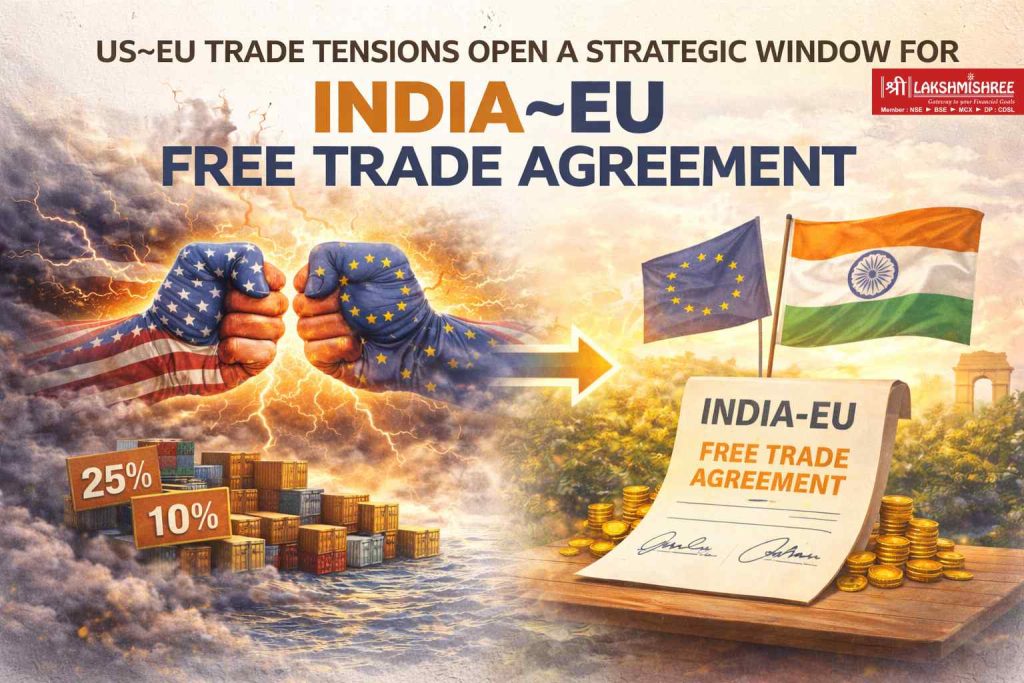
The escalation of US–EU Trade Tensions between the United States and the European Union in late 2025 has begun to reshape global trade alignments, creating a rare strategic opening for India–EU economic cooperation. What initially appeared as a limited tariff dispute has evolved into a broader confrontation with implications that extend well beyond transatlantic trade, accelerating Europe’s search for alternative, reliable economic partners. At the center of this realignment lies the long-pending India–EU Free Trade Agreement (FTA), which is now approaching a decisive moment.
The immediate trigger for renewed friction was Washington’s proposal to impose fresh tariffs — including a 10 per cent duty on timber and lumber imports and levies of up to 25 per cent on select European products. While these measures were framed as trade corrections, they were widely interpreted in Brussels as politically motivated, reflecting a broader trend in US policy of using tariffs as instruments of diplomatic pressure. The European Union responded by signalling readiness to deploy its Anti-Coercion Instrument, a powerful legal mechanism that allows retaliatory tariffs, regulatory countermeasures, and restrictions on market access.
Although the US–EU Trade Tensions directly involved the US and the EU, its consequences rippled across the global economy. Heightened uncertainty disrupted supply chains, weakened investor confidence, and forced third-country economies to reassess their trade exposure. For India, already navigating volatility in global markets, the situation presented a dual challenge and opportunity. Indian exporters were simultaneously facing declining access to the US market, while European firms were looking for alternatives to an increasingly unpredictable transatlantic corridor.
By late 2025, the strain on Indian exports to the US had become visible. Shipments of gems and jewellery to America fell sharply, with industry estimates suggesting a contraction of nearly 44 per cent year-on-year. Exporters began redirecting trade toward destinations such as the UAE and Australia, but the scale of the US market remained difficult to replace. At the same time, European exporters confronted higher tariff barriers and regulatory uncertainty in the US, pushing Brussels to diversify its trade relationships more aggressively.
This convergence of pressures brought India into sharper focus for European policymakers. India offered a unique combination of scale, demographic momentum, manufacturing capability, and political stability attributes increasingly valued in an era of supply-chain fragmentation and geopolitical risk. Against this backdrop, negotiations on the India–EU Free Trade Agreement, formally known as the Broad-based Trade and Investment Agreement, gained renewed urgency.
Talks on the agreement, which began in 2007 and remained stalled for years due to disagreements over tariffs, regulatory standards, and intellectual property, were formally revived in 2022. However, it was the deterioration in the US–EU trade relationship that injected new momentum into the process. By early 2026, officials on both sides indicated that the agreement could be finalised around the India–EU Summit scheduled for January 27, 2026. Senior Indian ministers described the pact as potentially the “mother of all trade deals”, reflecting both its scope and strategic importance.
The economic scale of the agreement is substantial. Bilateral trade in goods between India and the EU crossed USD 136 billion in 2024–25, making the EU one of India’s largest trading partners. The proposed FTA aims to significantly reduce or eliminate tariffs across a wide range of goods, while also deepening cooperation in services, investment, digital trade, and professional mobility. Importantly, Europe’s heightened urgency has strengthened India’s negotiating leverage, increasing the likelihood of faster timelines and more favourable market-access commitments.
Sectorally, the gains for India could be transformative. The textiles and apparel industry, a major employer, stands to benefit significantly from tariff elimination, potentially doubling export volumes over the medium term. Pharmaceuticals and specialty chemicals could gain enhanced access to Europe’s high-value healthcare market, reinforcing India’s role as a global supplier of affordable medicines. Engineering goods and machinery exports may integrate more deeply into European manufacturing ecosystems, supporting India’s ambition to move up global value chains. In services, improved regulatory cooperation could further entrench India’s strength in information technology and business services.
However, tariff liberalisation alone will not determine outcomes. Non-tariff barriers remain a critical challenge. The EU’s stringent sanitary and phytosanitary standards, product certification requirements, environmental regulations, and climate-linked mechanisms such as the Carbon Border Adjustment Mechanism could limit the practical benefits of market access. Compliance costs may be particularly burdensome for small and medium Indian firms. Similarly, restrictions on professional mobility and limited mutual recognition of qualifications could constrain the services dividend.
Beyond economics, the broader geopolitical implications are significant. The US–EU trade rift and the parallel India–EU rapprochement reflect a gradual reconfiguration of the global trade order. Europe is seeking to reduce strategic dependence on the United States, while India is positioning itself as a stable, rules-based economic partner amid rising protectionism. For New Delhi, the FTA represents not just an export opportunity, but a means of embedding India more deeply into high-value global supply chains and strengthening the economic foundations of its foreign policy.
In an era where trade is increasingly shaped by geopolitics rather than pure economics, the India–EU Free Trade Agreement is emerging as more than a commercial pact. It is becoming a strategic instrument one that could redefine India’s trade orientation and secure its place in a rapidly evolving global economic order.

Kaashika is a social media strategist and financial content creator at Lakshmishree. She specialises in simplifying complex IPO and stock market concepts into clear, easy-to-understand content. Having created over 500+ pieces of financial content across reels, blogs, website posts and digital creatives, Kaashika helps audiences connect with the world of finance in a more accessible and engaging way.