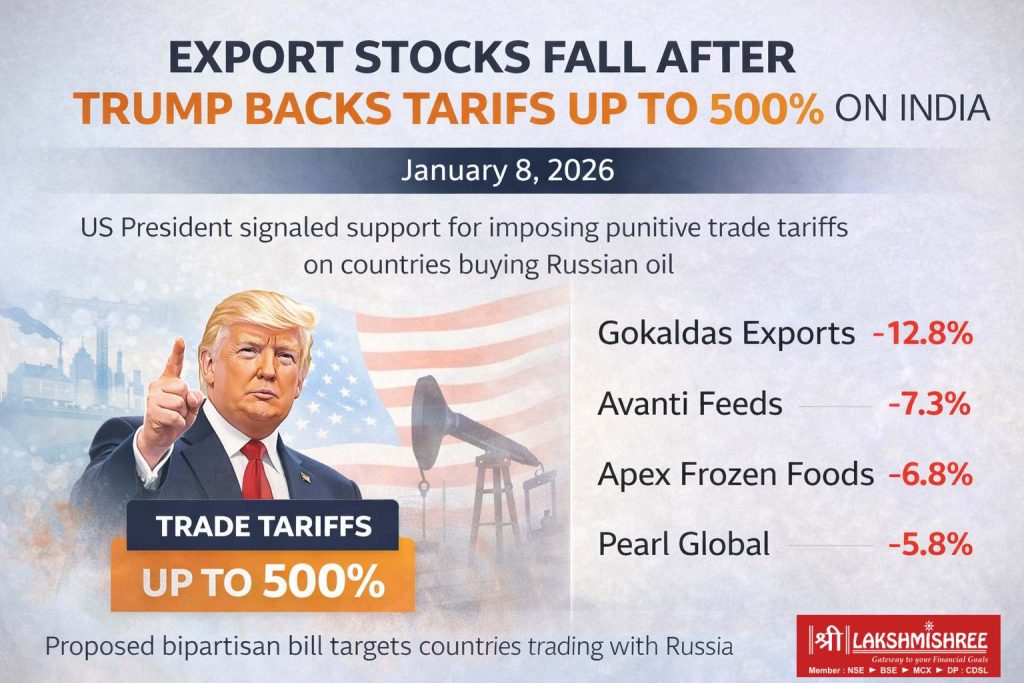
Shares of several Indian export-oriented companies fell sharply on January 8, 2026, after US President Donald Trump indicated support for advancing a bipartisan sanctions bill that proposes steep 500% Tarrif on countries continuing trade with Russia, including purchases of Russian oil.
The development triggered a broad sell-off in textile and seafood exporters, sectors with high exposure to the US market, as investors reassessed trade risks amid escalating geopolitical pressure.
What Triggered the Market Reaction
The immediate catalyst was Trump’s approval to move forward with the proposed Sanctioning of Russia Act, 2025, a bill that would grant the US President expanded authority to impose punitive trade measures on countries deemed to be indirectly financing Russia’s war efforts through commerce, particularly energy imports.
Republican Senator Lindsey Graham, one of the bill’s sponsors, said the legislation could be brought up for a bipartisan vote as early as next week. He added that the bill would allow Washington to exert pressure on countries buying discounted Russian oil, explicitly naming India, China, and Brazil.
While the legislation has not yet been passed or enacted, Trump’s endorsement was viewed by markets as a meaningful escalation from legislative discussion to political intent.
Stock-Specific Impact
Stocks of companies that derive a significant share of revenues from the US market came under pressure:
- Gokaldas Exports fell nearly 13%
- Avanti Feeds declined around 7%
- Apex Frozen Foods dropped over 6%
- Pearl Global Industries slid about 6%
- KPR Mill fell more than 2%
Market participants noted that these sectors are particularly vulnerable to tariff-related disruptions due to thin margins, limited pricing power, and heavy reliance on US buyers.
Background: Existing Trade Frictions
The sell-off also reflects cumulative trade concerns. Since returning to office, Trump has already raised tariffs on certain Indian imports to an effective 50%, citing India’s continued purchase of Russian crude oil.
The proposed bill would mark a significant escalation, introducing the possibility of secondary sanctions—a mechanism under which countries trading with a sanctioned nation face penalties themselves.
According to the US Congress website, the bill would impose duties of at least 500% on Russian goods and allow similar punitive measures against countries and entities that facilitate Russian trade.
India’s Position
India has consistently rejected claims that it agreed to halt Russian oil purchases. Government officials have maintained that India’s energy sourcing decisions are driven by energy security and national interest, especially amid volatile global crude markets.
New Delhi has also stated that no formal commitment has been made to alter its trade or energy policy under external pressure.
What is for real? 500%?
Confirmed:
- Trump has approved advancing the bill
- The legislation increases presidential authority over trade penalties
- Markets have responded by pricing in higher risk for export-dependent sectors
Unclear:
- Whether the bill will pass Congress
- Whether India will be directly targeted
- Whether tariffs, if imposed, would reach the proposed maximum level
- Whether exemptions or negotiated outcomes could mitigate the impact
Trade experts note that US tariff proposals under Trump have historically been used as leverage during negotiations, with final outcomes often differing from initial threats.
Investor and Market Outlook
Analysts expect continued volatility in export-oriented stocks until greater clarity emerges on the bill’s legislative progress and the direction of India–US trade discussions.
Sectors with high geographic concentration of revenues, particularly apparel and seafood exports, are likely to remain sensitive to developments in US trade policy, while domestically oriented sectors may remain relatively insulated.
Conclusion
The decline in export-focused Indian stocks underscores how policy signals—rather than enacted measures—can swiftly influence markets. While the proposed 500% tariff remains at the legislative stage, President Trump’s endorsement has elevated the issue from hypothetical risk to a credible policy consideration.
For now, investors and companies alike are closely watching Washington’s next steps, as well as any diplomatic engagement that could shape the final outcome.

Kaashika is a social media strategist and financial content creator at Lakshmishree. She specialises in simplifying complex IPO and stock market concepts into clear, easy-to-understand content. Having created over 500+ pieces of financial content across reels, blogs, website posts and digital creatives, Kaashika helps audiences connect with the world of finance in a more accessible and engaging way.