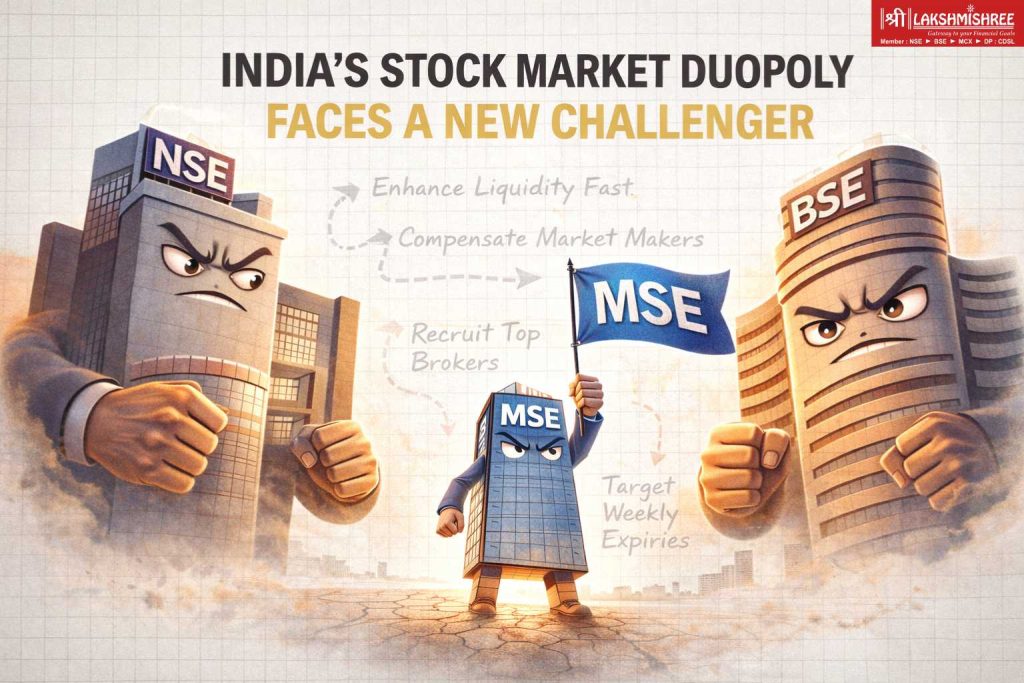
India’s stock market infrastructure has long been defined by a near-total duopoly. The National Stock Exchange (NSE) and the Bombay Stock Exchange (BSE) together dominate almost the entirety of equity and derivatives trading, shaping price discovery, liquidity, and capital formation across the country. That dominance has endured for decades not because alternatives were absent, but because the structure of exchange economics makes competition exceptionally difficult.
Stock exchanges generate the bulk of their revenue by charging transaction fees on trades executed on their platforms. These fees are typically levied per crore of turnover. While the per-transaction charge appears marginal, the cumulative impact is substantial. At BSE, transaction charges contribute an estimated 70–75% of total revenue, underscoring that volume is the single most important determinant of an exchange’s viability.
This creates a structural barrier for new entrants. Liquidity begets liquidity. Investors and traders gravitate toward platforms where counterparties are guaranteed, bid–ask spreads are tight, and exits are frictionless. In contrast, low-volume exchanges expose participants to execution risk, price inefficiency, and the possibility of being unable to exit positions. As a result, trading activity naturally concentrates on dominant exchanges, reinforcing their lead and marginalising competitors.
These dynamics explain why India has functioned with only two national stock exchanges for over two decades.
That equilibrium, however, is now being tested.
Why launching MSE is structurally difficult
Regulatory barriers compound the liquidity challenge. To obtain a licence, the Securities and Exchange Board of India (SEBI) mandates a minimum net worth of ₹100 crore for an exchange. Additionally, the exchange must establish a separate clearing corporation—responsible for trade settlement—with another ₹100 crore in net worth. This implies an upfront capital commitment exceeding ₹200 crore before a single trade is executed.
Post-launch requirements are equally stringent. Exchanges must achieve a minimum annual trading volume of ₹1,000 crore. Failure to meet this threshold for two consecutive years can result in regulatory shutdown. The rationale is rooted in market integrity: thinly traded exchanges are more susceptible to manipulation, provide unreliable price signals, and fail to serve their core function of efficient capital allocation.
Beyond capital and volume thresholds, exchanges must also meet extensive governance norms, including surveillance systems, investor grievance mechanisms, and statutory committees. They must onboard at least 25 active trading members. Yet brokers are reluctant to join platforms without volume, creating a circular dependency where liquidity requires participation, and participation requires liquidity.
This framework explains why even well-capitalised players struggle to break into the exchange business.
MSE’s strategic pivot: subsidising liquidity
Against this backdrop, the Metropolitan Stock Exchange (MSE) is attempting a renewed expansion, backed by capital, regulatory opportunity, and a deliberate liquidity strategy.
MSE is not a new entity. Established in 2008 as MCX-SX, it initially focused on currency derivatives. Its growth was curtailed after NSE introduced competing products at zero transaction fees, a move MSE challenged as predatory pricing. The Competition Commission of India (CCI) later ruled in MSE’s favour, holding NSE guilty of abusing its dominant position and awarding ₹856 crore in compensation.
While the ruling significantly strengthened MSE’s legal position, the case remained tied up in appeals for years. The situation has now gained renewed relevance as NSE prepares for its long-anticipated IPO. Pending litigation of this magnitude represents a material contingent liability that could weigh on NSE’s valuation, creating strong incentives for settlement. If resolved, MSE would gain a sizeable financial buffer, materially improving its ability to sustain losses while scaling operations.
MSE’s immediate growth strategy centres on a Liquidity Enhancement Scheme (LES). Under this framework, the exchange has identified approximately 130 actively traded stocks and appointed designated market makers tasked with continuously providing buy and sell quotes. Transaction fees on these trades are waived, and market makers are compensated directly by the exchange.
The objective is not organic liquidity discovery, but artificial liquidity seeding—ensuring that early participants can execute trades without friction. The scheme is designed to operate for six months, allowing MSE time to build brand recall, broker participation, and habitual trading behaviour.
Regulatory shifts and timing advantages
MSE’s renewed push coincides with regulatory changes that have altered competitive dynamics in derivatives markets. In 2024, SEBI restricted exchanges to offering weekly derivatives expiry on only one index per week. This forced NSE to discontinue Bank Nifty weekly options, which had previously accounted for nearly half of its weekly options premium turnover.
This opened a tactical window. MSE can now introduce derivatives products on non-overlapping expiry days, offering traders additional hedging and speculative opportunities during the week. While the volume opportunity is modest relative to NSE’s scale, it represents a foothold in a segment that drives disproportionately high engagement.
Capital backing and distribution leverage
MSE’s latest phase is also underpinned by capital infusion. Since 2024, the exchange has raised approximately ₹1,240 crore from major brokerage-linked investors, including Rainmatter Investments (Zerodha), Billionbrains Garage Ventures (Groww’s promoter entity), and Peak XV Venture Partners.
Collectively, these platforms control a significant share of India’s retail demat accounts. Their involvement provides not only capital, but distribution leverage—access to millions of traders through broker interfaces. This materially improves MSE’s ability to attract initial volumes compared to its earlier attempts.
Risks that could derail the strategy
Despite these tailwinds, structural risks remain substantial. The Liquidity Enhancement Scheme is time-bound and scheduled to conclude by June 2026. Once incentives are withdrawn, sustained participation will depend on genuine trader preference rather than subsidies.
NSE’s dominance remains overwhelming, with over 90% market share across equities and derivatives. Trading systems, algorithms, institutional workflows, and broker infrastructure are deeply integrated around NSE. Overcoming this entrenchment requires not incremental improvements, but differentiated value propositions that compel market participants to actively use a second exchange.
Moreover, incumbent exchanges are unlikely to remain passive. Product replication, pricing responses, and enhanced incentive schemes can be deployed rapidly, limiting MSE’s ability to carve out durable niches.
A defining test for India’s market structure
MSE’s renewed expansion effort represents the most credible challenge to India’s exchange duopoly in over two decades. Its success or failure will have implications beyond a single institution shaping competition, transaction costs, and innovation in India’s capital markets.
Whether MSE evolves into a viable third national exchange or remains a niche, subsidised platform will depend on its ability to convert temporary incentives into permanent behavioural change. The coming years will determine whether India’s stock market structure remains concentrated, or finally opens to sustained competition.
For now, the duopoly faces its most serious test in a generation.

Kaashika is a social media strategist and financial content creator at Lakshmishree. She specialises in simplifying complex IPO and stock market concepts into clear, easy-to-understand content. Having created over 500+ pieces of financial content across reels, blogs, website posts and digital creatives, Kaashika helps audiences connect with the world of finance in a more accessible and engaging way.