The global energy map was redrawn this week as the Strait of Hormuz: the world’s most vital energy jugular: effectively went dark. We are no longer observing a temporary “blip” in the charts; we are witnessing a fundamental, structural shift in market mechanics triggered by military hostilities involving the U.S., Israel, and Iran.
To navigate the current volatility, where the Sensex has plummeted 1,097 points and the Nifty has slipped below 24,500, one must understand the interconnected layers of this crisis.
1. The Supply Chain Fracture: From LNG to Fertilizer
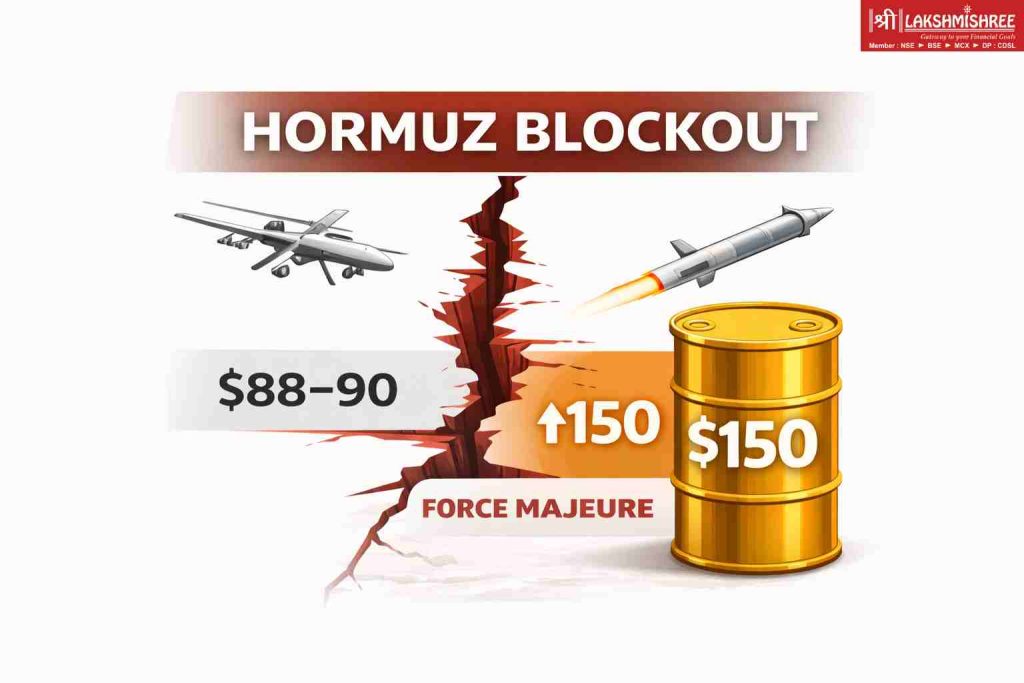
The tipping point was reached when Qatar declared force majeure at its Ras Laffan facility—a site controlling 20% of the global LNG supply—following a drone strike.
- The Qatar Factor: Normalizing exports will take weeks to months, even if hostilities cease today.
- Domestic Impact: For the Indian investor, this translates directly into spiked electricity costs and potential food inflation, as our fertilizer plants lose their primary gas feedstock.
- The Oil Trap: Approximately 21 million barrels of oil per day (over 20% of global consumption) is currently trapped behind the Strait.
- Price Projections: While Brent currently hovers near $88–$90, a three-week continued blockage is projected by Goldman Sachs to catapult prices to $150 per barrel.
- Macro Math: For India, the equation is stark: every $10 rise in oil prices typically widens our Current Account Deficit (CAD) by approximately 0.5% of GDP.
2. The Russian Rescue: A Strategic Geopolitical Pivot
In a rare move of pragmatic diplomacy, the U.S. Treasury (OFAC) issued a 30-day emergency waiver on March 5, 2026. This allows Indian refiners like Reliance and IOCL to tap into “marooned” Russian crude that was previously sidelined by sanctions.
- Floating Inventory: Approximately 15 million barrels of Russian Urals are currently idling on tankers in the Arabian Sea and Bay of Bengal.
- The Security Buffer: While this does not replace the 2.6 million barrels per day India typically sources from the Gulf, it provides a vital 25-day buffer for our domestic fuel security.
3. Sectoral Divergence: Identifying the Safe Havens
Beneath the broad market sell-off, a professional analysis reveals a clear divergence in sectoral fortunes:
| The Vulnerable (Bearish) | The Resilient (Bullish) |
| Aviation: Fuel is 40% of costs; Middle East airspace closures force longer, costlier flight paths. | Defense: HAL and BEL have gained up to 13% this week as “Atmanirbharta” becomes a national security mandate. |
| Paints & Chemicals: Dependence on oil derivatives as raw materials will lead to a massive margin squeeze. | Upstream Oil: ONGC and Oil India benefit directly as higher global extraction prices lift their realizations. |
| Autos: Rising fuel prices and the threat of inflation-driven interest rate hikes will likely dampen consumer demand. | Gold: The ultimate hedge; global prices have crossed $5,300/ounce as trust in paper currency wanes. |
Strategic Verdict: Ignore the Noise, Watch the VIX
In times of “Hormuz Blackouts,” the most dangerous move is a panic exit. Historically, the Law of Geopolitical Rebound suggests that markets overreact to the onset of conflict but stabilize once the “new normal” is priced in.
- Rebalance, Don’t Exit: Consider moving 10-15% of your portfolio into Gold ETFs or Sovereign Gold Bonds to act as a stabilizer.
- The Fear Gauge: The India VIX is up 20%. Peak fear often marks a poor time to sell but a prime opportunity to scout for “distress-priced” blue-chip gems.
- The Rupee Factor: If the USD-INR pair crosses 85, IT stocks (TCS/Infosys) may provide a vital currency hedge for your holdings.
The global community cannot afford a sustained $150 oil environment. Diplomacy typically follows extreme economic pain. Stay patient, stay hedged, and keep your eyes on the data—not the headlines.

Kaashika is a social media strategist and financial content creator at Lakshmishree. She specialises in simplifying complex IPO and stock market concepts into clear, easy-to-understand content. Having created over 500+ pieces of financial content across reels, blogs, website posts and digital creatives, Kaashika helps audiences connect with the world of finance in a more accessible and engaging way.