
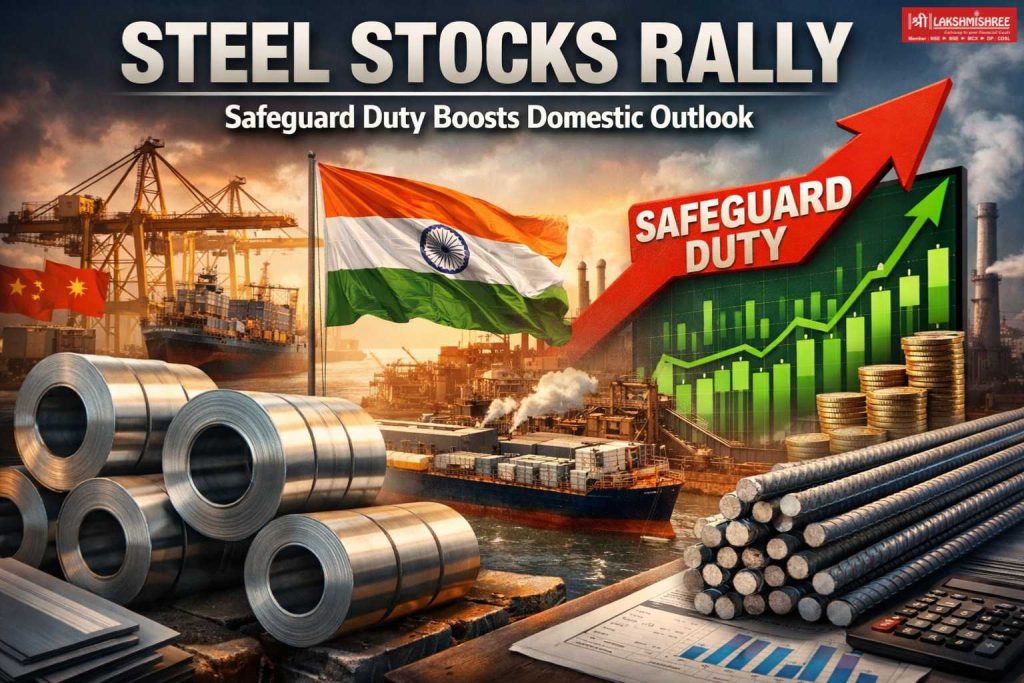
Indian steel stocks rallied sharply after the government announced a three-year safeguard duty of up to 12% on select steel imports, a decisive policy move aimed at protecting the domestic industry from a surge in low-priced overseas supplies. The announcement triggered renewed buying interest across this sector, reinforcing investor confidence that pricing discipline and margin stability may improve over the medium term.
Shares of leading producers such as Tata Steel, JSW Steel, Jindal Steel, and Jindal Stainless rose between 2% and 4% in a single session. The rally was broad-based, reflecting optimism across the ferrous metals sector rather than stock-specific speculation.
Importantly, market participants are viewing this development not as a short-term trading trigger, but as a structural positive for the Indian industry.
What Triggered the Rally ?
The rally followed the government’s decision to impose a graduated safeguard duty on non-alloy and alloy flat products, structured as follows:
- 12% in the first year
- 11.5% in the second year
- 11% in the third year
The safeguard duty primarily targets imports from China, Vietnam, and Nepal, countries that have significantly increased shipments into India in recent quarters. These imports were often priced aggressively, exerting pressure on domestic prices and distorting market equilibrium.
Notably, specialty products such as stainless are excluded from the safeguard duty, ensuring that downstream users and niche segments remain unaffected. This calibrated approach signals that the policy is designed to curb unfair trade practices rather than impose blanket protectionism.
Why the Safeguard Duty Matters
It is a highly cyclical and capital-intensive sector, where even modest changes in pricing can significantly affect profitability. In recent months, rising imports of cheaper flat steel had begun to cap domestic price realizations, despite steady demand from infrastructure, construction, and manufacturing.
The safeguard duty directly addresses this imbalance by:
- Reducing the influx of low-priced imports
- Stabilising domestic prices, especially in flat segments
- Improving capacity utilisation for Indian manufacturers
- Enhancing earnings visibility over a multi-year horizon
For integrated producers with large exposure to flat products, this policy creates a more predictable operating environment, an element equity markets typically reward with higher valuation multiples.
Structural Confidence Reflected in Steel Stock Performance
The latest rally adds to an already strong performance by stocks in 2025:
- Tata Steel and NMDC are up over 25% year-to-date
- JSW Steel has gained more than 22%
- Jindal Stainless has advanced nearly 19%
These returns comfortably outperform the Nifty 50, indicating that the market has been progressively re-rating the sector even before the safeguard duty announcement.
The policy decision acts as a confirmation catalyst, reinforcing the thesis that the worst of margin pressure from imports may now be behind the industry.
Implications for Steel Prices, Margins, and Earnings
From a fundamentals perspective, the safeguard duty strengthens domestic steel pricing power without artificially inflating prices. By discouraging dumping and predatory pricing, the measure helps align domestic prices more closely with production costs and demand dynamics.
Key implications include:
- Improved EBITDA margins for large steelmakers
- Lower volatility in realizations over the next three years
- Greater confidence in capex planning and balance-sheet management
- Reduced earnings downside risk during global downturns
However, it is important to note that the safeguard duty does not insulate the sector entirely from global steel cycles. International prices, iron ore costs, coking coal prices, and global demand conditions will continue to influence profitability.
What This Means for the Broader Economy
It is a backbone industry, closely linked to infrastructure development, housing, capital goods, and manufacturing. Policy support for the steel sector aligns with India’s broader economic priorities, including:
- Large-scale infrastructure expansion
- Strengthening domestic manufacturing under “Make in India”
- Enhancing supply chain resilience
- Reducing dependence on volatile imports
By ensuring fair competition for domestic producers, the safeguard duty supports industrial stability without undermining India’s commitment to global trade norms.
Bottom Line: The Sector Enters 2026 on Stronger Footing
The safeguard duty marks a structural policy intervention designed to protect the Indian industry from unfair import pressure while maintaining trade balance. The rally in this sector stocks reflects expectations of improved margin stability, healthier competitive dynamics, and stronger earnings visibility not speculative exuberance.
As the policy takes effect, the Indian steel sector enters 2026 with clearer visibility, improved sentiment, and stronger alignment with national industrial priorities, positioning the stocks as a key beneficiary of India’s long-term growth story.

Kaashika is a social media strategist and financial content creator at Lakshmishree. She specialises in simplifying complex IPO and stock market concepts into clear, easy-to-understand content. Having created over 500+ pieces of financial content across reels, blogs, website posts and digital creatives, Kaashika helps audiences connect with the world of finance in a more accessible and engaging way.