Mumbai | March 14
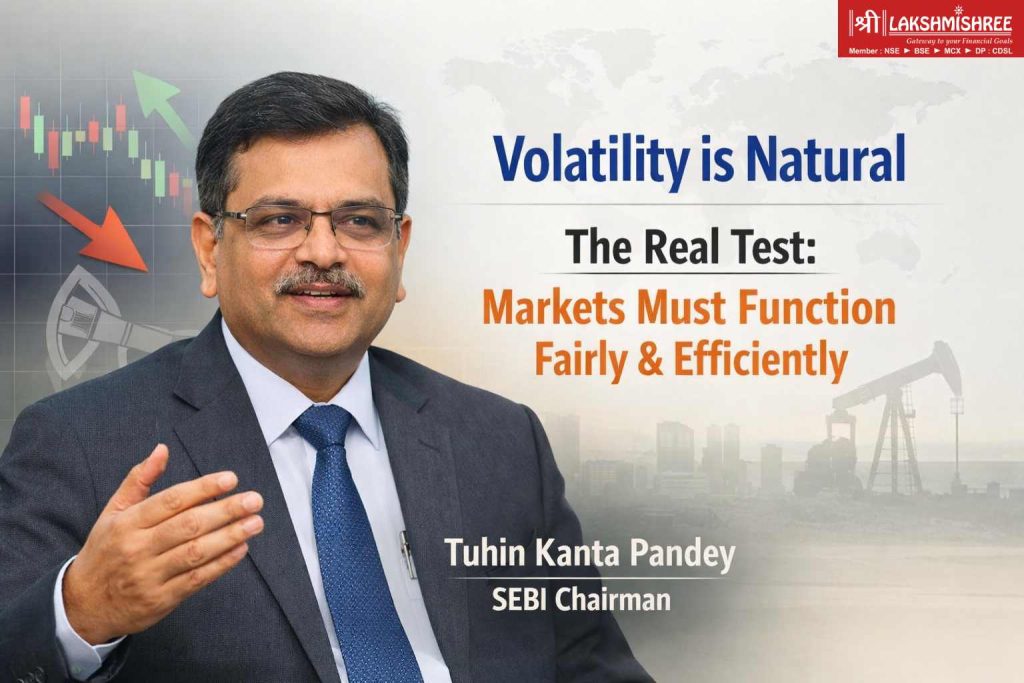
Amid rising geopolitical tensions, volatile oil prices and sharp swings in global markets, SEBI Chairman Tuhin Kanta Pandey has delivered a clear message to investors: volatility is a natural feature of financial markets, and India’s capital markets have become strong enough to withstand such shocks.
Speaking at the Global Wealth Summit 2026, Pandey said that the real test for markets is not whether volatility occurs, but whether the financial system continues to function fairly and efficiently during periods of stress.
Volatility is a natural feature of markets. The real test is that markets function fairly and efficiently even in periods of stress. Indian markets will thrive, Pandey said.
His remarks come at a time when global markets are facing uncertainty triggered by the West Asia conflict, disruptions in oil supplies and rising geopolitical tensions.
Why Markets Are More Volatile Today
According to Pandey, the environment in which markets operate has changed dramatically over the past decade.
One major factor is the speed of information.
“News travels quickly, opinions travel even faster, and markets today react almost instantly to narratives,” Pandey said.
In today’s world of algorithmic trading, artificial intelligence and high-speed data analytics, market reactions are often immediate.
For example, when crude oil prices crossed $100 per barrel this week after tensions in the Strait of Hormuz, global markets reacted within minutes. Stock indices across Asia fell sharply even before physical oil supplies were affected.
This shows how information and sentiment can move markets faster than real economic changes, creating short-term volatility.
Indian Markets Have Become Stronger
Despite these challenges, Pandey said India’s financial markets have grown significantly over the past decade.
Since FY2015, India’s capital markets have expanded at around 15 percent compound annual growth rate (CAGR).
The mutual fund industry has grown even faster, with assets under management rising over 20 percent annually, reflecting deeper participation by retail investors.
At the same time, India’s corporate bond market has expanded by around 12 percent CAGR, helping companies raise long-term capital.
Pandey said this expansion has made markets deeper, more diversified and more resilient.
“Efficient capital markets play a stabilising role in uncertain times. They enable transparent price discovery and help absorb shocks without destabilising the broader financial system,” he said.
Real-World Examples of Market Resilience
Pandey pointed to past global crises to show how markets eventually stabilise.
During the Covid-19 pandemic in 2020, the Nifty index fell nearly 40 percent in a matter of weeks. However, markets recovered rapidly as economic activity resumed.
Similarly, during the Russia-Ukraine conflict in 2022, energy prices surged and global markets saw turbulence. Yet markets eventually adjusted and stabilised.
These examples show that while volatility may be intense, it is often temporary rather than structural.
Global Linkages Are Increasing
Pandey also emphasised that as India’s markets grow, they are becoming more connected with global economic developments.
“Trade corridors are changing, supply chains are being restructured and investment flows are responding to these shifts,” he said.
For instance, geopolitical disruptions in the Middle East can influence oil prices, currency movements and capital flows, which in turn affect Indian markets.
This global linkage means volatility abroad can quickly transmit to domestic markets.
The Next Phase of Market Development
Looking ahead, Pandey said India’s financial system will need deeper bond markets, stronger institutional participation and continued technological innovation to support economic growth.
He also stressed the importance of corporate governance, transparency and investor protection.
Initiatives such as SEBI Check and action against misleading financial claims on social media are aimed at strengthening investor confidence.
Message for Investors
Pandey’s core message for retail investors was simple: remain patient during periods of uncertainty.
History shows that extreme volatility does not last forever. Markets eventually stabilise as fundamentals reassert themselves.
As India’s economy continues to expand, its capital markets will play an increasingly important role in financing growth and supporting investment.
For investors, the lesson is clear: short-term turbulence may shake markets, but a stronger financial system is being built underneath.

Kaashika is a social media strategist and financial content creator at Lakshmishree. She specialises in simplifying complex IPO and stock market concepts into clear, easy-to-understand content. Having created over 500+ pieces of financial content across reels, blogs, website posts and digital creatives, Kaashika helps audiences connect with the world of finance in a more accessible and engaging way.