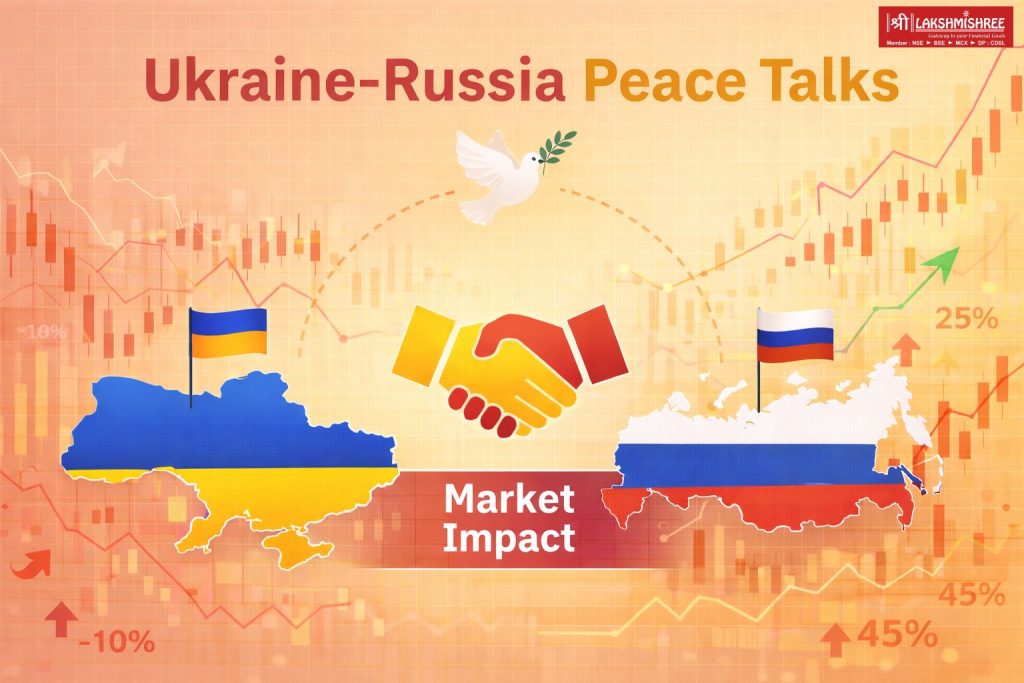
US President Donald Trump said on Sunday that negotiations between Russia and Ukraine have reached their most advanced stage so far, following discussions with Ukrainian President Volodymyr Zelenskyy at his Florida residence. While expressing optimism about the progress, Trump cautioned that the talks remain fragile, noting that unresolved issues could still derail the process and prolong the conflict.
Renewed diplomatic engagement between Russia and Ukraine, highlighted by recent talks involving US President Donald Trump and Ukrainian President Volodymyr Zelenskyy, is being closely watched by global financial markets. Even without a finalized peace agreement, the perception that negotiations are progressing has meaningful implications across commodities, currencies, interest rates, equities, and geopolitics-linked risk premiums.
Markets react to changes in probability. A higher perceived chance of de-escalation alters expectations around inflation, supply chains, capital flows, and government spending, all of which directly influence asset prices.
1. Energy Markets: The Most Immediate Transmission Channel
The Russia–Ukraine war has been one of the biggest structural drivers of global energy volatility since 2022. Russia remains a major exporter of crude oil, refined products, natural gas, and fertilizers. Any credible movement toward peace raises expectations that:
- Sanctions could be eased or selectively relaxed over time
- Russian energy flows to Europe may partially normalize
- Supply uncertainty premiums embedded in oil and gas prices could decline
Even without immediate policy changes, risk premiums in Brent crude and European natural gas tend to compress when geopolitical tail risks recede. Lower or more stable energy prices reduce input costs for industries, ease inflation pressures, and improve margins for energy-importing economies like India, Japan, and most of Europe.
For equity markets, this typically benefits:
- Airlines, logistics, chemicals, and manufacturing
- Consumer discretionary sectors sensitive to fuel and inflation
- Emerging markets dependent on imported energy
2. Inflation Expectations and Central Bank Policy
The war significantly contributed to global inflation through energy, food, and fertilizer supply shocks. A credible path toward peace alters forward inflation expectations, even if current prices remain elevated.
If markets believe that:
- Energy prices will remain capped
- Grain exports from the Black Sea region may stabilize
- Fertilizer availability improves
Then long-term inflation expectations soften. This directly impacts bond yields, particularly in developed markets, where rate trajectories are sensitive to inflation outlook rather than current inflation alone.
Lower inflation risk strengthens the case for:
- Earlier or deeper rate cuts
- Reduced volatility in bond markets
- Improved risk appetite for equities and credit
For India, lower global inflation helps stabilize imported inflation and gives the Reserve Bank of India more policy flexibility.
3. Global Risk Sentiment and Capital Flows
Geopolitical conflict increases global risk aversion. Funds move into safe-haven assets such as the US dollar, gold, and government bonds, while equities and emerging markets face outflows.
A perceived reduction in geopolitical risk can reverse this dynamic:
- Emerging market equities and bonds attract inflows
- Equity risk premiums compress
- Volatility indices (like VIX) tend to soften
India, as a high-growth emerging market with strong domestic liquidity, stands to benefit from any rotation away from global defensive positioning toward risk assets.
4. Currency Markets and the US Dollar
Geopolitical uncertainty has historically supported the US dollar due to its safe-haven status. If tensions ease, the dollar may weaken marginally as capital reallocates toward higher-yielding or growth-oriented markets.
A softer dollar typically:
- Supports emerging market currencies
- Reduces pressure on countries with dollar-denominated debt
- Improves commodity affordability
For India, a stable or weaker dollar helps manage import costs and supports external balance.
5. Defense Spending and Fiscal Dynamics
A prolonged conflict has led to sustained increases in defense spending across Europe and NATO countries. Any credible peace process raises questions about:
- Long-term defense budget trajectories
- Reallocation of public spending toward infrastructure, social sectors, or fiscal consolidation
While defense companies may face valuation recalibration, broader fiscal stability can support sovereign bonds and reduce long-term borrowing pressures.
6. Long-Term Geopolitical and Trade Implications
The war reshaped global trade routes, supply chains, and alliances. Even partial normalization could:
- Improve cross-border trade efficiency
- Reduce logistics costs
- Ease bottlenecks in food, fertilizer, and metals
Markets price not just peace, but predictability. Reduced geopolitical uncertainty lowers the cost of capital and encourages corporate investment decisions that were previously deferred.

Kaashika is a social media strategist and financial content creator at Lakshmishree. She specialises in simplifying complex IPO and stock market concepts into clear, easy-to-understand content. Having created over 500+ pieces of financial content across reels, blogs, website posts and digital creatives, Kaashika helps audiences connect with the world of finance in a more accessible and engaging way.