
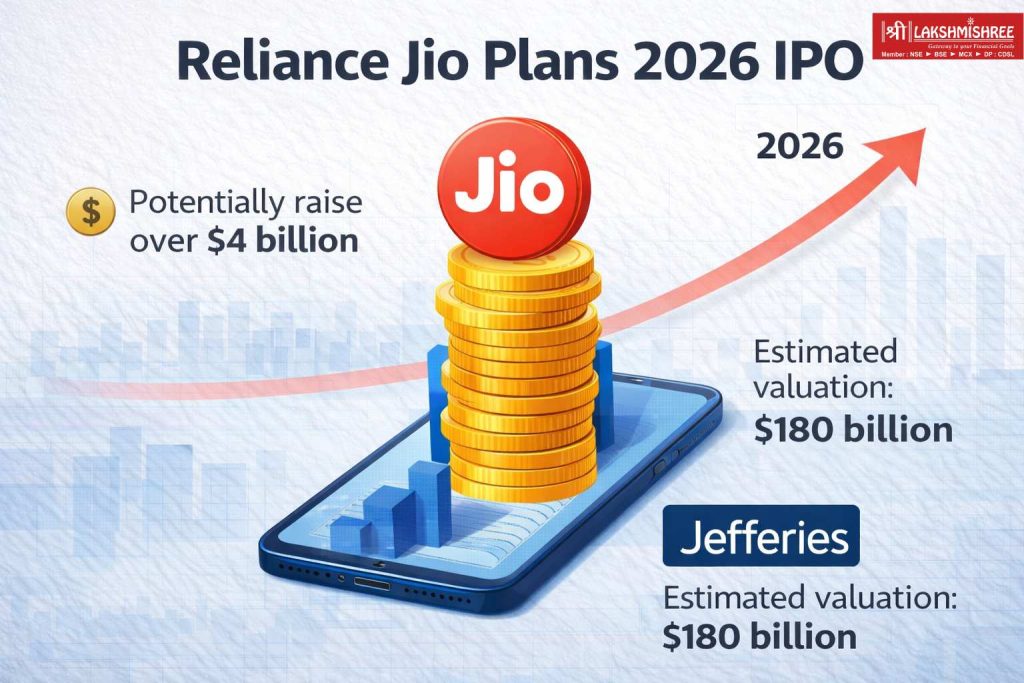
Reliance Jio Platforms, the digital and telecom arm of billionaire Mukesh Ambani’s Reliance Industries, is actively evaluating a public listing in 2026, with discussions centred around floating just 2.5% of the company, according to people familiar with the matter. If executed, the listing could become India’s largest IPO ever, raising more than $4 billion and reshaping expectations around large-cap listings in the country.
The proposed IPO would mark a significant milestone not only for Reliance Jio Platforms, but also for India’s capital markets, which have already emerged as one of the most active global IPO destinations over the past two years.
A Giant by Scale, a Cautious IPO by Design
Reliance Jio Platforms is the parent of Reliance Jio, India’s largest telecom operator with over 500 million subscribers. Over the last six years, Jio has expanded beyond telecom into cloud computing, artificial intelligence, digital services, and enterprise technology.
According to estimates, Jio Platforms is valued at around $180 billion. At that valuation, a 2.5% stake sale would raise approximately $4.5 billion, surpassing even Hyundai Motor India’s $3.3 billion IPO in 2024.
Sources indicate that Reliance prefers a smaller float to create pricing discipline and scarcity value—an approach increasingly favoured by large promoters globally. Some bankers have pitched even higher valuations in the range of $200–240 billion, although no final decision has been taken.
Regulatory Overhang: The 2.5% Rule of REliance Jio IPO
A key factor shaping the IPO structure is a proposed regulatory change under consideration in India. Currently, large companies are required to offer at least 5% public shareholding at the time of listing. The market regulator has proposed reducing this threshold to 2.5% for very large issuers, a move that would allow mega-listings without flooding the market with supply.
Reliance is reportedly waiting for the finance ministry’s approval of this rule change before finalising the IPO size. If approved, the Jio listing could set a precedent for future large-cap IPOs in India.
Strategic Timing and Market Conditions
Ambani has previously stated that Jio would list in the first half of 2026, but the final timeline will depend on market conditions. India’s IPO market remains strong: in 2025, the country ranked as the world’s second-largest primary equity market, raising over $21.6 billion, according to LSEG data.
Market participants note that global investors continue to show strong appetite for India’s digital and infrastructure-linked growth stories, especially those with scale, predictable cash flows, and long-term visibility.
Investor Line-Up and Exit Opportunities
Over the years, Jio Platforms has raised capital from global investors including KKR, General Atlantic, Silver Lake, and the Abu Dhabi Investment Authority. The IPO is expected to provide partial exits for some of these investors, although the company has not clarified whether the offering will be a pure offer-for-sale or include fresh equity issuance.
For comparison, Hyundai Motor India’s IPO was entirely an offer-for-sale, raising no new capital for the company itself.
Competition, Technology, and the Next Growth Phase
Jio’s listing comes at a time when competition in India’s digital ecosystem is intensifying. The company is expected to face direct competition from Starlink, backed by Elon Musk, which is preparing to launch satellite internet services in India.
At the same time, Jio has strengthened its technological positioning through a partnership with Nvidia to build AI infrastructure, signalling its ambition to become a central player in India’s data and computing economy.
While telecom continues to contribute 75–80% of annual revenues, the diversification into AI, cloud, and enterprise services is a key reason Reliance delayed the IPO beyond 2025—to command a higher, more defensible valuation.
Banks, Paperwork, and What Comes Next
Although formal mandates have not been announced, bankers from Morgan Stanley and Kotak are reportedly already working on drafting IPO documents. Preparing a prospectus for a company of Jio’s scale is expected to be a lengthy process.
Separately, Reliance has also indicated plans to list its retail arm, though that is unlikely before 2027–28, underscoring a phased monetisation strategy rather than a one-time sell-down.
Why the Reliance Jio IPO Matters
The Reliance Jio IPO is not just another listing—it is a market-defining event. Its structure could influence future regulations, its valuation could reset benchmarks for Indian digital companies, and its success or failure will shape global investor perception of India’s capital markets.
More importantly, it reflects how India’s largest conglomerates are transitioning from private capital-fuelled growth to public market discipline—on their own terms.
As regulatory clarity emerges and market conditions evolve, the Jio IPO is set to become one of the most closely watched financial events of 2026, not just in India, but globally.

Kaashika is a social media strategist and financial content creator at Lakshmishree. She specialises in simplifying complex IPO and stock market concepts into clear, easy-to-understand content. Having created over 500+ pieces of financial content across reels, blogs, website posts and digital creatives, Kaashika helps audiences connect with the world of finance in a more accessible and engaging way.