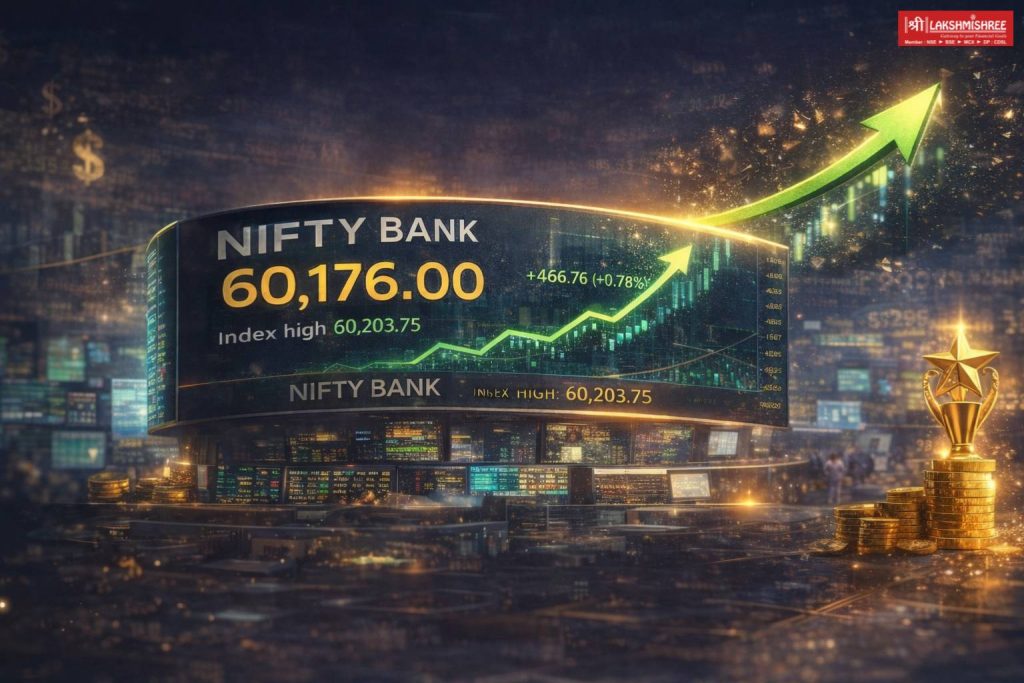
The Indian banking sector marked a historic milestone on January 2, 2026, as the Nifty Bank index surged past the 60,000 level for the first time, touching a fresh all-time intraday high of 60,203.75 before closing slightly lower at 60,176.0. The index ended the session with a 0.78% gain, reinforcing its leadership role in the broader equity market rally at the start of the new year.
The strong move in banking stocks also supported the headline indices, with the Nifty 50 scaling new record levels, reflecting renewed investor confidence in India’s financial system and macroeconomic stability.
Why Nifty Bank Is Rising: Key Drivers Behind the Market Momentum
The rally was driven by a convergence of fundamental, sectoral, and macroeconomic factors that positioned banks as the strongest contributors to market performance in early 2026.
A key trigger was the release of positive Q3 FY26 business updates from major lenders. Banks reported resilient loan growth, steady deposit mobilisation, and stable asset quality, easing concerns around credit stress following aggressive rate hikes in previous years. These updates reassured investors that the banking sector remains well-capitalised and operationally strong.
PSU Banks Outperform Private Peers
State-owned banks emerged as the standout performers, with the Nifty PSU Bank index rising 1.5%, significantly outperforming private sector lenders. Stocks such as State Bank of India (SBI), Bank of Baroda, Union Bank of India, and Yes Bank posted strong gains, reflecting improving balance sheets and better-than-expected credit traction.
The renewed interest in PSU banks signals a structural shift in market perception. After years of underperformance due to asset-quality concerns, public-sector lenders are increasingly being viewed as beneficiaries of India’s credit upcycle, supported by government-backed recapitalisation, declining non-performing assets, and stronger governance frameworks.
Macro Tailwinds Support Credit Expansion
The broader economic environment has played a crucial role in sustaining banking-sector optimism. Inflation has moderated sharply, with projections indicating consumer price inflation could remain close to 2% in FY26. This disinflationary trend enabled the Reserve Bank of India (RBI) to cut the repo rate to 5.25% in late 2025, creating a supportive environment for credit growth.
Lower borrowing costs, combined with improving demand from corporates and households, have strengthened the outlook for loan expansion across segments such as housing finance, MSME lending, and industrial credit.
Asset Quality at Multi-Decade Lows
One of the most significant structural positives for banks is the sustained improvement in asset quality. According to the latest available data, the Gross Non-Performing Assets (GNPA) ratio for Scheduled Commercial Banks declined to 2.1% as of September 2025, marking a multi-decade low.
Cleaner balance sheets have enhanced banks’ ability to lend aggressively without compromising financial stability. This improvement has also reduced provisioning pressure, freeing up capital for growth and shareholder returns.
Outlook for 2026: Growth With Guardrails
Analysts remain broadly constructive on the banking sector’s prospects through 2026, though with a more nuanced view compared to the margin-led rally of previous years.
- Credit Growth: Banking credit is expected to expand in the range of 10.4% to 12.5% in FY26. While unsecured retail lending remains under regulatory scrutiny, growth is increasingly shifting toward productive segments such as infrastructure, manufacturing, MSMEs, and housing.
- Net Interest Margins (NIMs): Following the RBI’s rate cuts, banks may face mild margin compression in the near term. However, analysts expect margins to stabilise by mid-2026 as deposit repricing cycles conclude and loan growth gains momentum.
- Regulatory Changes: From January 1, 2026, new digital banking norms require explicit customer authorisation for electronic services, along with enhanced cybersecurity and audit standards. While this raises compliance costs in the short term, it is expected to strengthen systemic resilience over the long run.
Sectoral Performance Snapshot (January 2, 2026)
- Nifty Bank: +0.78% (record high at 60,203.75)
- Nifty PSU Bank: +1.50% (sectoral outperformance)
- Nifty Auto: +1.13% (record highs led by two-wheelers)
- Nifty Metal: +1.47% (supported by global cues)
- Nifty FMCG: -1.19% (dragged by ITC)
Risks to Monitor
Despite the optimism, the RBI has cautioned banks to remain vigilant about hidden risks in unsecured retail and SME lending, where stress could re-emerge if economic conditions weaken. Some estimates suggest that bad-loan ratios could inch toward 3% by March 2026 under adverse scenarios.
However, robust capital adequacy ratios—18.1% for private banks and 16% for public banks—provide a substantial buffer against potential shocks.
Nifty Bank Crossing 60,000
The Nifty Bank’s decisive move above 60,000 reflects more than short-term momentum. It signals growing confidence in the structural strength of India’s banking system, backed by clean balance sheets, supportive macro conditions, and disciplined regulation. While challenges remain, the sector enters 2026 from a position of resilience rather than recovery—marking a meaningful shift in India’s financial cycle.

Kaashika is a social media strategist and financial content creator at Lakshmishree. She specialises in simplifying complex IPO and stock market concepts into clear, easy-to-understand content. Having created over 500+ pieces of financial content across reels, blogs, website posts and digital creatives, Kaashika helps audiences connect with the world of finance in a more accessible and engaging way.